
Share this
by Matthew Moss on Oct 27, 2026
A B2B website redesign can look successful at launch while creating fragmented data, unclear ownership, manual handoffs, and reporting gaps across marketing, sales, and service.
The right choice is not determined by templates, plugins, or design flexibility alone. It depends on whether the website should function as a governed revenue system or as a publishing layer that requires additional systems, integrations, and technical ownership.
This guide provides a RevOps decision model for comparing HubSpot and WordPress across CRM alignment, content operations, integrations, governance, performance, security, automation, and five-year operating cost. It also shows how to apply a 30-Point Quality Gate before approving the redesign.
The Real HubSpot vs. WordPress Decision for B2B
For a VP of Revenue Operations, the website is part of the revenue architecture. Forms create contacts, content influences buying journeys, behavioral data informs prioritization, and routing logic determines whether sales receives usable context or another incomplete notification.
Here's why: a CMS decision can affect CRM data quality, attribution, pipeline visibility, campaign launch speed, and service handoffs for years after the redesign is complete.
The urgent trigger may be declining conversion rates, disconnected website and CRM data, slow campaign launches, expensive agency dependency, or inconsistent buyer experiences. The platform should address that operational problem rather than simply provide a new visual layer.
The central question is this: which architecture can support required revenue workflows with the fewest unmanaged dependencies and the clearest accountability?
HubSpot and WordPress: What Each Platform Owns
HubSpot is designed to connect content, CRM, marketing automation, sales activity, service workflows, and reporting within one commercial platform. The benefit is not that every capability is automatically superior; it is that fewer core workflows require custom synchronization between separate systems.
WordPress is a flexible content management foundation with a broad extension ecosystem and extensive control over themes, plugins, hosting, data structures, and development patterns. That flexibility can support highly customized experiences, but it also transfers more responsibility to the organization and its implementation partners.
The secret? Compare ownership, not feature counts.
| Responsibility | HubSpot-centered model | WordPress-centered model |
|---|---|---|
| Website content | Native content tools and governed publishing | WordPress core, theme, plugins, and custom development |
| Contact capture | Native forms and CRM context or configured integrations | Plugin, API, middleware, or embedded form ownership |
| Lifecycle management | Native CRM properties and workflows | External CRM and synchronization logic |
| Lead routing | CRM workflows, assignment rules, and notifications | CRM workflows plus form, API, or middleware reliability |
| Hosting and updates | More platform-managed responsibility | Organization, host, developer, or agency responsibility |
| Reporting | Connected platform reporting where configured correctly | Multiple data sources requiring reconciliation |
| Extensibility | Platform APIs, modules, and supported integrations | Broad ecosystem with variable quality and maintenance needs |
Neither platform eliminates architecture work. HubSpot concentrates more responsibility inside a commercial platform, while WordPress provides more control over the publishing layer and requires explicit design for the surrounding revenue system.
A RevOps Comparison: HubSpot vs. WordPress
The comparison should begin with the workflows that must work after launch. A feature is useful only when it produces reliable business execution, measurable data, and an accountable owner.
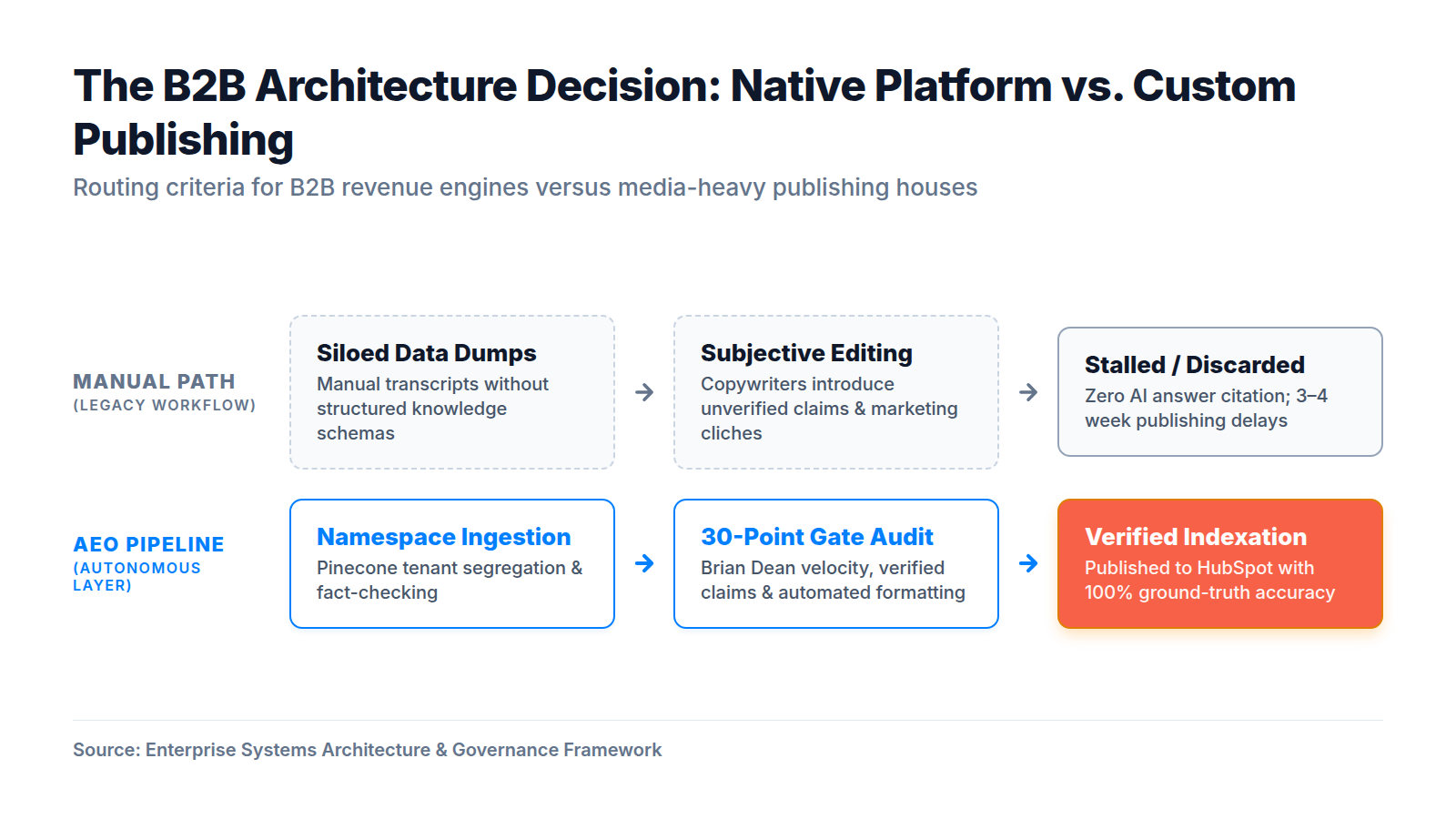
CRM, lifecycle, and handoffs
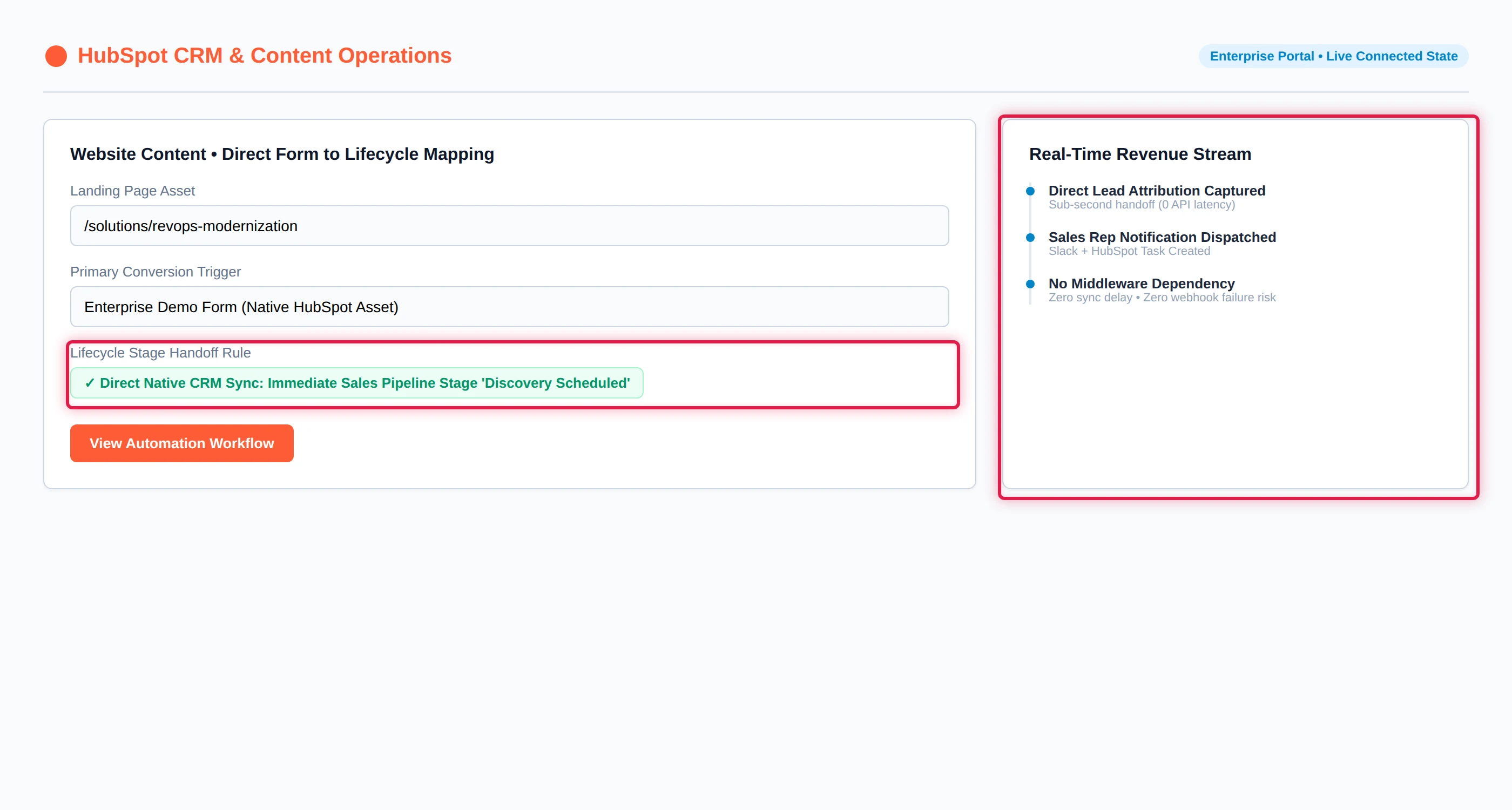
HubSpot is usually stronger when the website must use shared CRM records, lifecycle stages, behavioral context, lead routing, and sales notifications as part of the primary operating model. The architecture still requires property governance, deduplication rules, consent management, and testing.
WordPress can support the same outcomes, but the implementation typically depends on embedded forms, native or custom APIs, middleware, plugins, or a combination of these. Each additional boundary introduces failure modes such as incomplete submissions, mismatched field types, delayed synchronization, duplicate records, and unclear incident ownership.
Define acceptance criteria before choosing the platform. Examples include form-to-owner assignment time, required CRM field completion, duplicate rate, attribution coverage, and the percentage of submissions that reach the intended workflow without manual repair.
Content operations and governance
WordPress offers broad control over content types, templates, taxonomies, multilingual structures, and custom experiences. That is valuable when the organization has engineering capacity and a well-defined publishing operating model.
HubSpot can reduce the distance between content production, campaign execution, CRM segmentation, and reporting. Its constraints may matter for highly specialized content models, unusual front-end requirements, or teams that need complete control over infrastructure and deployment.
Evaluate how many approvals are required, who can publish, how changes are reviewed, how localization is managed, and how quickly a campaign can move from request to live experience. A platform that is flexible but difficult to govern can reduce execution speed.
Analytics and attribution
A connected architecture can improve reporting only when event definitions, campaign parameters, identity resolution, lifecycle rules, and source-of-truth ownership are documented. Neither platform produces reliable attribution by default.
The buying committee should test whether a known contact, anonymous visitor, form submission, sales activity, opportunity, and service interaction can be associated without creating conflicting records. Finance and executives should also understand which revenue reports are directional and which are suitable for operating decisions.
The Hidden Cost of a WordPress-Centered Architecture
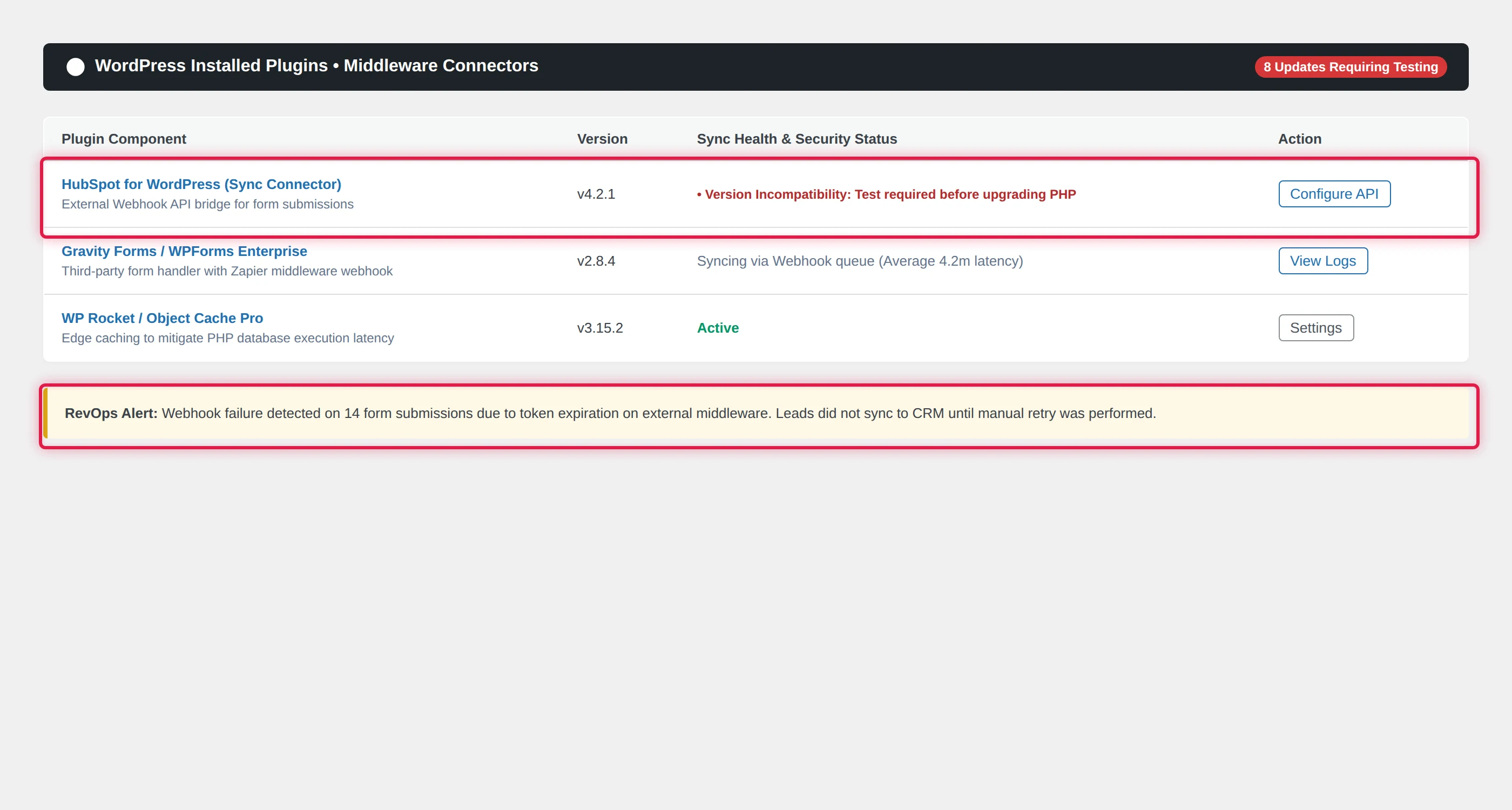
WordPress may appear less expensive when evaluated through licensing or initial development alone. The relevant comparison includes hosting, security, backups, updates, plugin compatibility, accessibility remediation, performance work, monitoring, integration maintenance, and the internal time required to coordinate changes.
A WordPress-centered model can be appropriate, but its cost profile is often distributed across departments and vendors. That makes the expense less visible while increasing the risk that no single owner is accountable for the complete revenue workflow.
Here is the breakdown:
| Cost and risk area | Questions for the buying committee |
|---|---|
| Development | Who owns theme, template, plugin, and custom feature changes? |
| Hosting | Who manages uptime, scaling, backups, environments, and recovery? |
| Security | Who patches vulnerabilities, reviews access, and monitors exposure? |
| Integrations | Who maintains forms, APIs, webhooks, field mappings, and retries? |
| Analytics | Who validates events, attribution, consent, and reporting reconciliation? |
| Agency dependency | What knowledge remains internal if the implementation partner exits? |
| Operational delay | What is the cost when a campaign or routing change waits for development? |
Plugin count is not the only risk indicator. The more important questions are whether each component has a named owner, a support lifecycle, a rollback method, and a tested failure path.
When HubSpot Is the Better B2B Redesign Choice
HubSpot is generally a strong fit when the website must operate closely with the CRM and when marketing, sales, and service teams need a common execution layer. It is especially suitable when rapid campaign launches, standardized handoffs, centralized permissions, and shared reporting are more valuable than unrestricted infrastructure control.
The strongest case exists when the organization wants to reduce integration surface area. Native or closely connected workflows can make it easier to manage forms, lifecycle transitions, segmentation, notifications, and reporting within a consistent governance model.
HubSpot is not automatically the right answer. Subscription growth, vendor concentration, platform constraints, migration effort, and requirements for specialized experiences must be assessed directly.
Choose HubSpot when most of the following are true:
- CRM context is central to the website experience.
- Marketing and sales require fast, repeatable campaign execution.
- The organization wants centralized permissions and publishing governance.
- The revenue team lacks capacity to own a broad custom integration stack.
- Reporting depends on shared lifecycle, contact, and campaign data.
- Automation must include auditability, approval boundaries, and exception handling.
When WordPress Is the Better B2B Redesign Choice
WordPress can be the better choice when the website requires advanced content structures, specialized front-end behavior, unusual publishing workflows, or infrastructure control that a managed platform cannot provide. It may also fit organizations with a mature digital engineering team that already owns hosting, deployment, security, observability, and integration operations.
The decision is defensible when those capabilities are real, funded, and available after launch. A stated preference for flexibility is not equivalent to an operating capability.
WordPress may fit when:
- The website is primarily a complex publishing and experience platform.
- Engineering owns deployment, security, performance, and incident response.
- Content models or front-end requirements exceed the selected managed platform.
- CRM and marketing automation are intentionally separate systems.
- Integration contracts, monitoring, retries, and data ownership are documented.
- Finance accepts the continuing cost of technical ownership.
A decoupled or headless model should be selected only when the organization can support its additional architecture, deployment, caching, identity, preview, analytics, and troubleshooting requirements.
The Hybrid Option: Define the System of Record First
A hybrid architecture can work when responsibilities are explicit. It fails when WordPress, HubSpot, analytics tools, marketing automation, and Jira all appear to own the same contact, content, event, or workflow state.
Start with a system-of-record matrix before selecting tools.
| Data or capability | Primary owner | Downstream consumers | Failure owner |
|---|---|---|---|
| Web content | WordPress or HubSpot | Website, campaigns, search | Web or content operations |
| Contact identity | CRM | Marketing, sales, service | RevOps or CRM owner |
| Form submission | Form platform and CRM | Routing and reporting | RevOps integration owner |
| Work request | Jira | Delivery teams and reporting | Program or operations owner |
| Behavioral event | Analytics platform or CRM | Attribution and prioritization | Data or analytics owner |
| Approval state | Governance workflow | Publishing and automation | Functional approver |
A typical workflow may begin with a website form, create or update a CRM record, evaluate lifecycle and routing rules, create a Jira issue when delivery work is needed, and notify a human owner when a threshold or exception is reached. Every transition needs an idempotency rule, retry behavior, error queue, audit trail, and escalation path.
Hybrid architecture increases the need for documentation and monitoring. It should not be used as a compromise that avoids making a system-of-record decision.
Governance for Automation and Agentic Employees
Platform selection should account for how work will be automated over time. Website and RevOps processes may include content briefs, data enrichment, ticket creation, QA checks, campaign setup, routing, and reporting preparation, but not every action should be autonomous.
A governed Agentic Employee can prepare or execute bounded work when permissions, evidence, review thresholds, and rollback procedures are defined. High-impact actions such as publishing material changes, altering routing logic, changing lifecycle definitions, or modifying customer records should retain human approval unless the organization has explicitly authorized the action.
A practical control model includes:
- Scope: define the systems, records, and actions the agent can access.
- Permission: use least-privilege credentials and separate read, draft, and publish capabilities.
- Evidence: require source records, validation results, and a complete activity log.
- Approval: route material changes to an accountable human reviewer.
- Exception handling: send failed or ambiguous work to a queue instead of guessing.
- Rollback: preserve prior versions and provide a tested recovery procedure.
- Measurement: track completion rate, exception rate, defect rate, and time saved.
HubSpot-Jira workflows can route website and RevOps work effectively, but the integration must preserve human-in-the-loop control. Automation should make ownership clearer, not hide it.
Apply the 30-Point Quality Gate Before Approval
The 30-Point Quality Gate gives the buying committee a structured launch decision instead of relying on stakeholder confidence or a successful visual review. Each point should have an accountable owner, evidence, severity rating, and pass threshold.
Suggested categories include:
- Strategy and conversion requirements
- Information architecture and user experience
- Content accuracy and approval ownership
- SEO, redirects, metadata, and structured data
- CRM fields, lifecycle stages, consent, and routing
- Forms, APIs, webhooks, retries, and error handling
- Analytics, attribution, and reporting reconciliation
- Security, identity, permissions, and access reviews
- Performance, availability, accessibility, and mobile behavior
- Automation, Agentic Employee boundaries, audit trails, and rollback
Before approval, require evidence rather than verbal assurance. Test representative forms, verify migrated records, reconcile key reports, review permissions, execute failure scenarios, inspect redirects, and confirm that the support team knows how to respond to incidents.
Define launch thresholds in advance. For example, a critical routing failure should block launch, while a low-severity cosmetic issue may receive a dated remediation owner. The exact threshold is a governance decision, but it must be documented before stakeholders are under launch pressure.
A Five-Year Cost and Risk Comparison
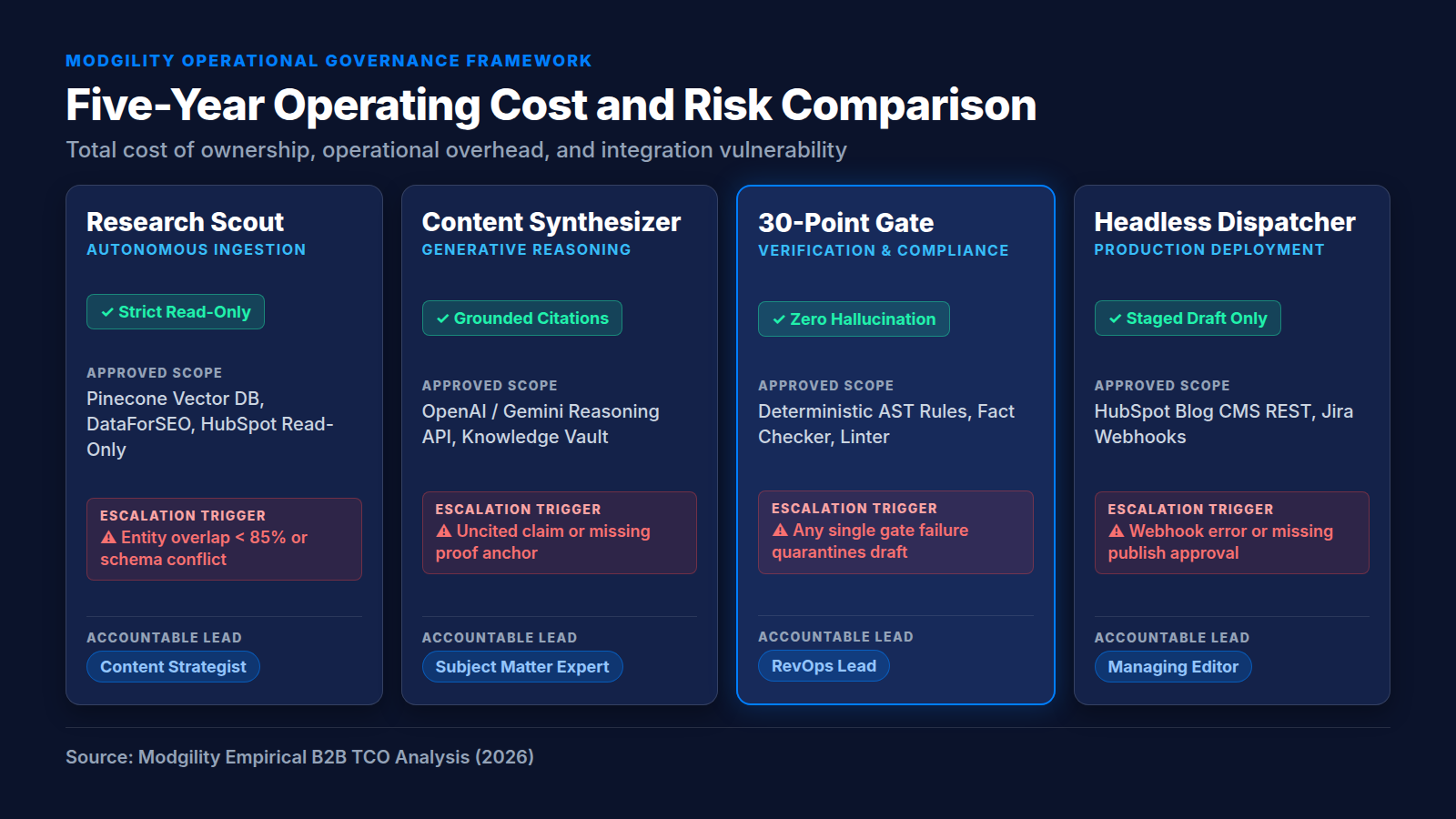
Five-year cost should include more than software subscriptions and the initial redesign. Model implementation, development, hosting, maintenance, security, integrations, analytics, training, agency support, internal administration, migration, and expected change requests.
Also model the cost of operational failure. Slow campaign launches, broken handoffs, incomplete CRM records, reporting disputes, security incidents, and unmeasured pipeline can exceed visible platform costs.
Use a weighted model rather than a single price score:
| Decision dimension | Example weighting question |
|---|---|
| Revenue workflow fit | Can the platform support required handoffs without unmanaged workarounds? |
| Data integrity | Can the team maintain complete, consistent, and attributable records? |
| Operating capacity | Does the organization have the people and skills to own the architecture? |
| Governance | Can permissions, approvals, audit trails, and exceptions be controlled? |
| Change capacity | How quickly can the team adapt campaigns, content, and workflows? |
| Five-year cost | What is the full cost, including distributed technical ownership? |
| Risk exposure | What happens when an integration, plugin, vendor, or workflow fails? |
Do not invent precision where the business lacks estimates. Record assumptions, use ranges, and run sensitivity scenarios for campaign volume, staffing, agency rates, integration changes, and expected growth.
Final Recommendation Framework for Revenue Leaders
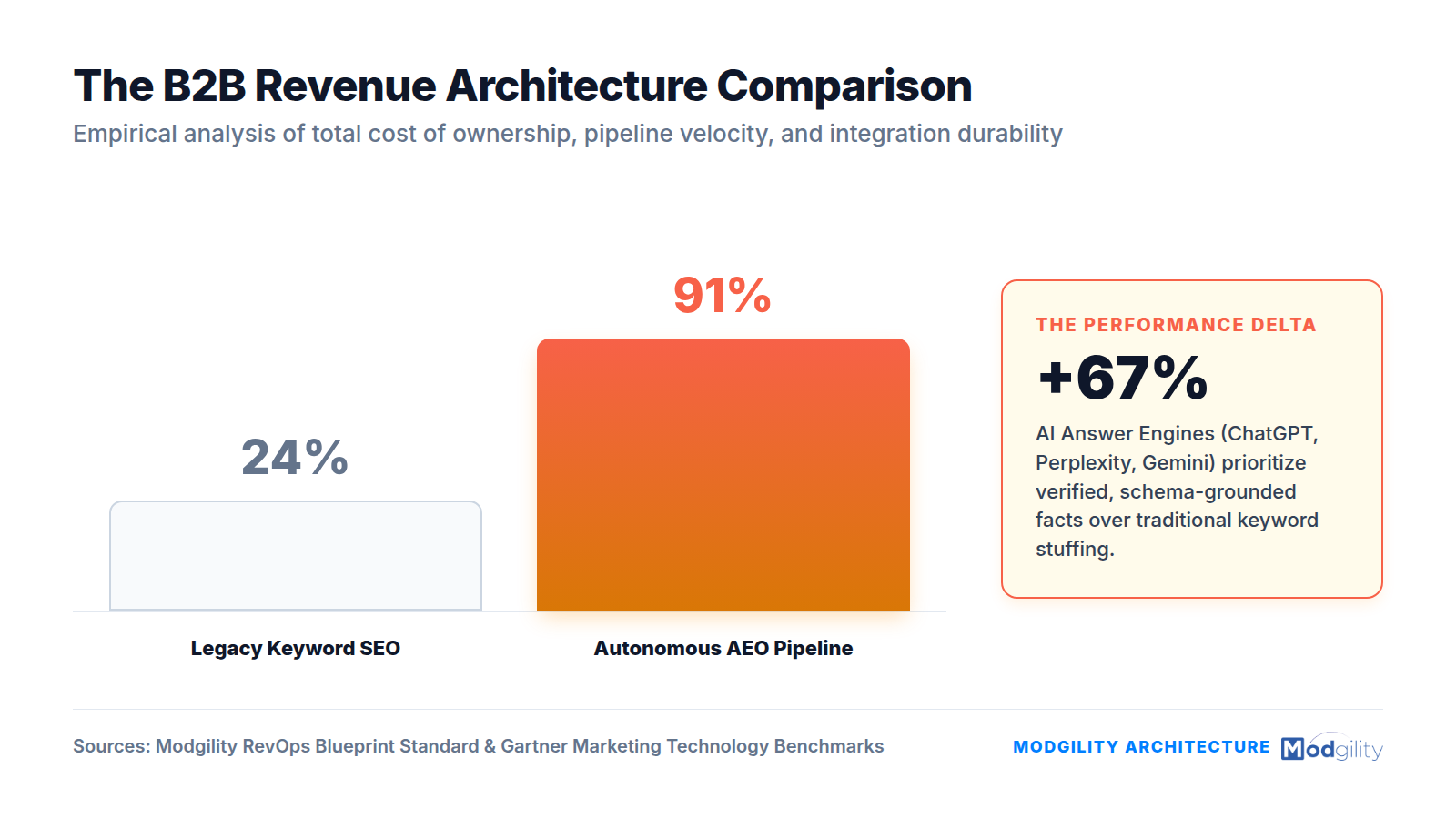
Choose HubSpot when connected RevOps execution, centralized governance, shared CRM context, and reduced integration ownership outweigh the need for unrestricted infrastructure control.
Choose WordPress when advanced content or experience requirements justify the technical ownership, and when engineering, security, deployment, integration, and support responsibilities are funded for the full operating period.
Choose a hybrid model only when system boundaries, owners, data contracts, monitoring, escalation paths, and Quality Gate controls are documented. Hybrid should be an intentional architecture, not the accidental result of adding tools during implementation.
The buying process should include RevOps, Marketing, Sales Operations, Demand Generation, Web or Digital, IT or Security, Finance, and executive leadership. Each group should evaluate its own success factors, then agree on a single operating model and decision score.
Recommended selection sequence
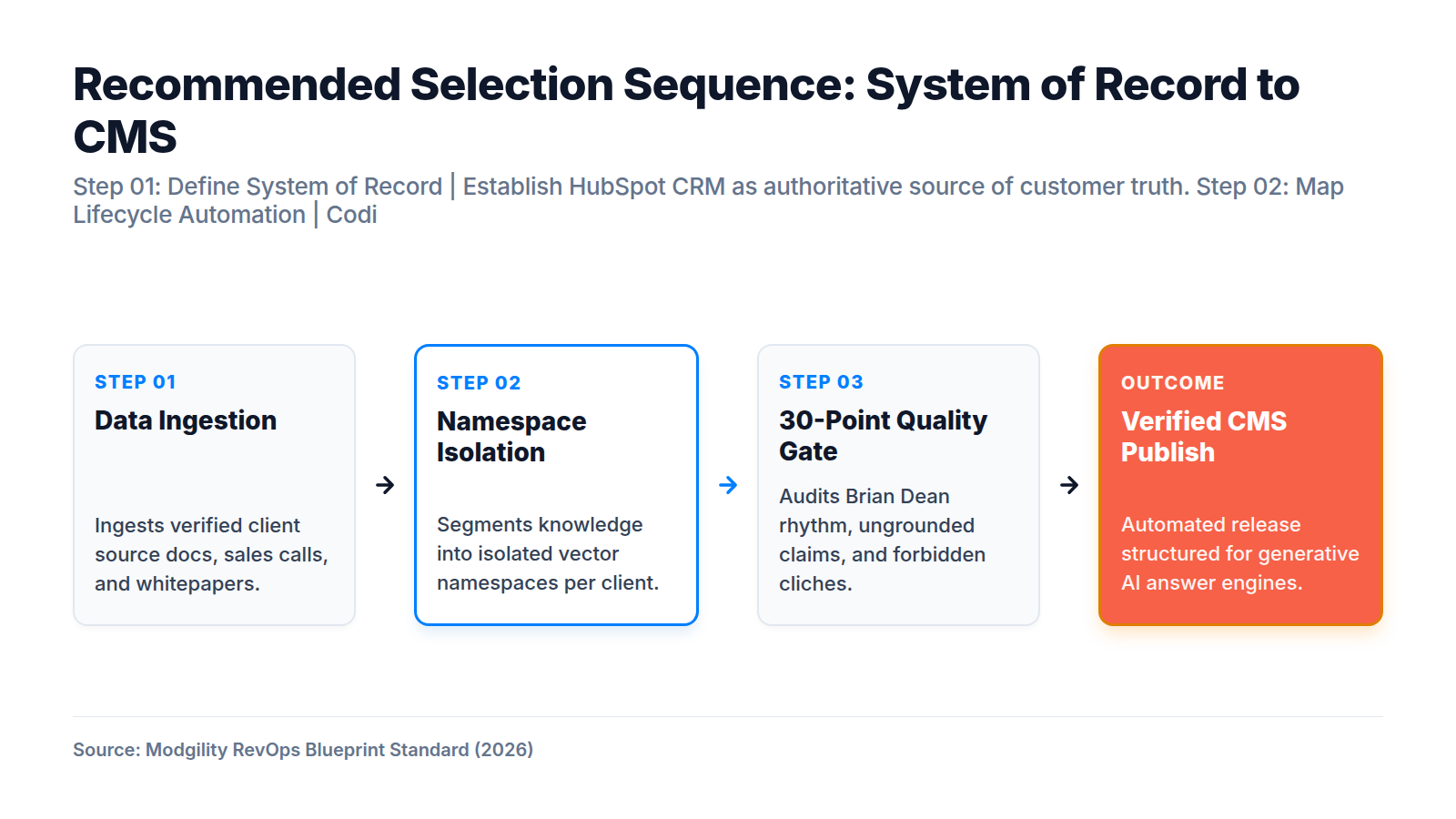
- Inventory revenue workflows, data objects, integrations, and failure points.
- Define the system of record for contacts, content, events, work requests, and approvals.
- Establish measurable success factors such as qualified conversion, routing time, launch speed, data completeness, attribution coverage, availability, and integration failure rate.
- Score HubSpot, WordPress, and hybrid options against the same decision criteria.
- Run a workflow proof of concept using representative forms, CRM records, Jira work, reporting, and approval paths.
- Model five-year cost and operational risk using documented assumptions.
- Apply the 30-Point Quality Gate and assign remediation owners before approval.
- Launch with monitoring, incident response, reporting reconciliation, and a scheduled post-launch review.
Modgility Governance and Blueprinting
Modgility helps revenue teams treat the website as part of the governed operating architecture rather than as an isolated marketing project. The work can connect HubSpot CRM, Jira, and autonomous AI agents while preserving human approval, auditability, permission boundaries, and clear exception handling.
The engagement begins with a complimentary form-first assessment. This assessment maps the required forms, data objects, routing logic, handoffs, approval points, integrations, and failure scenarios before platform or implementation decisions are finalized.
The output is an Agentic Workforce Blueprint that identifies where agents can prepare, route, validate, or execute work and where human review remains mandatory. The fee is quoted after the assessment and is 100% credited toward implementation when implementation begins within 90 days.
For a VP of Revenue Operations, the practical value is decision clarity: defined ownership, measurable acceptance criteria, documented architecture, and a defensible path from redesign approval to reliable revenue execution.
Frequently Asked Questions
Is HubSpot better than WordPress for every B2B website?
No. HubSpot is often better when the website must operate closely with CRM data, lifecycle automation, routing, reporting, and governed campaign execution. WordPress may be better when advanced content structures, specialized experiences, infrastructure control, or an established engineering operating model are more important. The decision should be based on workflow fit and ownership capacity, not a universal platform preference.
Can WordPress integrate reliably with HubSpot CRM?
Yes, but reliability depends on the integration design and operating discipline. The implementation should define field mappings, identity rules, consent handling, retry behavior, duplicate prevention, error queues, monitoring, audit logs, and incident ownership. A form that appears to submit successfully is not sufficient evidence that the complete CRM and routing workflow is reliable.
Does a hybrid HubSpot and WordPress architecture reduce cost?
Not necessarily. Hybrid can provide useful flexibility, but it adds integration, monitoring, documentation, testing, security, and support responsibilities. It can reduce cost when the separation of responsibilities is intentional and stable; it can increase cost when multiple systems own overlapping data or require frequent synchronization changes.
What should a VP of Revenue Operations validate before approving the redesign?
Validate the system of record for every important data object, the required revenue workflows, the ownership of integrations and failures, the five-year cost model, security and permission controls, reporting reconciliation, and the human approval boundaries for automation. Require representative workflow tests and apply a documented 30-Point Quality Gate before launch approval.
No Comments Yet
Let us know what you think