
Share this
What is Agentic AI and Why It Matters
by Andrew Gutierrez on Sep 12, 2025
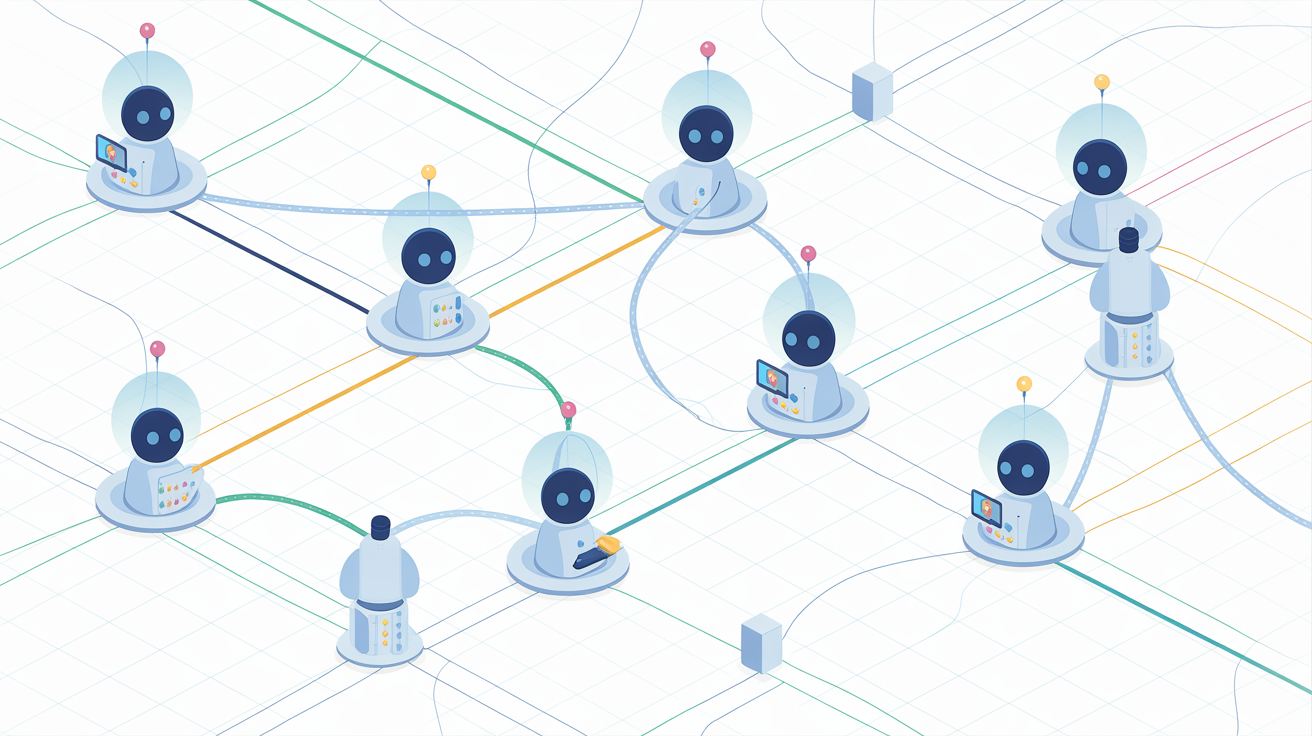
Agentic AI represents a fundamental shift from reactive AI to proactive, autonomous systems that can independently pursue goals. It goes beyond content creation by using large language models to orchestrate and execute multi-step actions to achieve high-level business objectives.
Frequently Asked Questions
What is Agentic AI?
Agentic AI refers to autonomous systems capable of independently setting goals, creating multi-step plans, and executing complex tasks with minimal human intervention. They are proactive, adaptive, and use various tools to interact with their digital environment to achieve defined objectives.
How is Agentic AI different from generative AI?
The key difference lies in their primary function. Generative AI is designed to create content, whereas Agentic AI is designed to execute tasks. Agentic AI uses Large Language Models (LLMs) as a reasoning engine to understand goals, devise strategies, and take action, operating on a continuous 'observe, think, act' cycle.
What are the core characteristics of Agentic AI?
The core characteristics of Agentic AI are:
- Autonomy: Operating independently without constant step-by-step instructions.
- Reasoning and Planning: Breaking down complex objectives into a sequence of actionable steps.
- Goal-Driven Behavior: Orchestrating a series of actions with a clear purpose and course-correcting as needed.
- Adaptability and Learning: Improving performance over time by learning from action outcomes and user feedback.
What are the business benefits of adopting Agentic AI?
Businesses that adopt an Agentic AI framework can achieve several key benefits, including exponential productivity gains from agents working 24/7, enhanced decision quality through unbiased data analysis, proactive problem prevention by identifying and addressing issues before they impact the business, and the ability to scale expertise by encoding expert knowledge into infinitely deployable systems.
The AI landscape is experiencing a paradigm shift from reactive tools to proactive, autonomous systems that can think, plan, and act independently. At the center of this transformation is Agentic AI, artificial intelligence that doesn't just respond to commands but actively pursues goals and makes decisions with minimal human intervention.
Unlike traditional AI models that passively analyze data based on predefined inputs and outputs, Agentic AI systems can observe their environment, reason through complex scenarios, plan multi-step solutions, and execute tasks autonomously. This represents a fundamental evolution from AI as a tool to AI as a digital collaborator.
Agentic AI is a subset of generative AI that goes beyond content creation to orchestrate and execute actions in underlying systems, using large language models as its reasoning engine. While generative AI focuses on creating new content like text, images, or code, Agentic AI leverages that same foundational technology to achieve higher-level business objectives through autonomous action.
This shift from reactive AI tools to proactive, autonomous systems is transforming how enterprises approach automation, decision-making, and human-AI collaboration across every industry vertical.
Key Characteristics That Define Agentic AI
Modern Agentic AI systems stand apart from traditional automation due to six core principles that define their autonomous and goal-driven behavior.
1. Autonomy: Independent Operation Without Micromanagement
Agentic AI operates without constant supervision, assessing situations, evaluating options, and executing actions in real-time. These systems adapt to changing conditions and emerging priorities, making thousands of micro-decisions while aligning with broader organizational goals.
2. Reasoning: LLM-Powered Intelligence at the Core
Large language models form the core reasoning engine, enabling Agentic AI to analyze complex data, understand context, and plan multi-step strategies. Chain-of-thought planning ensures transparent, auditable, and reliable decision-making.
3. Advanced Decision-Making Under Uncertainty
By combining reasoning, planning, and prioritization, these systems make informed choices even with incomplete information. Reinforcement learning and feedback loops allow context-aware, continuously improving performance.
4. Goal-Driven Behavior: Purpose Beyond Tasks
Every action aligns with defined objectives; short-term tasks or long-term strategic goals. Agentic AI actively pursues outcomes, often identifying and addressing issues humans might overlook.
5. Adaptability and Continuous Learning
Agentic AI evolves based on feedback and environmental changes, improving accuracy and effectiveness over time. Its adaptive nature builds institutional knowledge that benefits the organization broadly.
6. The "Observe, Think, Act" Cycle
Agentic AI mirrors human problem-solving:
- Perception: Collect and interpret information
- Planning: Break goals into actionable steps
- Action: Execute tasks autonomously
- Reflection: Learn from outcomes to optimize future performance
This cycle transforms AI from a passive tool into a digital collaborator capable of autonomous, intelligent operations.
Enterprise Benefits of Agentic AI
Agentic AI transcends traditional automation by adapting dynamically to new situations, making decisions, and executing tasks without requiring constant human oversight. For enterprises, this shift delivers measurable improvements in productivity, accuracy, and decision-making that directly impact competitiveness.
Exponential Productivity Gains
Unlike rule-based automation, Agentic AI learns and adapts dynamically to new situations. This makes it possible to automate not only repetitive workflows but also complex decision-making in unpredictable environments. According to McKinsey, generative and agentic AI could add the equivalent of $2.6 trillion to $4.4 trillion in annual global productivity across industries by transforming functions like customer operations, marketing, software engineering, and R&D.
Enhanced Decision Quality at Scale
Agentic AI systems can process vast datasets, simulate multiple scenarios, and provide consistent recommendations at scale. This is especially valuable in financial trading, supply chain optimization, and customer service, where the required decision volume often exceeds human capacity. PwC highlights how AI agents are transforming financial reporting—enabling smarter workflows, greater speed, and stronger governance.
Reduced Human Error in Critical Processes
Processes like compliance checks and risk reviews are prone to human error. Agentic AI minimizes these risks by running detailed pattern checks in real time. Deloitte discusses how internal auditors can leverage GenAI to produce the initial draft of workpapers and conduct the first round of review and quality assurance, enhancing efficiency and accuracy.
24/7 Operations Without Human Oversight
Agentic AI enables continuous operations that don’t depend on human availability. From cybersecurity monitoring to healthcare alerting systems, AI agents provide autonomous responsiveness that reduces downtime and accelerates response times. Gartner explores strategies to balance innovation and risk, ensuring a secure, AI-powered future for organizations.
Industry Applications of Agentic AI
These enterprise benefits come to life through real-world applications across industries.
Financial Services
AI agents support fraud detection, compliance automation, and trading systems that react to market signals in real time. Financial institutions use them to assess creditworthiness, monitor transactions, and manage portfolio risks. The World Economic Forum reports that in 2023, financial services firms spent $35 billion on AI, with projected investments across banking, insurance, capital markets, and payments businesses.
Supply Chain & Logistics
AI agents forecast demand, reroute deliveries during disruptions, and optimize inventory in real time. MIT Sloan examines innovation systems and strategies for business leaders in supply chain management, highlighting the transformative potential of AI in logistics.
Healthcare Monitoring
Hospitals use intelligent monitoring platforms to track patient vitals, flag risks, and support clinicians with real-time alerts. NIH discusses diverse methods for monitoring the performance of clinical AI systems in healthcare, emphasizing the importance of performance evaluation and safety.
IT & Cybersecurity
Autonomous IT agents detect anomalies, predict system failures, and remediate issues without human intervention. Gartner provides insights into how AI is transforming cybersecurity, enabling organizations to minimize risks and maximize impact
Bringing It Together
The enterprise benefits of Agentic AI (productivity gains, decision accuracy, continuous operations, and proactive problem-solving) are already being realized across industries like finance, healthcare, logistics, and IT. By linking strategic outcomes with practical applications, organizations can see both the “why” and the “how” of adopting Agentic AI into their core operations.
The Strategic Imperative: Getting Started
The shift toward autonomous, intelligent systems isn't a distant future possibility, it's happening now across industries. Early adopters are already demonstrating significant competitive advantages, while the technology platforms supporting these implementations continue to mature rapidly.
Organizations that delay implementation risk falling behind competitors who are already benefiting from autonomous decision-making, continuous optimization, and scalable AI expertise. The question isn't whether to adopt Agentic AI, but how quickly you can implement it effectively within your specific business context.
Success requires more than technology deployment; it demands new approaches to governance, human-AI collaboration, and organizational design that maximize the potential of autonomous intelligent systems while maintaining appropriate oversight and control.
Share this
- September 2026 (2)
- August 2026 (2)
- July 2026 (5)
- June 2026 (7)
- May 2026 (4)
- April 2026 (24)
- March 2026 (43)
- February 2026 (20)
- January 2026 (20)
- December 2025 (1)
- November 2025 (1)
- September 2025 (34)
- August 2025 (7)
- July 2025 (1)
- June 2025 (2)
- May 2025 (2)
- April 2025 (3)
- March 2025 (2)
- February 2025 (1)
- January 2025 (1)
- December 2024 (3)
- August 2024 (1)
- July 2024 (2)
- June 2024 (17)
- November 2022 (1)
- February 2022 (1)
- July 2021 (1)
- June 2021 (1)
- May 2019 (1)
- March 2019 (1)
- February 2019 (1)
- October 2018 (1)
- September 2018 (1)
- April 2018 (1)
- March 2017 (1)
- December 2016 (2)
- September 2016 (2)
- January 2016 (1)
- April 2015 (2)
- March 2015 (2)
- February 2015 (1)
- January 2015 (1)
- December 2014 (1)
- September 2014 (1)
- April 2014 (1)
No Comments Yet
Let us know what you think