


Bunting-Newton-v2

How Bunting Magnetics Replaced 10 Years of ERP-Only Operations With a HubSpot Revenue System Their Leadership Could Finally See Through

For the first time in their history, Bunting's leadership can identify which marketing efforts and which sales reps are driving pipeline and revenue — including a tradeshow attribution model that's reshaping how the company plans its event spend.

Time to first results: Within 90 days of go-live, after a 12-month phased build.

At a Glance

Industry Industrial Engineering & Manufacturing — magnetic separation, metal detection, and material handling solutions
Company size 200+ employees with operations in the United States and the United Kingdom
HQ / Geography Newton, Kansas (North America) and Redditch, England (Europe)
Founded 1959
Engagement type Multi-hub HubSpot Implementation — Sales Hub, Marketing Hub, Service Hub, and Data Hub
Project duration 12 months, phased
HubSpot Hubs deployed Sales, Marketing, Service (with Data Hub principles applied to the foundation)
Adjacent systems Epicor (system of record, account hierarchy mirrored), Microsoft Teams (notifications)
Modgility team RevOps Strategist, HubSpot Implementation Specialist

Customer Info

Bunting Magnetics is a global leader in the design, manufacturing, and distribution of advanced magnetic separation, metal detection, and conveying solutions. Founded in 1959 and headquartered in Newton, Kansas with a European base in Redditch, England, Bunting serves industrial customers across food processing, recycling, plastics, ceramics, mining, and pharmaceuticals. After more than six decades of growth and product expansion, the company supports operations across the United States and the United Kingdom with a workforce of more than 200 engineers, fabricators, sales professionals, and support staff.

Overview

Bunting Magnetics is a global leader in the design, manufacturing, and distribution of advanced magnetic separation, metal detection, and conveying solutions. Founded in 1959 and headquartered in Newton, Kansas with a European base in Redditch, England, Bunting serves industrial customers across food processing, recycling, plastics, ceramics, mining, and pharmaceuticals. After more than six decades of growth and product expansion, the company supports operations across the United States and the United Kingdom with a workforce of more than 200 engineers, fabricators, sales professionals, and support staff.

mark

“I can see data that I've never been able to get before. Being able to see pipeline, won revenue, and lost revenue by tradeshow will change the way that we do marketing and sales.”

Mark Friesen
VP of Marketing, Bunting Magnetics

The Challenge

Bunting's challenge was not that they had bad processes. It was that for more than a decade, they had been running a global, multi-product, multi-region manufacturer through a single ERP and a marketing tool that had no connection to anything else. The company had outgrown what that combination could see.

"We aren't able to make educated business decisions because we don't have visibility into what's working and what's not."
— Mark Friesen, VP of Marketing, on the pre-state


1. Marketing was operating out of a contact list Epicor never saw

  • The Situation: All of Bunting's marketing email was sent from a Mailchimp account that lived completely outside the ERP. The contact list in Mailchimp and the customer/account data in Epicor were two separate truths that nobody reconciled.
  • Why It Mattered: Marketing campaigns went to outdated lists. Sales reps reached out to contacts marketing had already nurtured without knowing it. The most basic question — 'who has marketing already touched?' — couldn't be answered without an export-and-cross-reference exercise.
  • The Opportunity: Bringing marketing onto the same system as sales would eliminate the parallel database and let every campaign, send, and response live in one place tied to a real account record.


2. There was no way to tell which marketing efforts were producing pipeline — and tradeshows, the largest single line item, were the most opaque

  • The Situation: Bunting attends tradeshows across multiple industries. Spend was significant, leads were collected, and then the trail went cold. Once a lead became a deal, there was no link back to the show that originally produced it.
  • Why It Mattered: Marketing leadership couldn't defend the budget for the shows that were working or kill the spend on the ones that weren't. Every tradeshow decision was a gut call dressed up as analysis.
  • The Opportunity: With proper campaign architecture and attribution, Bunting could tie open pipeline, closed-won revenue, and closed-lost revenue back to the specific tradeshow that started the relationship — and use that as the foundation for every marketing investment decision.


3. Sales reps couldn't easily find or work the leads, contacts, and companies they needed

  • The Situation: Reps were prospecting against an Epicor account list that was never built for sales activity. Inbound leads landed somewhere in the system but weren't reliably routed to a specific rep with a specific next step.
  • Why It Mattered: Reps lost real selling time hunting through records to figure out who they could legitimately work and which leads belonged to them. Speed-to-lead suffered. The reps who hustled the hardest weren't necessarily the ones being rewarded — they were just the fastest searchers.
  • The Opportunity: A purpose-built sales workspace in HubSpot, with automated lead routing by region and division and clear lead-status logic, would give every rep an immediate view of what they owned and what to do next.


4. Leadership had no visibility into rep activity, performance, or pipeline against goal

  • The Situation: Sales leaders couldn't see what their reps were doing day-to-day. They couldn't easily compare any rep's open pipeline to that rep's number, couldn't see forecast versus goal, and couldn't see where deals were stalling.
  • Why It Mattered: Coaching was happening on intuition rather than data. Reps who were behind couldn't be helped because nobody knew they were behind until the quarter ended. Reps who were thriving couldn't be celebrated or learned from, because their patterns weren't visible.
  • The Opportunity: An executive reporting layer comparing open pipeline to goal, forecasted pipeline to goal, and closed-won to goal — for every team and every individual rep — would put leadership and reps on the same factual footing.


5. Customer service handoffs were happening in email, and the ball got dropped

  • The Situation: When a deal closed, internal email took over. Outside Sales emailed Inside Sales, who emailed Customer Service. None of those interactions were tied to the customer record. Updates lived in inboxes.
  • Why It Mattered: Customers experienced the friction directly. Internal teams spent measurable time chasing each other for status. The most common cause of a dropped customer issue wasn't malice or competence — it was a lost email.
  • The Opportunity: Pulling customer service into the same system as sales — with automated ticket creation triggered by closed deals — would eliminate the email handoff and put every customer interaction on a single timeline.

The Solution

The build was structured as a 12-month phased engagement, mapped one-for-one to the challenges above. Modgility's RevOps Strategist and HubSpot Implementation Specialist worked directly with Bunting's sales and marketing leaders to define the marketing-to-sales handoff process, the lead qualification criteria, and the sales pipeline definitions before any configuration began. That sequencing — process first, technology second — is what made the rest of the build possible.


1. A unified contact and company foundation, with parent-child relationships mirroring Epicor's account logic

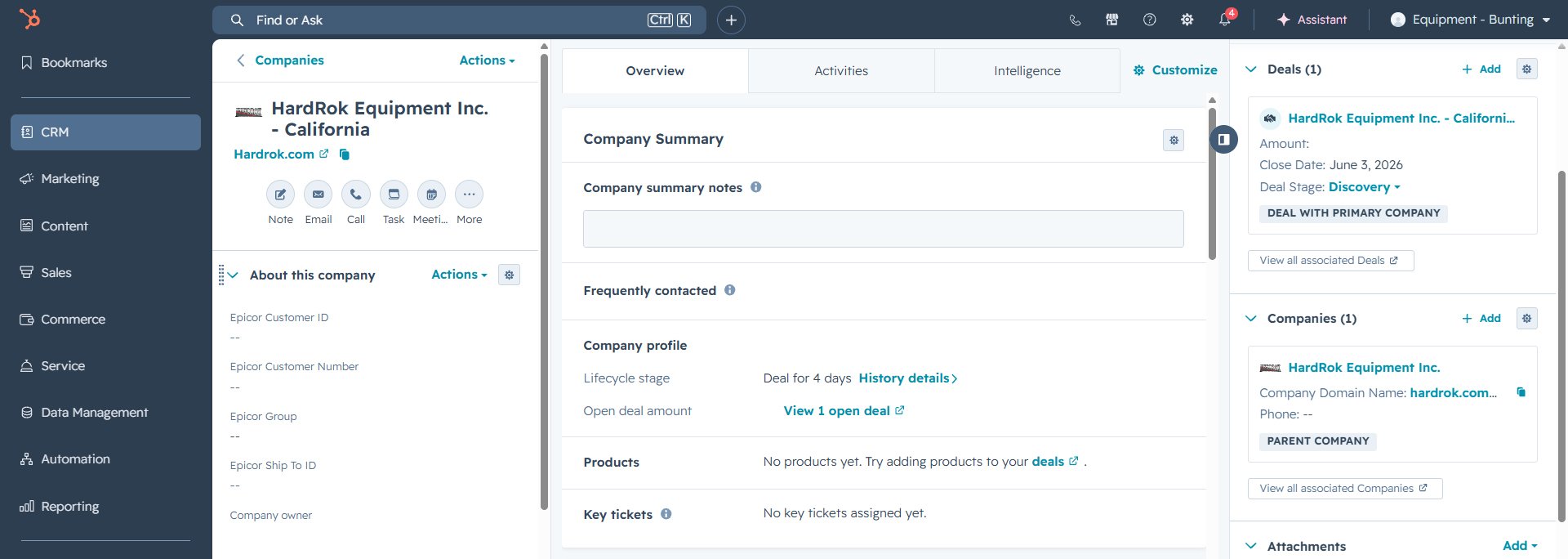
  • The Move: We built HubSpot's company structure to mirror Epicor's parent-child account hierarchy, ensuring that a global customer with multiple subsidiaries showed up in HubSpot with the same shape as it does in the ERP. Contacts and companies were deduped and reorganized to match.
  • How It Works: Marketing now sends from HubSpot against the same account structure sales uses. Reps see who has been touched, by which campaign, and how recently. Epicor remains the system of record for transactional data; HubSpot is the system of engagement, and the two are structured to speak the same language without a live data sync.
  • The Win: Marketing and sales operate against a single account picture for the first time. The 'has marketing already talked to this contact?' question takes seconds to answer.
company-record


2. Campaign architecture and full-funnel attribution — including tradeshow ROI

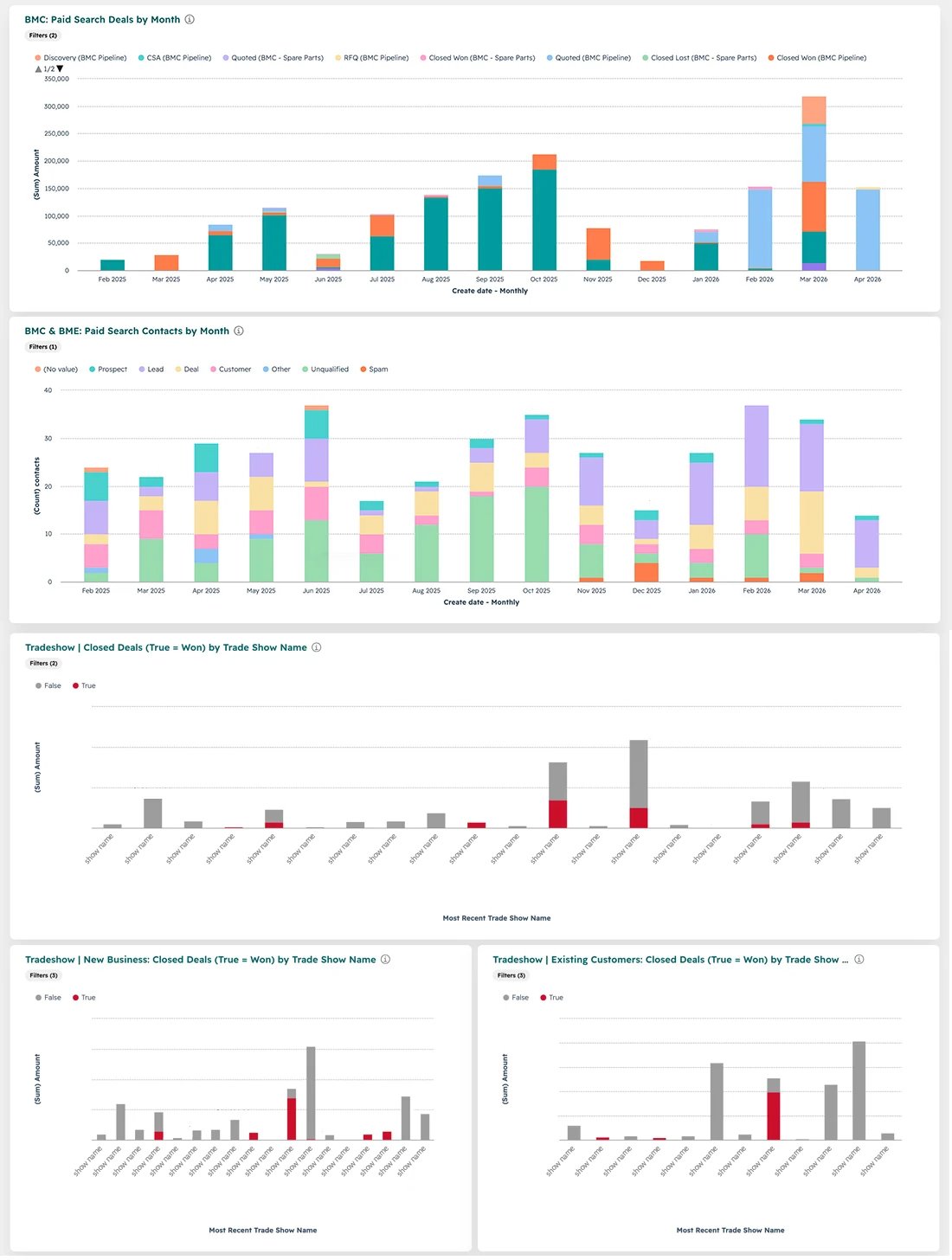
  • The Move: We implemented HubSpot's Campaign tool against Bunting's actual marketing motions, with workflows that put attribution data on the correct object (contact, deal, or company) at the right point in the lifecycle. For tradeshows specifically, we built logic to associate every show-sourced lead with its show, then carry that attribution all the way through to the deal.
  • How It Works: When Bunting attends a show, every lead captured is tagged to the show. As those leads convert into deals and as deals close-won or close-lost, the dashboard rolls open pipeline, won revenue, and lost revenue back to the originating event. Marketing leadership sees the picture per show and across the show portfolio.
  • The Win: Tradeshow planning is now a data conversation. Shows that produce pipeline get more investment; shows that don't get cut. The same attribution architecture powers digital, content, and email — every channel reports against the same revenue scorecard.
marketing-campaign-attribution-to-pipeline


3. Automated lead-status workflows and region/division-based routing

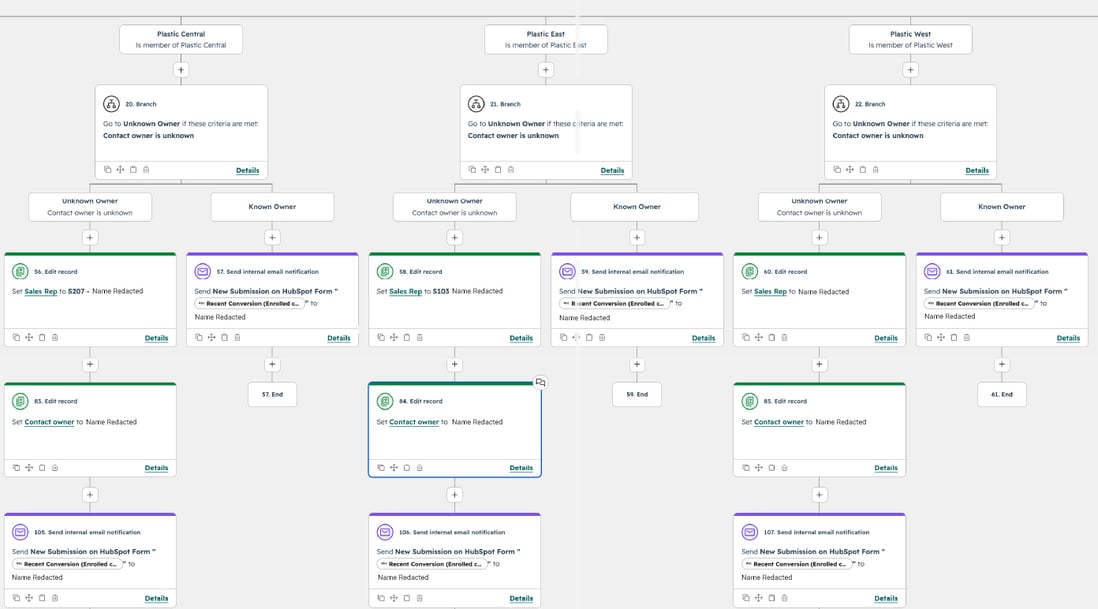
  • The Move: We implemented automated lead-status logic on the Contact object and built routing workflows that assign every inbound lead to the correct rep based on region and Bunting's internal division structure.
  • How It Works: When a form submission comes in, the system reads the region and product interest, applies the routing rules, and assigns the lead to the right rep — instantly, without manual triage. Each contact carries an auto-managed lead status that tells the rep what stage of follow-up the lead is in.
  • The Win: Reps stop hunting. Speed-to-lead drops because the routing is no longer a human bottleneck. Every rep starts the day knowing exactly which leads are theirs and which need a next action.
lead-assignment-1


4. An executive reporting suite that puts every team and every rep on the same scorecard

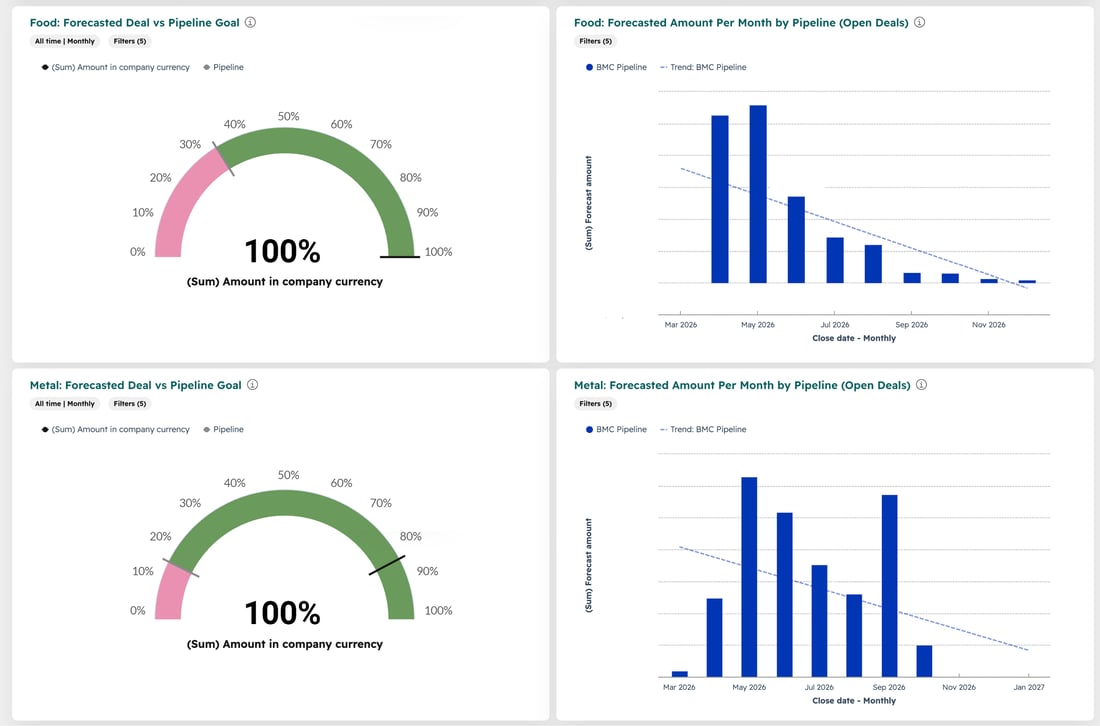
  • The Move: We built reports comparing open pipeline to goal, forecasted pipeline to goal, and closed-won to goal — at the team level and at the individual rep level — alongside activity dashboards covering calls, emails, and task completion.
  • How It Works: Sales leaders open one dashboard at the start of the week and see, by rep, who is ahead, who is behind, and where the gap is between forecast and goal. Activity dashboards show what work is producing the strongest follow-up rhythm.
  • The Win: Coaching conversations now start with data. Reps see their own performance the same way leadership sees it, which removes the surprise from quarterly reviews.
gauges-2


5. A Service Hub Customer Workspace with automated ticket creation from deals

  • The Move: We implemented the HubSpot Service Hub Customer Workspace and configured workflows that automatically create a service ticket when a deal moves to closed-won. Microsoft Teams was connected for in-line notifications so the right people get pinged at the right point in the handoff without leaving their day-to-day workflow.
  • How It Works: When a Deal advances through the sales pipeline, the appropriate downstream team members are notified automatically — Outside Sales, Inside Sales, and Customer Service — without anyone needing to write an email. Tickets created from closed-won deals carry the full deal and contact context.
  • The Win: The internal email handoff is gone. Customer issues no longer get dropped because somebody missed a thread. Sales, service, and the customer all see the same record.

The Impact

Within 90 days of go-live, Bunting's leadership saw four shifts that none of them had been able to produce in the prior decade.


1. For the first time, leadership can identify top-performing marketing efforts and top-performing sales reps

  • What Changed: The marketing attribution model and the sales scorecard make performance visible at every level — by campaign, by tradeshow, by team, and by individual rep.
  • The Result: Decisions about where to spend the next marketing dollar and where to invest the next coaching hour are now made against data, not memory.


2. Sales rep activity is up — calls, emails, and task completion all increased

  • What Changed: Reps stopped spending their day searching for the next thing to do. With routed leads and clear next-step status, the friction between intent and action came down.
  • The Result: Higher activity volume across the sales team in the first 90 days, with the activity now visible to leadership in a way that supports coaching rather than punishment.


3. Lead response time decreased

  • What Changed: Inbound leads route automatically to the correct rep based on region and division. The manual triage step is gone.
  • The Result: Faster first-touch on every lead, and a measurable speed-to-lead metric that didn't exist as a tracked number before the engagement.


4. Marketing spend was reduced on initiatives that weren't generating pipeline

  • What Changed: With attribution in place, Bunting could see which marketing line items produced pipeline and which didn't. Underperforming spend was cut.
  • The Result: Marketing budget reallocated toward the channels and shows that demonstrably contributed to revenue. The ROI of the implementation began compounding inside the marketing budget itself.


5. Tradeshow ROI is now measurable for the first time

  • What Changed: Open pipeline, won revenue, and lost revenue can all be filtered by tradeshow.
  • The Result: Bunting now plans its tradeshow calendar against demonstrated performance. As Mark Friesen put it: this single capability is reshaping how the company does marketing and sales.

What's Next

With marketing attribution and revenue reporting now in place, Bunting is moving into a content development phase focused on AI Engine Optimization (AEO) — building the kind of citation-ready content that wins visibility in conversational AI search and LLM-driven discovery. The foundation Modgility built supports this directly: a unified content engine that runs on the same data and brand voice as the rest of the marketing system, with attribution feeding back into the same revenue scorecard.

Why This Engagement Matters for Companies Like Yours

Bunting's situation is not unusual for established mid-market manufacturers. Decades on a single ERP, marketing run from a separate tool, sales operating on muscle memory, and leadership making decisions on what they can intuit because they cannot see. The reflex is to add a tool. The actual fix is to refactor the architecture — to take the time to define the marketing-to-sales handoff, mirror the account hierarchy that already exists in the ERP, and build the reporting that ties campaigns and tradeshows to revenue.

This is a textbook example of what we mean when we talk about engineering HubSpot into a high-performance asset rather than configuring it on top of a shaky foundation. The technical work — workflows, lead status, parent-child relationships, the Service Hub Customer Workspace — is the visible part. The discipline that produced it is the part that matters.

Could This Be Your Story?

If your company has been running for years on an ERP-plus-Mailchimp combination, and your leadership cannot answer the most basic question of which marketing and sales efforts are producing revenue, the path Bunting took is the same one available to you. The work begins with a clean process definition and an architecture that reflects how your business actually operates.

Service that delivered this work: Multi-Hub HubSpot RevOps Implementation — Sales Hub + Marketing Hub + Service Hub

Learn more about HubSpot RevOps

Or start with the entry point that fits:

Sales Hub Implementation Marketing Hub Implementation Service Hub Implementation