
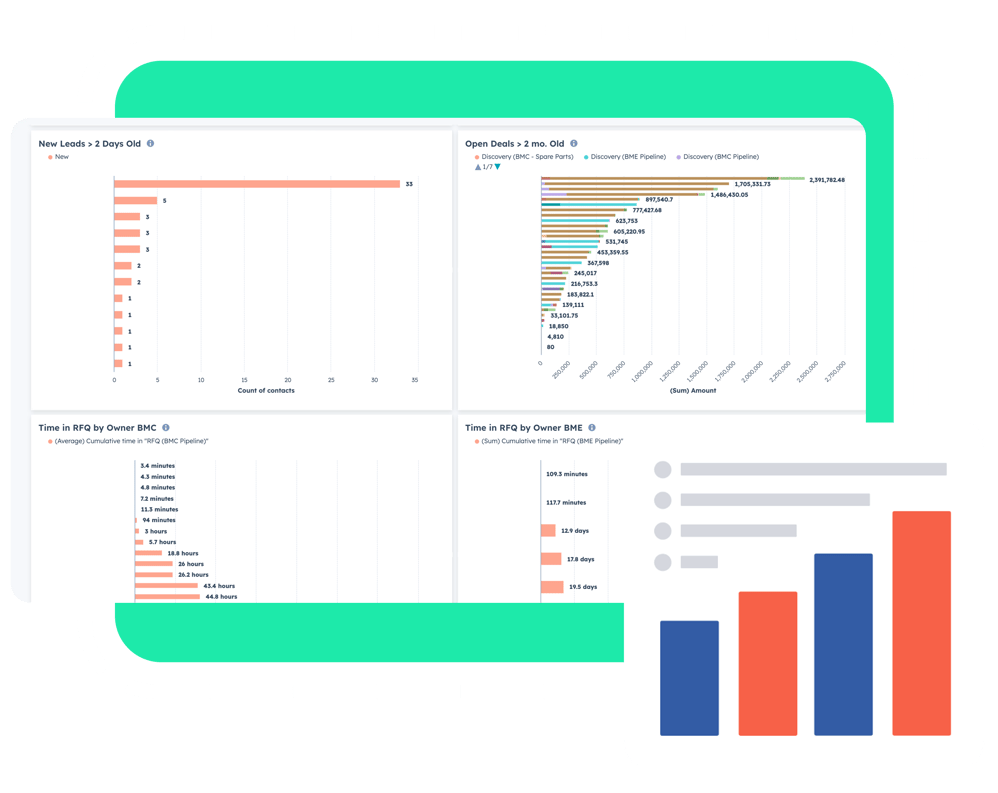

HubSpot Sales Hub Implementation
Pipeline visibility, rep accountability, forecasting accuracy, and deal velocity insights.

HubSpot Marketing Hub Implementation
Unify your data, automate your customer journey, and campaign attribution visibility.

Loop Marketing
Services
AI-powered framework that unifies brand identity, audience intelligence, and multi-channel execution.
Services

HubSpot Service Hub Implementation
Customer journey visibility, retention insights, support performance tracking, and expansion readiness.

HubSpot Data Hub Implementation
Clean, reliable customer data, automated data quality workflows, and accurate reporting across all hubs.

HubSpot Integrations
We specialize in the "hard stuff"—connecting your custom software or HubSpot RevOps to your back-office ERPs, inventory systems, and legacy databases.

HubSpot AI Agent Implementation
Stop the "administrative heavy-lifting" and give your team the automated support they need to scale.

AI Coaching / Enablement
Equip your team to execute modern marketing and sales workflows using HubSpot’s AI tools — without adding headcount.
How the Structural Build Works
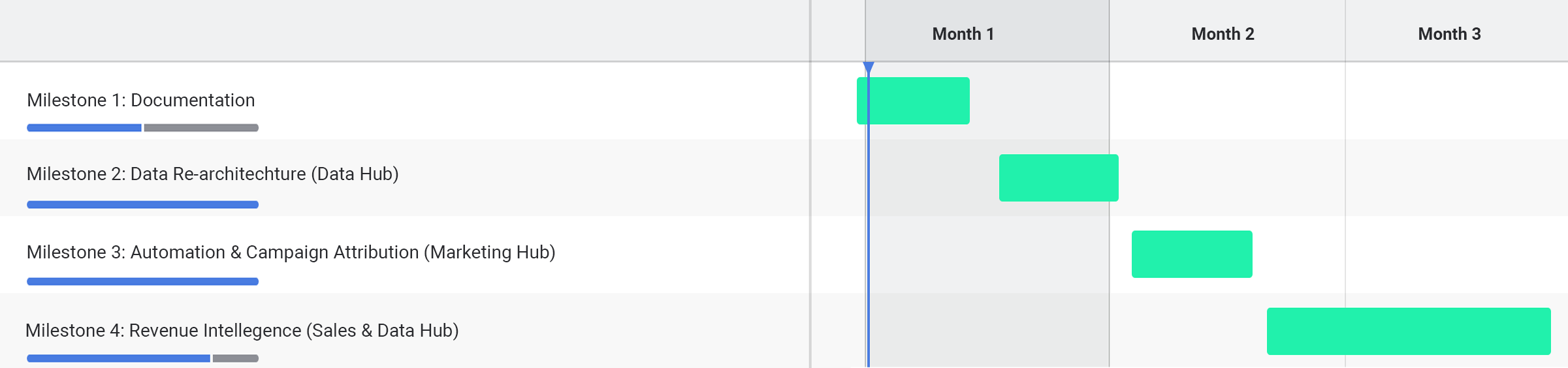
Siloed systems stall business growth; a structured implementation framework restores your operational momentum. Our deployment methodology is structured into four distinct milestones across a 90-day cycle, transforming fragmented tracking into a unified revenue engine.
Across five distinct operational milestones, we transform your disconnected software platforms into a unified revenue engine. This phased approach minimizes internal disruption, ensures rapid team adoption, and provides executive leadership with total pipeline transparency from day one.
Strategic Documentation & Process Mapping
Timeline: 2-4 Weeks
Before executing technical changes, we analyze existing system architecture to uncover hidden points of tracking friction. This baseline discovery phase aligns your marketing tools with true sales outcomes.
- System Discovery and Mapping: Our team documents your legacy sales and marketing workflows to isolate operational bottlenecks.
- KPI Definition Strategy: We establish clear parameters for tracking your primary indicators, including Website Conversion Rates and Cost Per Lead (CPL).
- Data Lifecycle Blueprints: We map the exact relationship boundaries between contacts, companies, and historic transaction data.
Data Re-architecture & Centralization
Timeline: 2-4 Weeks
Data silos actively destroy marketing velocity. During this milestone, we dismantle disconnected infrastructure to assemble a centralized Data Hub.
- ERP and HubSpot Alignment: We construct clean data pathways between your active ERP environment and HubSpot CRM.
- Establishing a Single Source of Truth: Centralized architecture ensures that your sales, operations, and marketing groups view identical data sets.
- AI Engine Optimization: Unifying your records prepares your database to leverage advanced AI modeling on a single, clean data layer.
Automation & Campaign Attribution
Timeline: 2-4 Weeks
Manual reporting waste resources and introduces systemic human errors. Once your data foundation is clean, we implement advanced automation models across your HubSpot Marketing Hub environment.
- Elimination of Manual Data Entry: Automated sync parameters automatically pass operational metrics between platforms, preserving data integrity.
- Lead Nurturing & Scoring Frameworks: We configure real-time intent triggers to move leads through the sales pipeline efficiently.
- Multi-Touch Attribution Setup: Our team installs granular campaign tracking tools so you can tie external marketing expenditures directly to generated revenue.
Revenue Intelligence Reporting
Timeline: 4-6 Weeks
A marketing initiative is only as valuable as the executive visibility it produces. The final phase deploys custom reporting interfaces that clearly prove your precise marketing ROI to executive leadership.
- Custom Executive Dashboards: We build native HubSpot dashboards displaying leading, lagging, and leaning pipeline indicators.
- Sales Qualification Alignment: Shared data access aligns lead generation criteria, enabling a seamless transition from MQL to Sales Qualified Lead (SQL).
- Continuous Performance Feedback: Armed with real-time conversion insights, marketing teams can continuously optimize campaigns for maximized pipeline volume.
Service Implementation & Closed-Loop Lifecycle
Timeline: 4-6 Weeks
A modern revenue engine does not stop at "Closed-Won." To maximize Customer Lifetime Value (LTV) and systematically lower churn, the final phase integrates your post-sale service operations into your centralized HubSpot ecosystem.
- Support & Onboarding Infrastructure: We configure customer support pipelines, service ticketing systems, or client onboarding workflows within HubSpot, preserving a single, unbroken timeline of the customer journey.
- Automated Feedback Loops: We implement automated feedback systems (such as CSAT, CES, or NPS delivery) tied directly to operational milestones, streaming customer health data back to marketing and account management teams in real time.
- Retention & Expansion Intelligence: Unifying customer service records with marketing and sales data gives leadership complete visibility into account health.

.svg)
“The team at Modgility has been able to help us integrate our legacy ERP with HubSpot CRM to collect Sales data and insights that help us make better decisions. They also did a great job building our website and are currently developing a custom e-commerce platform for us as well.”

Dean Payne
Bearing & Drive Systems
“The team at Modgility was able to integrate our ERP system, Quickbase, with HubSpot CRM allowing our Sales reps to be more efficient in their Sales activities and give management better insight into performance. Their attention to detail and customer service is outstanding! The ROI is obvious. Customers are seeing us as the leaders in our industry now.”

Patrick Di Marco
Compliant Healthcare Technologies, LLC