Share this
Custom vs. Off-the-Shelf Software: The Definitive 2026 Guide for Operations Management
by Hunter Liptrap on Mar 5, 2026
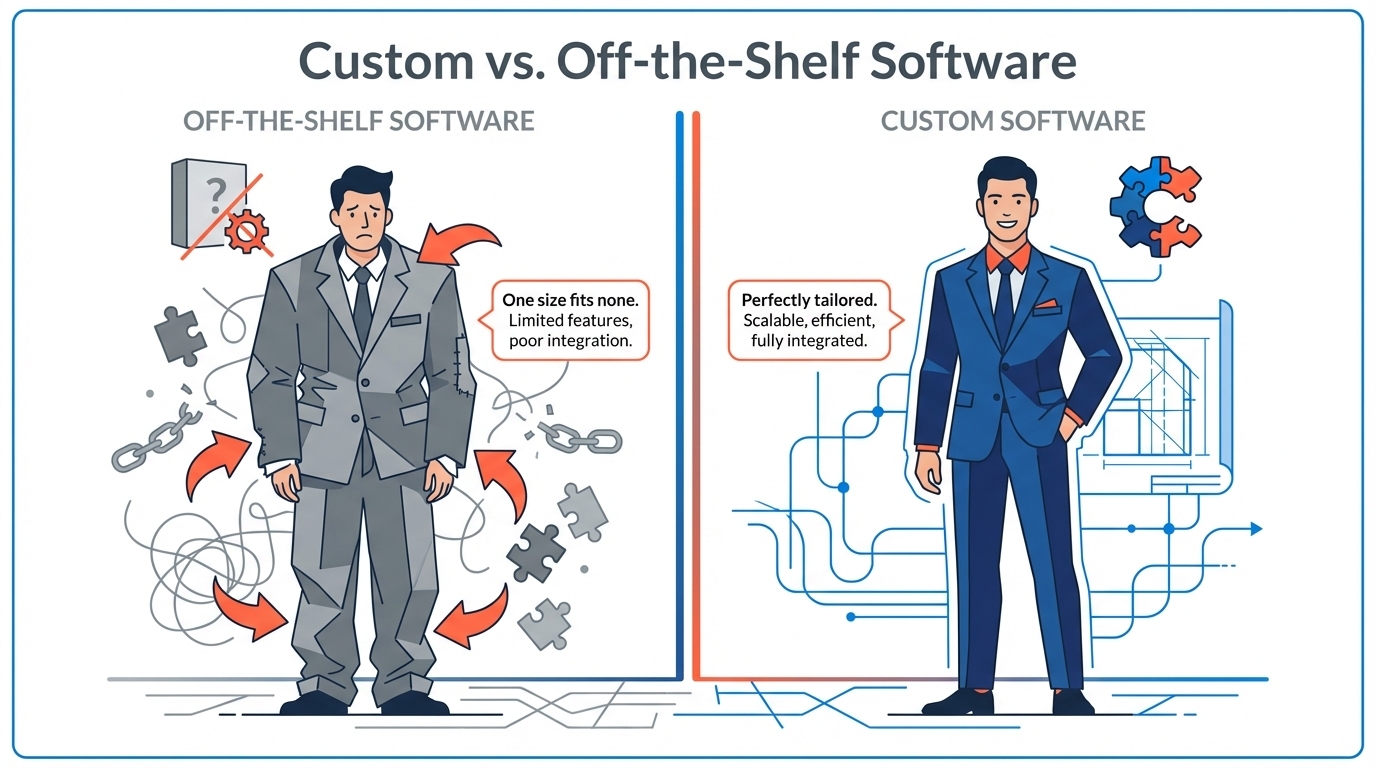
In 2026, choosing between custom and off-the-shelf software is a critical strategic decision. Off-the-shelf solutions offer speed and low initial cost, while custom software provides a perfect fit for unique operational needs, delivering a powerful long-term competitive advantage.
What You'll Learn
- The Core Difference: A clear breakdown of off-the-shelf (OTS) versus custom software.
- Pros and Cons: An objective look at the advantages and disadvantages of each approach.
- Key Decision Factors for 2026: When a Custom Business Operations Management System becomes a strategic necessity.
- The ROI of Customization: How a tailored system drives efficiency, scalability, and competitive advantage.
Understanding Off-the-Shelf (OTS) Software: The "One-Size-Fits-Most" Approach
Off-the-shelf (OTS) software, also known as commercial-off-the-shelf (COTS), is a ready-made product designed for a broad market. Think of project management tools like Asana, CRMs like Salesforce, or accounting software like QuickBooks. These are powerful, feature-rich platforms that serve a general set of business needs effectively.
Pros of Off-the-Shelf Software
- Lower Initial Cost: The development costs are spread across thousands of users, making the upfront price significantly lower.
- Immediate Availability: You can purchase, install, and start using OTS software almost instantly.
- Community and Support: Popular platforms have extensive user communities, documentation, and established customer support channels.
- Feature-Rich: These solutions are often packed with a wide array of features developed over many years.
Cons of Off-the-Shelf Software
- Generic Functionality: The software is designed for the "average" user. You may pay for dozens of features you'll never use while missing the one specific function you desperately need.
- Forced Workarounds: Your team must often adapt its processes to fit the software's rigid workflows, leading to inefficiency.
- Integration Challenges: Connecting OTS software with your other essential systems can be difficult, expensive, or impossible, creating data silos.
- Ongoing Costs: Subscription fees, per-user licenses, and costs for premium features can accumulate significantly over time.
The Power of Custom Business Operations Management Systems
A Custom Business Operations Management System is software that is designed, developed, and built to solve your specific business challenges. Instead of adapting your operations to a generic tool, the tool is built to perfectly match and enhance your unique workflows. It's the difference between buying a suit off the rack and having one tailored by an expert.
Pros of Custom Software
- Perfect Fit for Your Workflow: A custom system is engineered around your exact processes, eliminating inefficiencies and the need for workarounds.
- Competitive Advantage: By automating unique aspects of your business, a Custom Business Operations Management System can create a competitive moat that OTS software simply cannot replicate.
- Seamless Integration: It is built from the ground up to connect flawlessly with your existing databases, APIs, and third-party tools, creating a single source of truth.
- Unmatched Scalability: The system is designed to grow and evolve with your business, so you aren't forced into a costly migration when you outgrow a generic solution.
- Enhanced Security: You have complete control over the security protocols, ensuring they meet your specific compliance and data protection needs.
Cons of Custom Software
- Higher Upfront Investment: The initial cost to design and build a custom solution is greater than buying an OTS license.
- Longer Implementation Time: Development takes time, from initial discovery and design to deployment and testing.
- Requires a Development Partner: You need a skilled and reliable development partner to build and maintain the system.
Key Decision Factors for 2026: When to Choose Custom
As businesses become more complex and data-driven, the limitations of OTS software become more apparent. Here are the key scenarios where a Custom Business Operations Management System is the clear strategic choice.
1. You Have Unique Workflows and Processes
If your business's value is tied to a specific, proprietary process, forcing it into a generic software box will erode your efficiency and competitive edge.
- How a Custom System Helps: A Custom Business Operations Management System is built to mirror and optimize your exact workflow. It automates manual steps, eliminates redundant data entry, and provides insights specific to your operational model, directly aligning the technology with your core business goals.
2. You Need to Gain a Competitive Advantage
Off-the-shelf software puts you on the same playing field as your competitors. To outperform them, you need tools they don't have.
- How a Custom System Helps: By developing a Custom Business Operations Management System, you can build features that solve industry problems in a new way or deliver a superior customer experience. This transforms your operational software from a cost center into a strategic asset that drives growth.
3. Long-Term Scalability and Integration are Critical
Your tech stack is a collection of different tools. If they don't communicate, you create data silos and massive inefficiencies. As you grow, this problem only gets worse.
- How a Custom System Helps: A Custom Business Operations Management System is designed with integration at its core. Through custom API development and database design, it acts as the central hub for your operations, ensuring data flows seamlessly between departments and systems as your company scales.
4. You Have Strict Data Security and Compliance Needs
For industries like finance, healthcare, or government contracting, generic security protocols are often insufficient.
- How a Custom System Helps: With a Custom Business Operations Management System, you dictate the security architecture. You can implement specific encryption standards, access controls, and audit trails required to meet regulations like HIPAA or SOC 2, giving you full control and peace of mind.
The Bottom Line: Making the Right Choice for Your Business
For a startup or small business with standard processes, an off-the-shelf solution is a logical and cost-effective starting point.
However, for an established business looking to scale, optimize complex operations, and build a lasting competitive advantage in 2026, the discussion shifts from cost to investment. A Custom Business Operations Management System is an investment in efficiency, scalability, and a truly unique operational capability that cannot be bought off the shelf.
Frequently Asked Questions
Isn't custom software too expensive for a mid-sized business?
While the upfront cost is higher, the total cost of ownership can be lower over time. You eliminate recurring license fees, costs of unused features, and the high price of inefficient workarounds. The ROI from increased productivity and scalability often provides a rapid payback.
How long does it take to build a custom system?
The timeline depends on complexity, but a phased approach is common. A development partner can build a Minimum Viable Product (MVP) to solve the most critical pain points first, delivering value in months, not years, and then iterating from there.
What if my business processes change in the future?
This is a key strength of custom software. A well-designed Custom Business Operations Management System is built to be flexible and adaptable. Your development partner can easily modify and add new features as your business evolves, ensuring the software always serves your needs.
What is the main difference between custom and off-the-shelf software?
Off-the-shelf software is a ready-made product designed for a broad market, forcing your team to adapt its processes to the software's workflows. Custom software is designed and built specifically for your business's unique challenges, matching and enhancing your exact operational processes.
When is it better to choose custom software over an off-the-shelf solution?
A custom software solution is the strategic choice when your business has unique workflows, needs to gain a competitive advantage, requires seamless integration and long-term scalability, or has strict data security and compliance needs that generic software cannot meet.
Is custom software always more expensive than off-the-shelf options?
Custom software has a higher upfront investment compared to an off-the-shelf license. However, its total cost of ownership can be lower over time by eliminating recurring subscription fees, costs for unused features, and the significant hidden costs of inefficient workarounds.
Share this
- September 2026 (2)
- August 2026 (2)
- July 2026 (5)
- June 2026 (7)
- May 2026 (4)
- April 2026 (24)
- March 2026 (43)
- February 2026 (20)
- January 2026 (20)
- December 2025 (1)
- November 2025 (1)
- September 2025 (34)
- August 2025 (7)
- July 2025 (1)
- June 2025 (2)
- May 2025 (2)
- April 2025 (3)
- March 2025 (2)
- February 2025 (1)
- January 2025 (1)
- December 2024 (3)
- August 2024 (1)
- July 2024 (2)
- June 2024 (17)
- November 2022 (1)
- February 2022 (1)
- July 2021 (1)
- June 2021 (1)
- May 2019 (1)
- March 2019 (1)
- February 2019 (1)
- October 2018 (1)
- September 2018 (1)
- April 2018 (1)
- March 2017 (1)
- December 2016 (2)
- September 2016 (2)
- January 2016 (1)
- April 2015 (2)
- March 2015 (2)
- February 2015 (1)
- January 2015 (1)
- December 2014 (1)
- September 2014 (1)
- April 2014 (1)
No Comments Yet
Let us know what you think