
Share this
by Keith Gutierrez on Jun 23, 2026
When marketing reports a record quarter for lead generation, but sales misses the revenue target by twenty percent, the dashboard is usually lying.
Standard CRM configurations allow sales representatives to manually change deal stages based on instinct, corrupting the pipeline data long before the executive team reviews it.
If you are evaluating how to eliminate friction between your demand generation and sales operations, true pipeline visibility requires taking stage control away from the reps.
Below is an exact breakdown of how structured technical gates expose where your manufacturing pipeline is bleeding cash.
The Illusion of Visibility in Standard Configurations
A standard HubSpot implementation activates basic software features. A Modgility RevOps engagement dismantles organizational data silos to build a unified, high-velocity revenue engine.
Most industrial companies attempt to fix revenue leaks by buying more software. They layer complex visualization tools on top of unstructured CRM data.
This approach fails because a visualization tool cannot fix upstream data governance issues.
Here's the thing:
If sales reps can manually drag a contact from "Lead" to "Qualified" without fulfilling specific diagnostic criteria, the entire reporting structure is compromised.
You cannot build reliable multi-touch revenue attribution frameworks on top of human discretion.
Real-time pipeline health dashboards only survive executive scrutiny when data validity is enforced by rigorous validation rules at every lifecycle stage transition gate.
When you remove manual input, you force the system to reflect actual buyer behavior.
Replacing Guesswork with the Automated 5-Stage Funnel Model
The Automated 5-Stage Funnel Model replaces passive lifecycle definitions with strict technical entry and exit rules. Every stage transition is automated.
There are no manual stage changes, and there is absolutely no rep discretion allowed.
This produces reporting that is trustworthy at the executive level because the data highlights exact drop-off points between marketing handoffs and sales execution.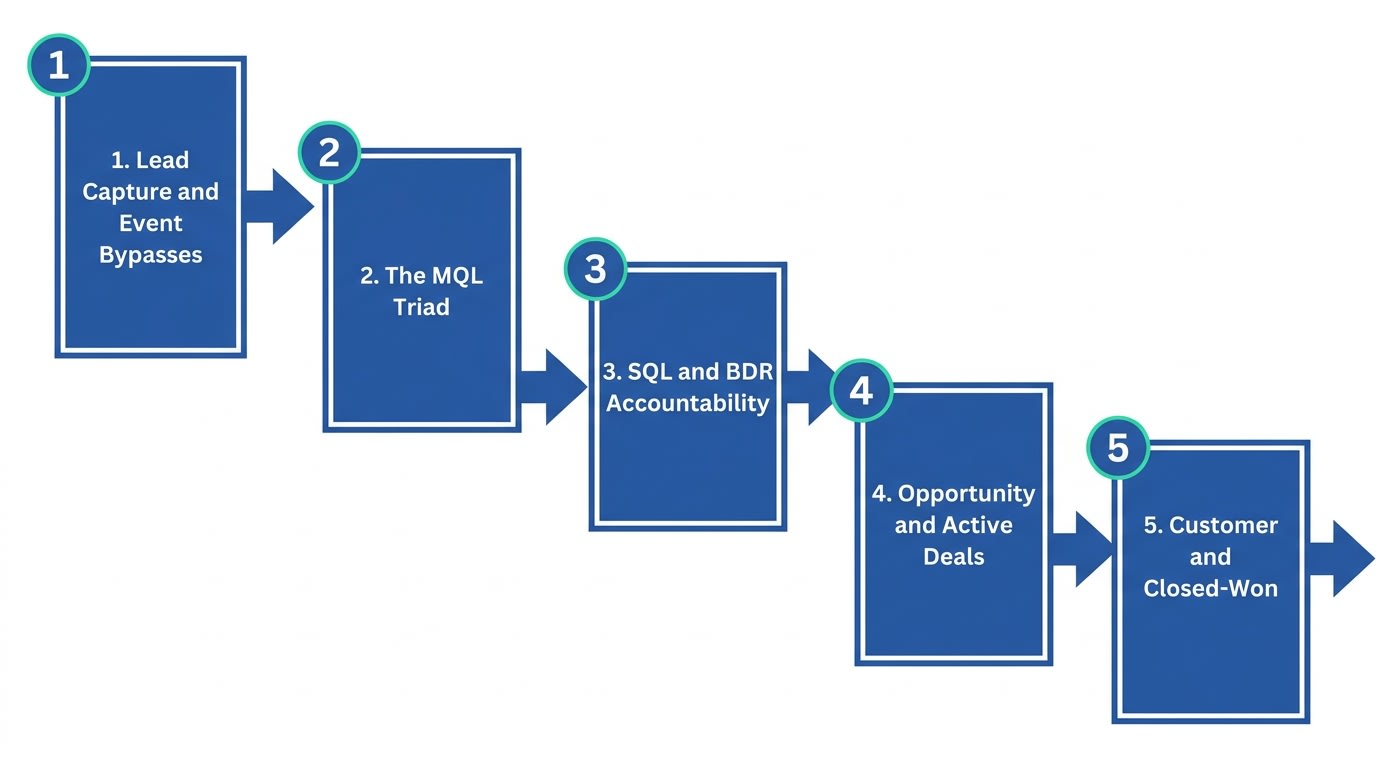
Stage 1: Lead Capture and Event Bypasses
The first stage of the funnel requires absolute precision in tracking source origination. Contacts enter the Lead stage automatically via form submission or certified list import.
We configure specific bypass rules for high-intent scenarios.
For example, trade show event badge scans bypass standard nurturing gates entirely. These high-priority contacts advance directly to the SQL stage to trigger immediate sales action.
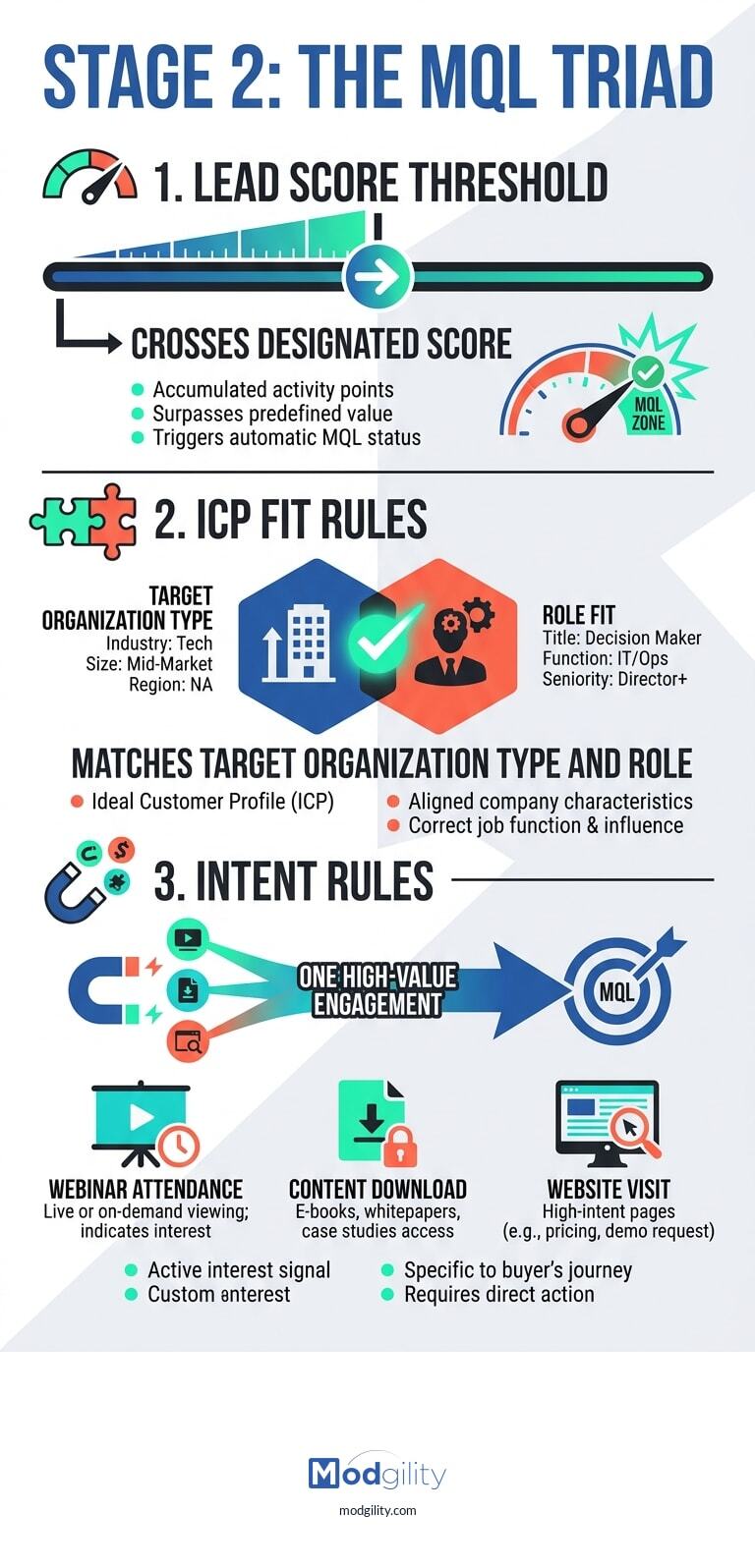
Stage 2: The MQL Triad
Most organizations base MQL status purely on arbitrary lead scoring. This creates massive pipeline bloat and ruins marketing credibility with the sales team.
The MQL stage must be triggered automatically only when a contact satisfies a strict triad of conditions.
First, they must cross a designated lead score threshold. Second, they must meet documented ICP fit rules, matching the target organization type and priority role.
Third, they must satisfy specific intent rules. This requires at least one meaningful engagement, such as a high-value website visit, a webinar attendance, or a technical content download.
If a contact misses any of these three pillars, they remain a lead.
Stage 3: SQL and BDR Accountability
The SQL stage is triggered automatically when a Business Development Representative explicitly accepts the lead and initiates outreach.
This stage is managed strictly through explicit Lead Status tracking. Reps must categorize the prospect as New, Attempting, or Connected.
If a lead sits in "New" for more than twenty-four hours, the dashboard flags a critical velocity leak.
Stage 4: Opportunity and Active Deals
The Opportunity stage is triggered automatically when the Lead Status equals Qualified and an active Deal is officially created in the CRM.
This transition is critical for calculating your true customer acquisition cost.
It provides a timestamp that proves exactly how long marketing had to nurture the account before sales generated a tangible financial opportunity.
Stage 5: Customer and Closed-Won
The final automated transition occurs when an associated Deal moves to Closed-Won.
This immediately triggers the Customer stage.
This automated final step is the linchpin for tracking macro-metrics including Opportunity Status and Customer Status, giving your CFO accurate data for forecasting.
Restructuring the Pipeline for 5 to 25 Rep Sales Teams
In our implementations with industrial distributors running 5 to 25 rep sales teams, we immediately remove redundant legacy pipeline stages.
Generic "Nurture" or "Follow Up" columns are where revenue goes to die.
We architect modern deal flows with precise advancement criteria. This includes introducing two named stages that most implementations completely miss, fundamentally changing how sales managers run forecast calls.
What does that look like in practice?
We build the Farming Stage. This stage is dedicated exclusively to the strategic nurturing of qualified prospects who are not in an active buying cycle due to budget freezes or leadership changes.
Reps cannot simply dump deals here. The Farming Stage requires a documented 'Hold Reason' property.
Once that property is filled out, it automatically triggers specific value-based content streams while maintaining complete sales oversight.
Enforcing the Qualified Stage Diagnostic
The second mandatory pipeline addition is the Qualified Stage. This is a formal diagnostic phase designed to prevent reps from forecasting deals based on a single polite conversation.
Entry into the Qualified Stage requires a scheduled discovery call, pre-call research documentation, and explicit champion identification.
Advancement out of this stage requires verified Pain-Solution alignment.
The sales representative must document how your product solves two to three core business problems for the prospect. They must also log a confirmed commitment to next steps.
These named stages enforce absolute accountability.
Managers gain a perfectly clear audit trail for pipeline review, and marketing stops taking the blame for deals that sales failed to diagnose properly.
Tracing Leaks to the Source with Multi-Touch Revenue Attribution
When a webhook breaks during a massive Q3 campaign, three weeks of attribution data are lost permanently if the dashboard does not immediately flag the missing inputs.
Modgility configures advanced multi-touch revenue attribution frameworks specifically in HubSpot Professional and Enterprise environments.
This tracks the complete buyer path from the very first Social, SEO, or Email touch all the way to a closed-won deal.
But here's where it gets interesting:
You cannot buy attribution visibility off the shelf. It requires enforcing data governance upstream.
If reps are not following the Qualified Stage rules, your attribution model will assign revenue credit to the wrong marketing channels.
When the infrastructure is built correctly, the financial impact is undeniable.
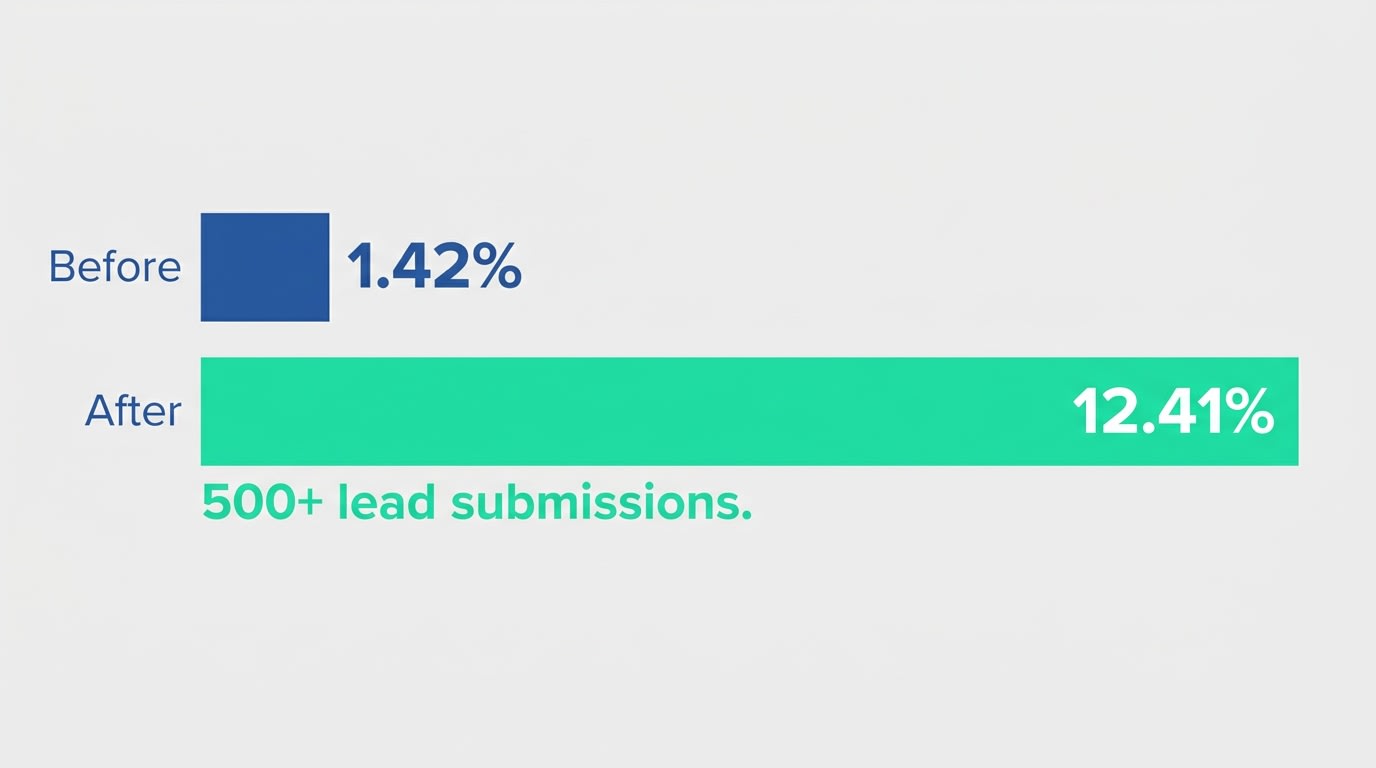
For a local-government software company with 201 to 500 employees, we raised top landing page conversion rates from 1.42 percent to 12.41 percent with over 500 lead submissions.
This outcome was achieved on an ongoing retainer averaging $4,000 per month, entirely through HubSpot CMS migration and rigorous A/B testing of high-impact landing pages.
"You're not likely to find someone at this price with their level of expertise. They're the machine that makes our HubSpot go." Mark Friesen, Marketing Director, Local-Government Software Company
The Missing Leak Metric: Post-Sale Service Signals
Traditional single-hub implementations completely ignore the post-sale loop. They build a marketing and sales machine but leave customer success operating in a dark silo.
True Revenue Operations requires customer retention data. This is exactly why Modgility embeds HubSpot Service Hub as the foundational core of every RevOps engagement.
This model connects the complete customer lifecycle.
It ties marketing lead capture, sales pipeline velocity, and post-sale service delivery together in a single closed loop.
Here's why that matters:
Service metrics such as ticket resolution times and customer satisfaction scores are wired directly back into acquisition pipelines.
We treat retention data as acquisition intelligence.
The churn signals and health metrics reveal exactly which customer segments produce the highest lifetime value.
If your dashboard does not show marketing the service cost of the leads they generate, you are optimizing for surface-level engagement instead of profitable revenue.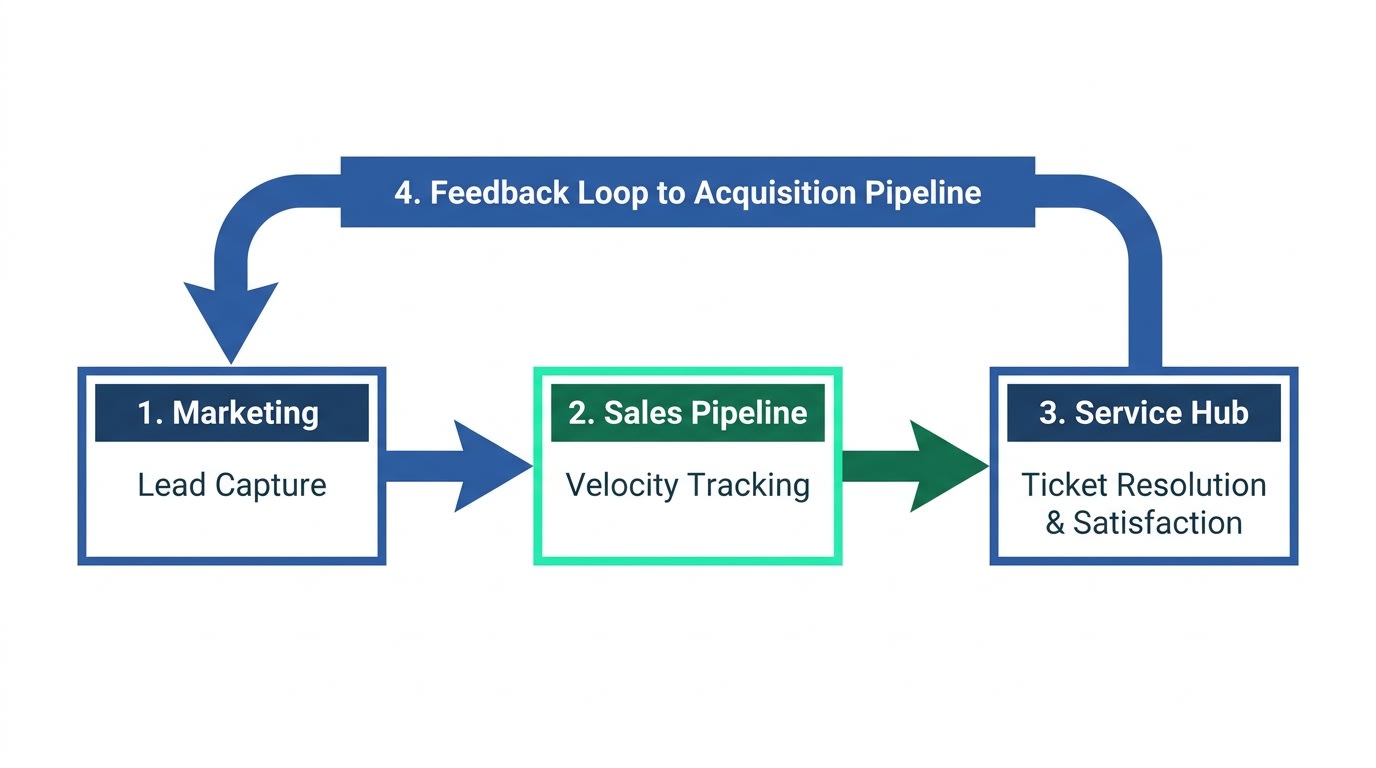
Sustaining Data Governance Post-Implementation
The transition from implementation to a long-term retainer follows a natural progression.
The implementation establishes the rigid data infrastructure, and the retainer runs high-velocity ongoing programs on top of it.
Post-implementation, Modgility offers structured Inbound Marketing and RevOps Retainers in two distinct tiers to keep the pipeline clean.
Now:
The Content Marketing Retainers range from $5,000 to $10,000 per month.
This focuses on continuous content production and campaign optimization, keeping fresh demand entering the top of the automated 5-Stage Funnel.
The Full Inbound plus Advanced Revenue Analytics Advisory ranges from $10,000 to $20,000 per month.
This tier provides comprehensive demand generation, sophisticated attribution modeling, and high-level RevOps strategy.
These retainers are specifically designed to continuously optimize the HubSpot environment and sustain deal velocity long after the initial implementation investment is complete.
Protecting Executive Credibility with Clean Data
The executive dashboard exists to display marketing contribution to revenue and progress toward cyclical revenue goals.
It is the tool a VP of Marketing uses to defend their budget to the CFO.
If the data feeding that dashboard is based on manual rep updates and disjointed service silos, executive credibility is destroyed the moment finance audits the numbers.
The bottom line?
You must architect a system that removes human error from the pipeline tracking process.
By tracking macro-metrics like Open Opportunities and Active Customers through automated technical gates, you build a revenue engine that tells the truth.
If your current attribution model cannot trace a closed-won deal back to the specific blog post or search term that started the conversation, start there.
Open your HubSpot portal and audit your lifecycle stage criteria.
If your sales reps have the permission to manually change a lead to an MQL, your dashboard is already lying to you.
No Comments Yet
Let us know what you think