
Share this
by Keith Gutierrez on May 26, 2026
- The Hidden Cost of Fragmented Content Tools
- What a HubSpot-Native Architecture Actually Means
- Powering The Citation Engine With Your Proprietary Data
- Measuring AI Attribution Instead of Vanity Metrics
- Accelerating Production Without Expanding Headcount
The Hidden Cost of Fragmented Content Tools
.webp?width=1376&height=768&name=frustrated-marketing-ops-disconnected-tools-20260526-201518).webp)
Marketing leaders face a recurring nightmare when attempting to scale content production. They invest in standalone writing platforms that force their team into isolated workflows disconnected from the central CRM. This fragmentation creates a massive blind spot for revenue operations. When tools do not speak the same language as your primary database, you lose the ability to track how a specific article influenced a closed-won deal.
For a marketing director focused on predictable pipeline, a tool that merely produces text is insufficient. The content must tie back to measurable business outcomes. Off-the-shelf generative systems require heavy manual intervention to move a drafted post into a live environment. Teams end up copying and pasting between multiple windows, stripping out weird formatting, and losing crucial metadata along the way.
This disconnect directly threatens data integrity because when data jumps through multiple platforms, attribution vanishes. Here is what we have seen in our own implementation: forcing a connection between disjointed systems makes it impossible to earn credibility with the CFO. A true integration unifies the entire production process within the ecosystem your team already trusts.
Why Third-Party Webhooks Fail RevOps
Operations professionals despise fragile connections. Relying on basic webhooks to tie a standalone content generator to HubSpot often introduces frustrating sync errors. These workarounds require constant maintenance. Every time an API updates, the connection risks breaking, leaving marketing teams stranded with stalled campaigns.
The business impact of these fragile setups is significant. Campaigns miss their launch dates. Lead handoffs fail because the tracking code was not properly embedded in the externally generated content. Bypassing these unreliable connectors is a proven way to protect the operational integrity of your marketing engine.
What a HubSpot-Native Architecture Actually Means
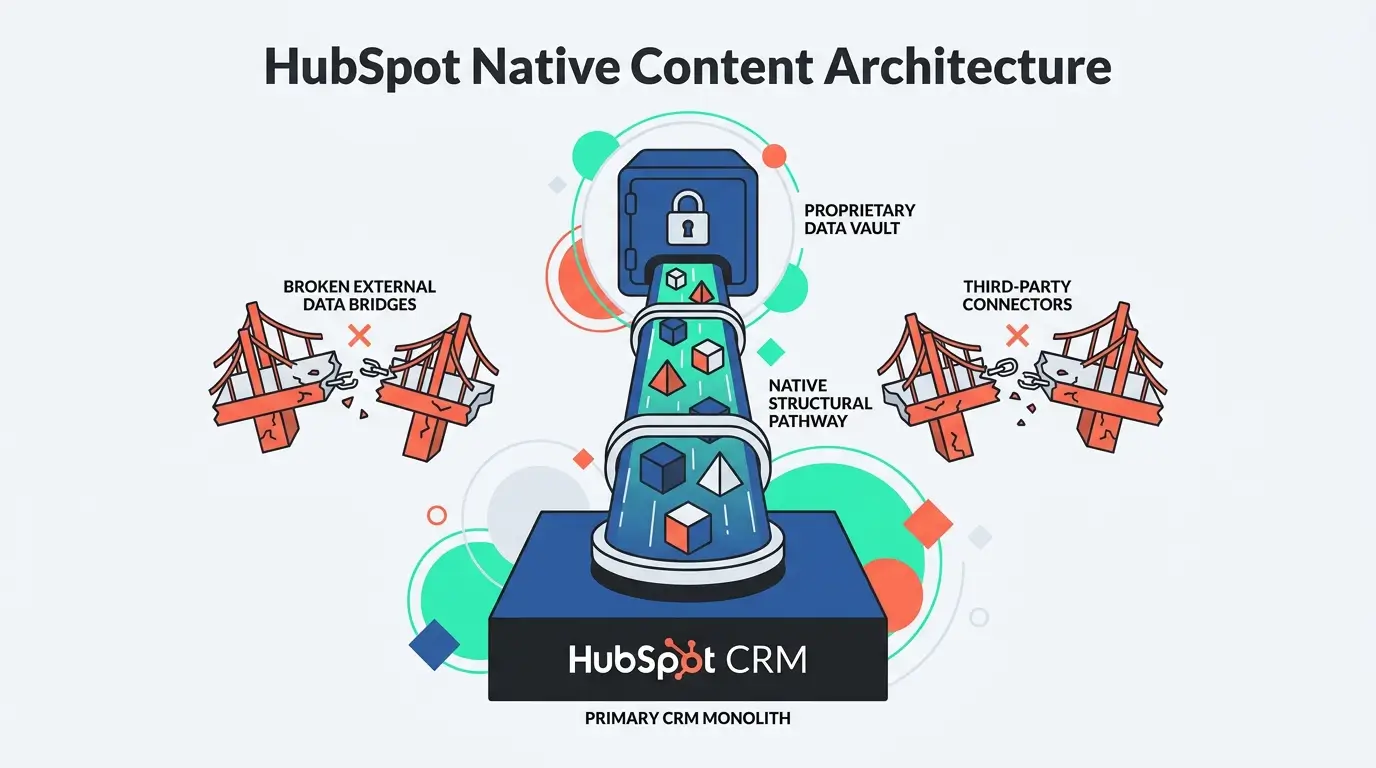
Content MAX completely changes the technical conversation because it functions as a HubSpot-native application. Your revenue operations leader does not need to audit a sprawling new tech stack or figure out complex data mapping. The platform fits directly into the environment your company already relies on for marketing automation and reporting.
Because it was engineered specifically for this ecosystem, the output requires no technical massaging. Content MAX generates articles that are publish-ready right out of the system. This includes fully optimized WebP featured and in-content images. It also delivers JSON-LD schema markup baked directly into the code.
The final output is delivered as HTML formatted for direct copy-paste into your HubSpot CMS. Your content execution roles eliminate the need to waste time fixing heading tags or resizing large image files. The system handles the entire technical lift in the background, keeping your primary database perfectly clean.
Protecting Total Data Integrity
Data integrity is a core requirement for any modern marketing team. When you introduce foreign software into your workflow, you invite formatting errors and broken tracking links. A native integration protects your core source of truth by keeping the entire production cycle aligned with your CRM protocols.
Your operations team maintains total visibility over what is being produced. You avoid the hidden technical debt that usually accompanies shiny new AI writing tools. The result is a clean, measurable database where every piece of published content can be accurately tracked back to actual visitor engagement.
Powering The Citation Engine With Your Proprietary Data
Generic content tools rely entirely on the open web to gather information. This causes brands to publish consensus opinions that sound exactly like their competitors. We solve this problem using a structured methodology called The Citation Engine. This process runs in five distinct phases: Discover, Ground, Author, Amplify, and Measure.
.webp?width=768&height=1596&name=powering-citation-engine-proprietary-data-20260526-201459).webp)
The magic happens in the Ground phase. Instead of pulling from public search results, Content MAX grounds your content entirely in a proprietary client Pinecone Knowledge Base. Nothing from the open web is used. We build this isolated namespace using three specific input types: your website product pages, your internal PDFs, and your detailed answers from the 5 Rings of Buying Insight framework.
By using the 5 Rings of Buying Insight framework, we surface your actual differentiators and founder perspectives. This is the proprietary knowledge that no standard website page captures on its own. Every article generated draws exclusively from this deep well of verified company intelligence.
Building an Isolated Pinecone Workspace
Security and originality are top concerns when evaluating AI tools. By utilizing an isolated Pinecone namespace for every client, we keep your proprietary data completely ring-fenced. Your internal playbooks and customer insights never train a public language model.
As you add more PDFs and product details over time, your specific Knowledge Base grows richer. Every subsequent article generated from it improves automatically. This architectural decision prevents hallucinations and protects your brand authority from being diluted by generic internet noise.
Measuring AI Attribution Instead of Vanity Metrics
For a marketing vice president, traffic volume means nothing if it does not convert into qualified demand. Traditional tools report on basic clicks and impressions. These are vanity metrics that fail to justify marketing spend to a skeptical executive board. You need transparent performance reporting that proves your content is dominating critical conversations.
Because Content MAX operates natively alongside HubSpot, it tracks exactly which content gets cited in AI answer engines like ChatGPT, Perplexity, and Gemini. This is how you measure genuine market authority. By tracking AI Share of Voice via the HubSpot AEO tool, you can definitively show stakeholders how often your brand is recommended as the definitive solution.
.webp?width=1376&height=768&name=share-of-voice-bar-chart-20260526-201457).webp)
Modgility is proof of this exact methodology. The platform was built on the identical system every client runs. Through this approach, we captured a 41% Share of Voice in the HubSpot AEO competitive category as of May 2026.
We secured 610 AI citations, making us the number two most cited domain in the entire category behind hubspot.com itself. Our nearest competitor holds only 18 percent.
Shifting from Page Views to Cited Authority
Answer Engine Optimization is where B2B search is moving. The window to establish authority is 6 to 18 months before the category becomes crowded. The brands that build citable Knowledge Bases now will own the AI answer landscape for their category. Those that wait will spend years catching up.- Keith Gutierrez, Founder, Modgility
When you can prove that AI platforms are naming your company as a top-tier vendor, you change the internal conversation about marketing ROI. Buyers are actively using these answer engines to evaluate their options before they ever speak to your sales team. Capturing this specific Share of Voice is the strongest leading indicator of future pipeline growth.
Accelerating Production Without Expanding Headcount
Your content managers are likely buried under manual formatting tasks, keyword research, and endless draft revisions. Traditional AI tools only solve the initial drafting phase. They leave the heavy lifting of formatting, image sourcing, and technical optimization entirely up to your staff. This creates a severe bottleneck in your publishing cadence.
.webp?width=1376&height=768&name=content-manager-reviewing-article-laptop-20260526-201508).webp)
Content MAX removes these manual formatting steps. By delivering publish-ready HTML, the platform reduces content production time to under 20 minutes per article from start to publish-ready. Compare this to the 1 to 2 hours required when using standard AI tools, or the 4 to 6 hours required to write an article entirely from scratch.
With a fully set up system, a marketing team can comfortably produce 5 to 10 AEO-optimized articles per week. Your total client time investment drops to just 2 to 5 hours per week for light editing and publishing. This massive reduction in labor allows your team to focus strictly on audience strategy and campaign alignment instead of tedious formatting work.
Removing the Formatting Bottleneck
When execution roles are freed from coding HTML tables and compressing image files, their job satisfaction skyrockets. Your team can maintain a highly consistent daily automated publishing cadence without burning out. This level of output consistency is precisely what answer engines reward when they crawl domains for authoritative sources.
This operational efficiency makes securing budget sign-off much easier. You are not asking the CMO for additional headcount to scale your content marketing. You are implementing an automated system that dramatically increases your output quality utilizing the team you already have in place.
A Structured Path to Stakeholder Buy-In
Switching to a new platform often triggers anxiety about a steep learning curve. Operations leaders naturally push back against software that requires heavy team retraining. We address this directly by eliminating the complex interface typical of standalone AI writers. Because the system outputs ready-to-use code for HubSpot, the adoption process requires very little behavioral change from your staff.
During the initial setup, we guide your team through gathering existing PDFs, service pages, and conducting the 5 Rings of Buying Insight interviews. This structured pilot process focuses heavily on data accuracy. By loading this precise information into your isolated Knowledge Base upfront, your daily operational workflow becomes incredibly simple.
You do not need to spend hours engineering complex prompts. The system already knows your brand voice, your product specifications, and your buyer's deepest pain points. Your content managers simply select the topic angle, and the platform handles the execution based entirely on your verified data.
Gaining Confidence Through Measurable Results
When evaluating new options, data-driven marketing leaders prioritize clear paths to ROI. Implementing a tool that respects your CRM architecture provides immediate peace of mind to your technical stakeholders. Once the system goes live, you can monitor the daily automated publishing cadence and begin tracking your rising Share of Voice.
Within the first 30 days of aligning production directly with your core database, your team will transition from manual formatting bottlenecks to publishing fully formatted articles in under 20 minutes. This operational shift provides the immediate tracking visibility required to earn credibility across the executive suite and establishes a predictable baseline for dominating your category's AI Share of Voice.
Frequently Asked Questions for Technical Marketing Leaders
How long does it take a content team to learn Content MAX and integrate it with HubSpot?
The adoption process requires very little behavioral change from your staff because Content MAX functions as a HubSpot-native application that eliminates complex interfaces. When marketing teams introduce foreign software into their workflow, they often face a steep learning curve and risk breaking their fragile API connections. This platform bypasses third-party middleware and unreliable webhooks entirely, keeping your entire production cycle aligned with your existing CRM protocols. Your operations leader does not need to audit a sprawling new tech stack or figure out complex data mapping to maintain data integrity. During the initial setup pilot, your team focuses simply on gathering existing PDFs, service pages, and conducting the 5 Rings of Buying Insight interviews. This verified information loads into your isolated Knowledge Base upfront. Since the system already knows your brand voice and product specifications, your content managers avoid spending hours engineering complex prompts. They simply select a topic angle, and the platform handles execution. Begin by auditing your internal playbooks and customer insight documents to prepare for the structured pilot process.
Can Content MAX improve our AI search performance without adding hours to our content production workflow?
Content MAX drives AI search visibility while reducing content production time to under twenty minutes per article from start to publish-ready. Traditional software forces staff to handle heavy formatting, image sourcing, and technical optimization manually, creating a severe bottleneck in your publishing cadence. This platform removes those tedious steps by delivering fully formatted HTML, JSON-LD schema markup, and optimized WebP images baked directly into the code. Because the output requires no technical massaging and is ready for direct copy-paste into your HubSpot CMS, a standard marketing team can comfortably produce five to ten optimized articles per week. This massive reduction in manual labor drops your total time investment to just two to five hours per week for light editing and publishing. By maintaining a highly consistent daily automated publishing cadence, your brand delivers the exact output consistency that answer engines reward when crawling domains for authoritative sources. Calculate your current weekly hours spent on keyword research and formatting to measure the potential labor reduction.
What happens if our proprietary company data mixes with public internet data during content generation?
If your platform relies on open web data, your brand will publish consensus opinions that sound exactly like your competitors and fail to establish distinct market authority. Content MAX completely avoids this problem during the Ground phase of its five-step Citation Engine process. The system grounds your content entirely in a proprietary client Pinecone Knowledge Base so that nothing from the open internet influences the output. We build this isolated namespace using your specific website product pages, internal PDFs, and detailed answers from the 5 Rings of Buying Insight framework. By strictly ring-fencing your proprietary data, your internal playbooks and private customer insights never train a public language model. This specific architectural decision prevents dangerous hallucinations and protects your brand authority from being diluted by generic internet noise. As you add more PDFs and product details over time, your database grows richer, meaning every subsequent generated article improves automatically based on your actual differentiators. Schedule interviews with your founders to capture their unique perspectives for your isolated workspace.
How do we measure the actual business impact of articles produced by Content MAX?
You measure the actual business impact of these articles by tracking your AI Share of Voice through the HubSpot AEO tool to prove genuine market authority. Traditional writing tools report on basic clicks and page views, which are vanity metrics that fail to justify marketing spend to a skeptical executive board. Because this platform operates natively alongside your primary database, it tracks exactly which content gets cited in top AI answer engines like ChatGPT, Perplexity, and Gemini. Tracking this specific cited authority definitively shows your stakeholders how often your brand is recommended as the definitive solution to buyers. Modgility used this exact system internally to capture a forty-one percent Share of Voice in the HubSpot AEO competitive category, securing six hundred ten citations to become the number two most cited domain. Capturing this specific visibility is the strongest leading indicator of predictable pipeline growth. Audit your current analytics dashboard to ensure you track answer engine citations instead of just basic search impressions.
Will my operations team need to fix formatting and metadata before publishing the generated articles?
Your operations team will not need to fix formatting or strip out strange code because Content MAX generates articles that are publish-ready right out of the system. When marketing data jumps through multiple disconnected platforms, teams usually end up copying and pasting text between multiple windows, which strips out crucial metadata. This tool fits directly into the environment your company already relies on, delivering final output as clean HTML formatted for direct copy-paste into your HubSpot CMS. The system handles the entire technical lift in the background, keeping your primary database perfectly clean. It automatically delivers fully optimized WebP featured images and in-content graphics while baking JSON-LD schema markup directly into the code. Your execution roles completely eliminate the need to waste time fixing heading tags or resizing large image files, which causes their job satisfaction to skyrocket. This native integration protects your core source of truth and prevents frustrating sync errors. Review a recent blog draft to see how many manual steps your team currently takes before hitting publish.
No Comments Yet
Let us know what you think