
Share this
by Keith Gutierrez on Aug 31, 2026
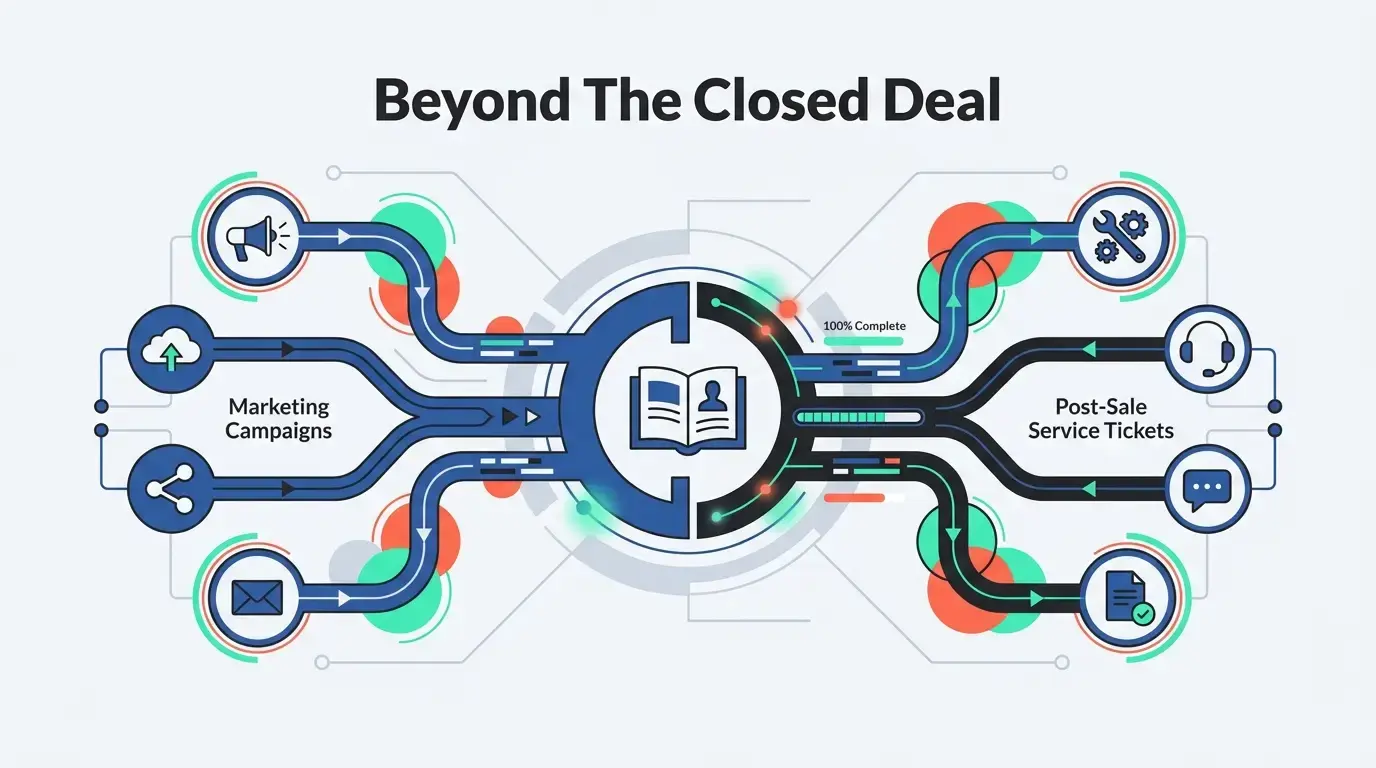
Most attribution reports stop at "closed-won."
That's the problem. The deal doesn't stop there. Retention, churn, upsell, and support costs all happen after the sale, and none of it flows back into the model that decided which campaigns get more budget.
If you've ever had to explain to a CFO why a "high-performing" channel produced customers who churned in month four, you already know why this matters.
Below: what full-lifecycle CRM revenue attribution actually means, why fragmented tools make it impossible, and where most implementations quietly fail before they ever produce a usable number.
Full-lifecycle CRM revenue attribution improves accuracy by connecting marketing, sales, and post-sale service data inside one system of record, so a closed deal's true revenue quality (not just its close date) can be traced back to the campaigns and touchpoints that produced it. Without that connection, attribution models can only measure what happens before the handoff to sales, which is roughly half the customer story.
The Category This Actually Falls Under
Let's name what we're talking about, because the term gets used loosely.
Full-lifecycle CRM revenue attribution is a specific category: a unified data and reporting architecture that tracks a contact from first touch through post-sale service interaction, inside a single CRM environment, so revenue can be attributed with input from every stage of the relationship, not just the pre-sale stages.
This is different from standard marketing attribution software, which typically stops measuring at the sale. One contrast worth naming clearly: marketing attribution tools tell you which campaign influenced a deal, while full-lifecycle CRM attribution tells you whether that campaign produced a customer worth keeping.
Here's why that distinction matters to anyone reporting to a CFO or CRO: a channel that produces fast, cheap closed-won deals but high churn is not efficient. It's deferred cost. Standard attribution models can't see that. Full-lifecycle models can, because they don't stop watching the customer once the deal closes.
Why Your Attribution Model Breaks the Moment a Ticket Gets Filed
Here's the thing: most CRM setups treat service data as a separate department's problem.
A support ticket gets logged. It gets resolved. It gets closed. None of that activity ever touches the contact record that marketing and sales use to calculate campaign ROI.
So what happens in practice? A customer acquired through a paid campaign has a rough onboarding, files three tickets in the first sixty days, and churns at renewal. The attribution report never sees any of it. The campaign still gets credit for a "won" deal.
That's not a reporting gap. It's a blind spot with a dollar figure attached, and it's the exact scenario that makes marketing spend indefensible in a QBR.
What "closed-loop" actually requires
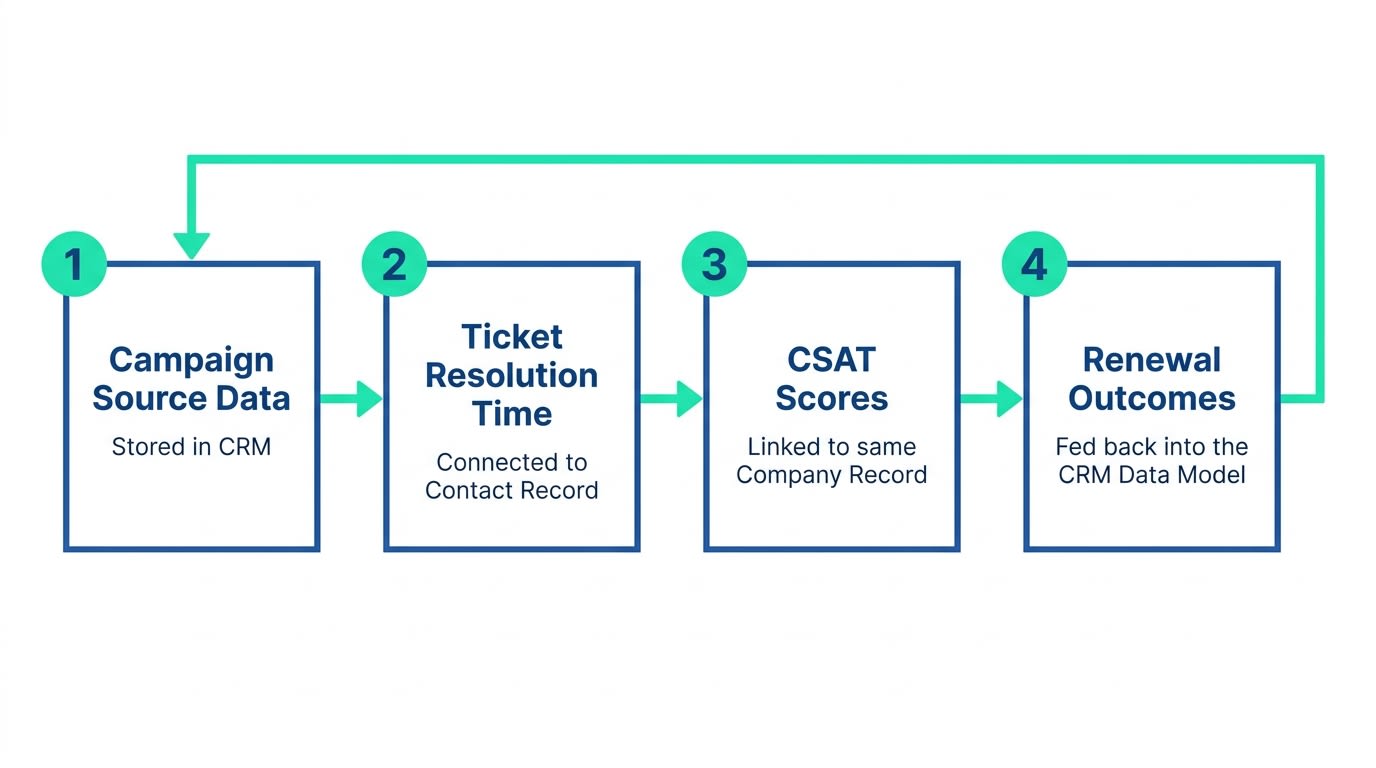
To close that loop, ticket resolution time, CSAT scores, and renewal outcomes all need to live on or connect to the same contact and company records that hold campaign source data. Not in a separate helpdesk tool. Not in a spreadsheet someone updates monthly.
Without that connection, retention data and acquisition data will always be two different conversations, told by two different teams, using two different sets of numbers that don't reconcile.
The Data Silo Nobody Puts in the Board Deck
Sales teams already know this problem by a different name: the handoff.
Marketing hands off a lead. Sales works it. Somewhere in that handoff, the original source data gets flattened, mislabeled, or lost entirely. By the time a deal closes, the CRM might show "direct" or "referral" as the source, even though a six-month nurture sequence did the actual work.
Now stretch that same problem into the post-sale stage. If marketing-to-sales handoffs already lose fidelity, marketing-to-service handoffs lose even more, because most organizations never built a pipeline for that data to travel at all.
The result is a revenue engine with two working parts and one dead zone. Marketing and sales talk to each other, badly. Service doesn't talk to either.
And the best part? This is entirely fixable at the data architecture level. It doesn't require a new attribution philosophy. It requires the CRM to actually be full-lifecycle instead of just being called that in a sales deck.
What "Full-Lifecycle" Actually Has to Track
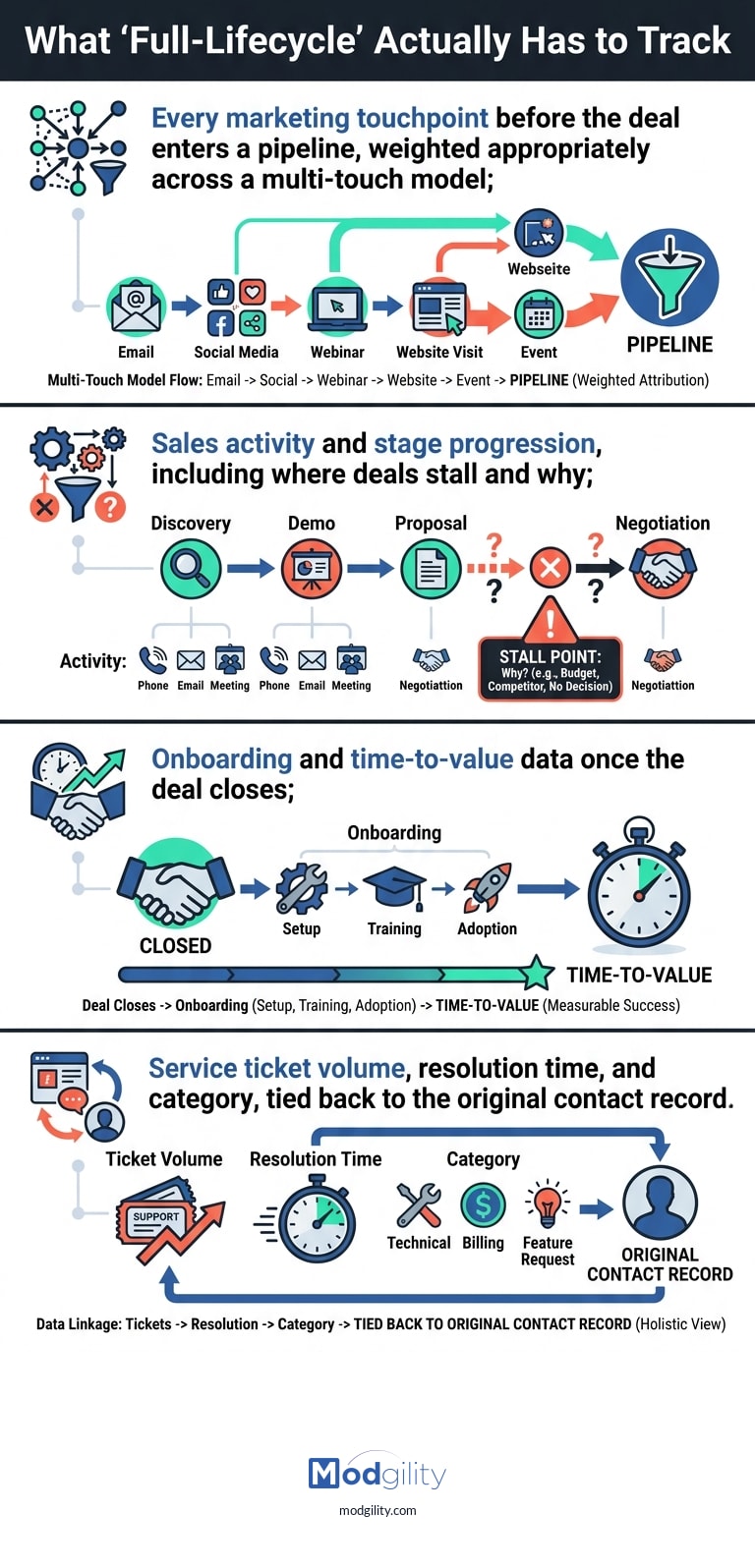
A model that claims full-lifecycle CRM revenue attribution has to account for more than first-touch or last-touch credit. It needs a defensible view across the entire relationship.
At minimum, that means tracking:
- Every marketing touchpoint before the deal enters a pipeline, weighted appropriately across a multi-touch model
- Sales activity and stage progression, including where deals stall and why
- Onboarding and time-to-value data once the deal closes
- Service ticket volume, resolution time, and category, tied back to the original contact record
- Renewal, expansion, and churn events, attributed back to acquisition source
Think about it this way: if any one of those five is missing, the attribution model is describing part of the customer, not the whole customer. And CFOs tend to ask about the part you didn't measure.
Why the Last CRM Project Didn't Fix This
So what went wrong the first time around, for the teams who already tried?
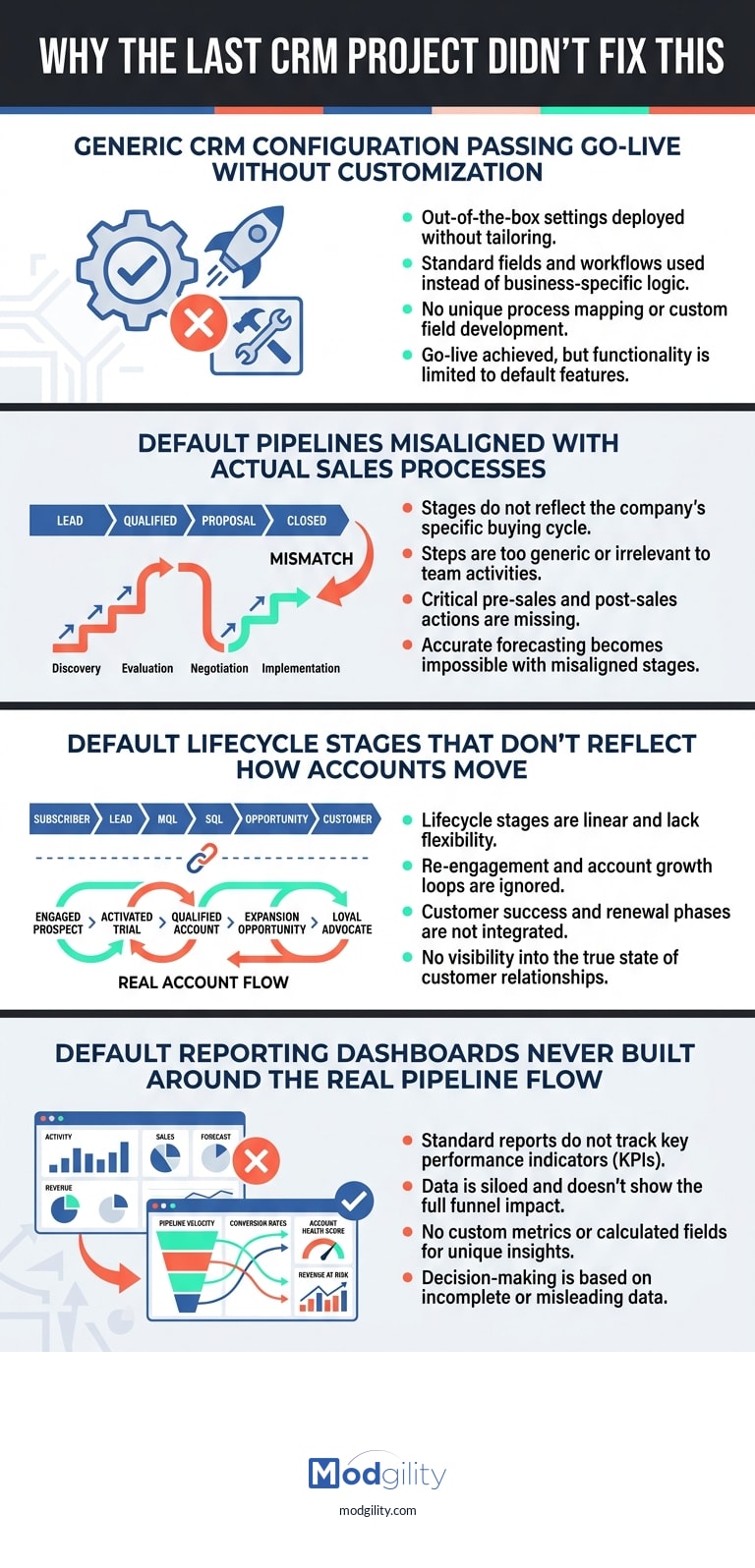
In most cases, the CRM got implemented, but the configuration didn't reflect how the business actually sells and services accounts. Default pipelines. Default lifecycle stages. Default reporting dashboards that look complete but were never built around the specific way this company's deals actually move.
That's a common failure pattern worth naming directly: a generic configuration can pass a go-live checklist and still produce unusable attribution data, because the underlying field mapping, lifecycle stage definitions, and service-to-sales handoff logic were never customized to match reality.
Here's why that matters for anyone who's already burned budget on a CRM rebuild: a second attempt that repeats the same generic setup will produce the same silos, just with a new login screen. The fix isn't a new platform. It's whether the implementation actually maps to how revenue moves through this specific organization.
What Changes When Service Data Feeds Back Into Attribution
Once ticket data, CSAT scores, and renewal outcomes connect back to the original acquisition record, the attribution conversation changes shape entirely.
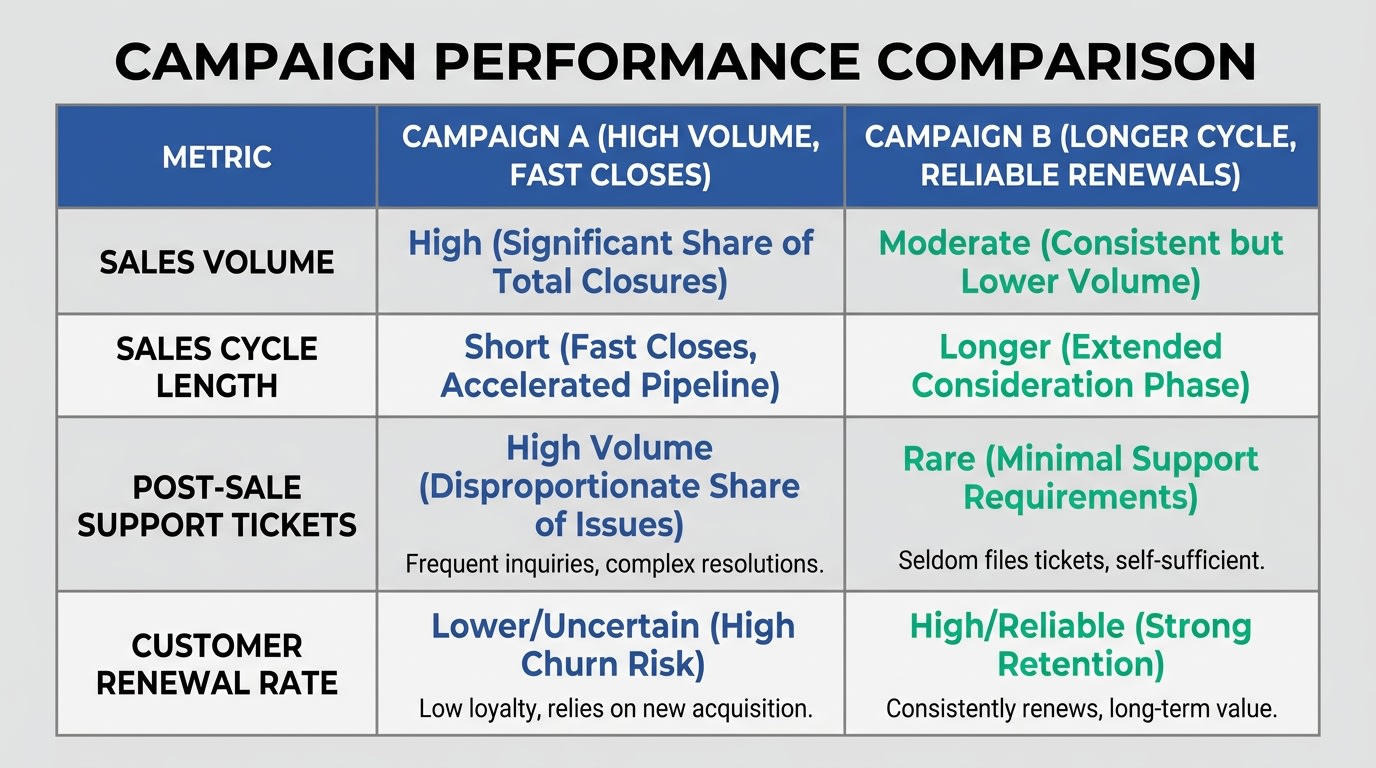
What does that look like in practice? A campaign that produces a high volume of fast closes but a disproportionate share of post-sale support tickets stops looking like a top performer. A campaign with a longer sales cycle but customers who rarely file tickets and renew reliably starts looking like the one worth funding.
That's the kind of finding that changes budget allocation, not just a slide in a QBR deck.
Where this earns credibility with finance
CFOs and CROs generally distrust marketing-reported numbers, and not without reason, because most marketing attribution has historically stopped at the point where marketing's job ends.
A model that includes retention and service outcomes signals something different: that marketing is being measured on the same terms as the rest of the revenue org, on what actually sticks, not just what closes.
Where This Shows Up First in Practice
The clearest early signal that a full-lifecycle model is working is simple: can you trace a specific closed-won deal, and its renewal outcome, back to the first touchpoint that started it, without pulling data from three different tools?
If the answer requires a spreadsheet export and a Slack message to the support team, the lifecycle isn't actually connected yet, regardless of what the CRM's dashboard claims.
A second signal worth checking: does customer satisfaction data ever influence how a campaign or channel gets scored? If CSAT and resolution times live entirely inside a service reporting tool with no connection to the contact's original source, retention insight and acquisition strategy will keep operating as two unrelated functions, no matter how good either one looks in isolation.
Full-lifecycle CRM revenue attribution isn't a reporting upgrade. It's a decision about which data gets to influence budget, and which data gets ignored because nobody built the pipeline for it to travel.
Conclusion
Open your CRM right now. Pull a closed-won deal from three months ago and try to trace it forward: what was its renewal status, its support ticket count, and its resolution time? If that trail breaks anywhere, that break is where the attribution accuracy problem actually lives.
No Comments Yet
Let us know what you think