
Share this
by Keith Gutierrez on Jun 25, 2026
Most marketing leaders try to fix a broken sales follow-up process by buying more software.
They plug an artificial intelligence tool into their CRM, hoping it will automatically nurture leads and revive dead deals. Instead, the AI hallucinates, sending generic demo requests to angry customers who just filed critical support tickets.
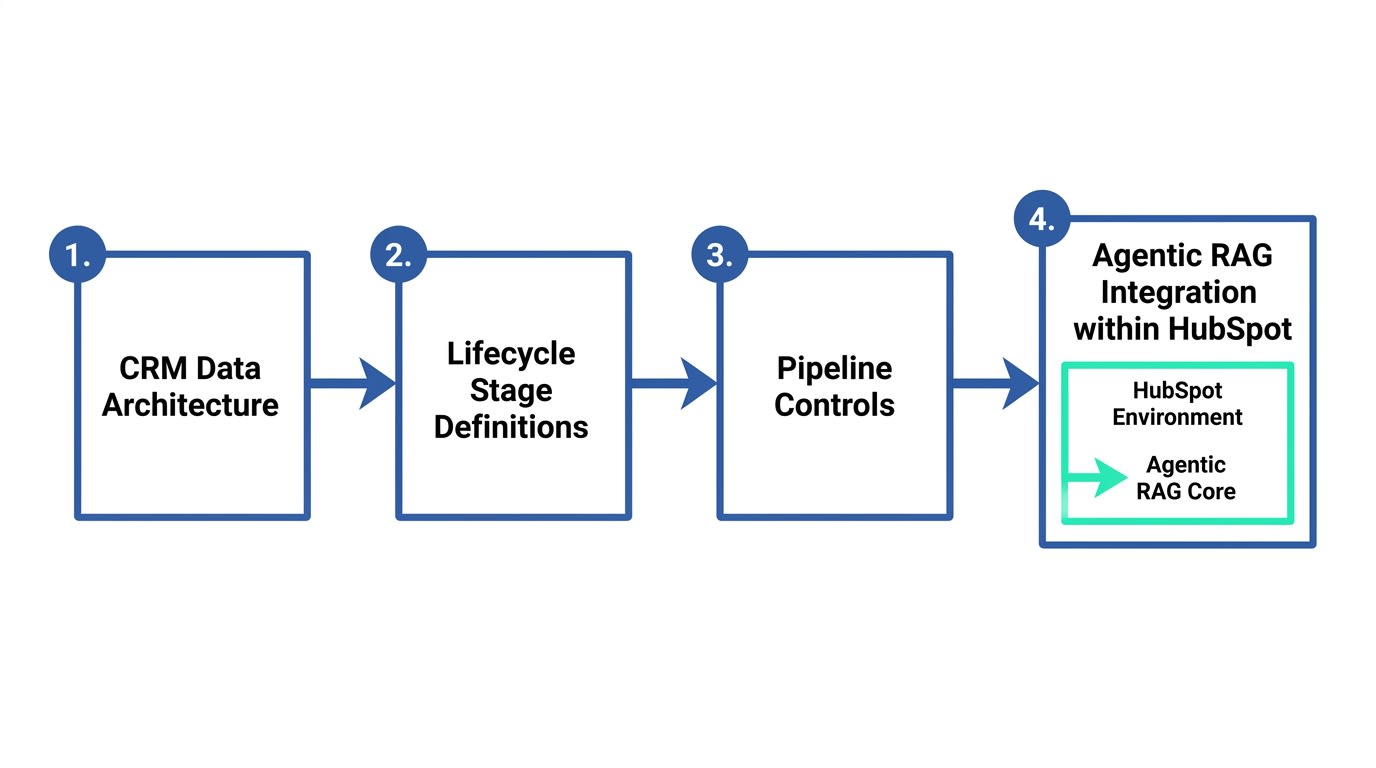
Below, we outline the exact CRM data architecture, lifecycle stage definitions, and pipeline controls required to make Agentic RAG actually function within HubSpot.
Why Large Language Models Fail in Subjective CRMs
A large language model reading a disorganized HubSpot instance will inevitably make catastrophic outbound communication errors.
Agentic Retrieval-Augmented Generation operates by pulling context from your database to formulate highly specific, autonomous actions. It needs context. It needs to know what a prospect cares about, what problems they face, and whether they are ready to buy.
If your sales team relies on subjective opinions and manual data entry, your database is empty. An AI agent cannot interpret a blank contact record. It cannot guess what happened on a discovery call if the representative never logged the outcome.
Here is the thing:
When you connect an Agentic RAG application to a CRM built on passive lifecycle definitions, you are simply automating your organizational dysfunction at scale.
Before an AI agent can execute intelligent sales follow-ups, it requires binary technical triggers. It needs to know exactly when a contact enters a stage and exactly what must happen before they leave it.
Replacing Passive Tracking With the 5-Stage Funnel Model
We replace legacy passive lifecycle definitions with a strict, automated 5-Stage Funnel Model governed by clear technical entry and exit rules.
This strict architecture provides the exact data environment an AI agent needs to operate safely.
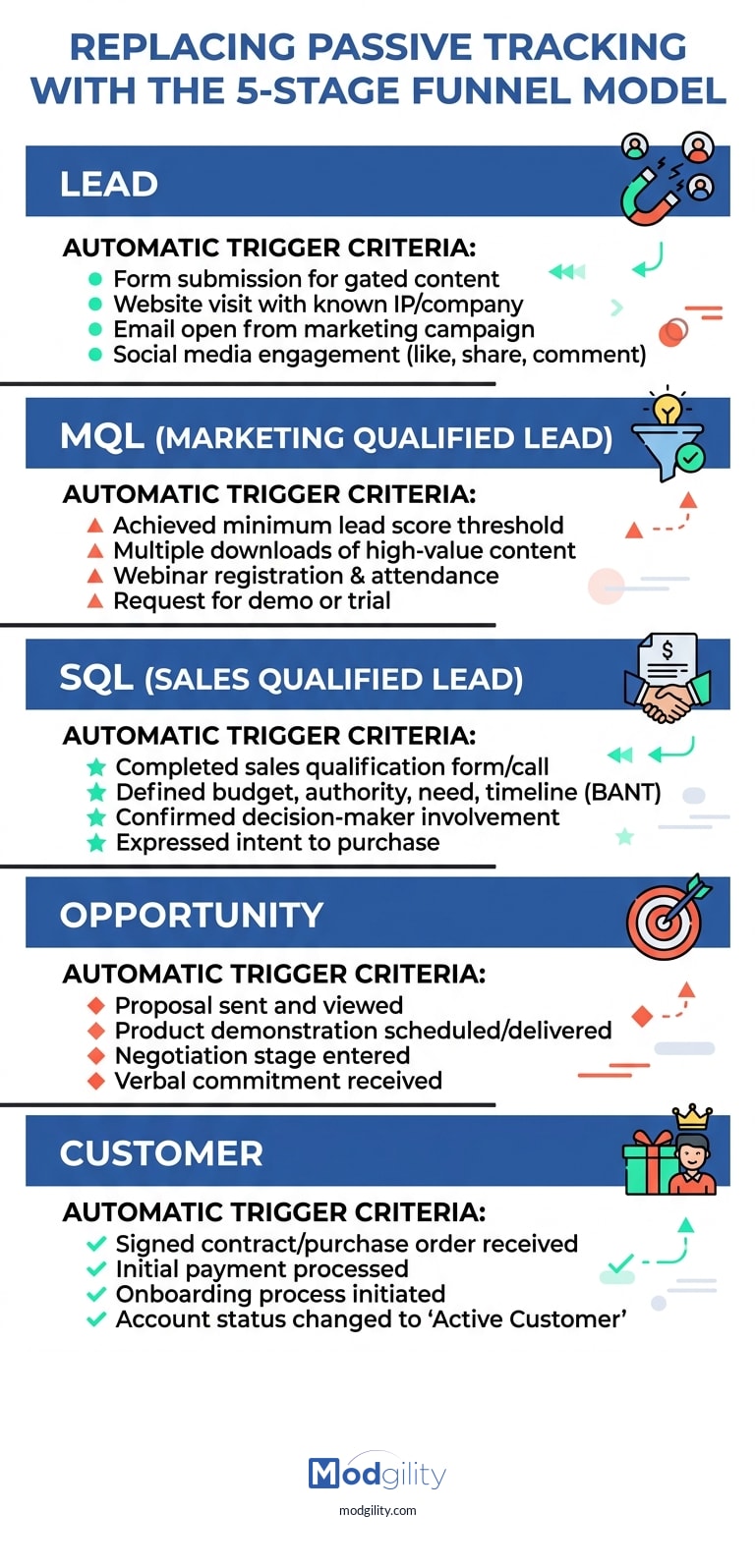
In this model, subjective interpretations are removed completely.
- Lead: Enters automatically via form submission or list import. Event badge scans bypass standard gates and advance directly to SQL.
- MQL: Triggered automatically when a contact crosses a designated lead score threshold AND meets ICP fit rules, which include target organization type and priority role. It also requires intent rules, demanding at least one meaningful engagement like a website visit, webinar attendance, or content download.
- SQL: Triggered only when a business development representative accepts the lead and initiates outreach. This is managed through explicit Lead Status tracking categorized as New, Attempting, or Connected.
- Opportunity: Triggered automatically when Lead Status equals Qualified and an active Deal is created.
- Customer: Triggered automatically when an associated Deal moves to Closed-Won.
This framework is non-negotiable for artificial intelligence.
When an Agentic RAG tool sees an MQL in this system, it knows with absolute certainty that the contact meets the exact firmographic fit and has demonstrated clear intent. The agent can immediately retrieve the specific webinar transcript the contact attended and draft a hyper-relevant follow-up message for the assigned representative.
Automating the Farming Stage With Contextual AI
In our implementations with industrial distributors running 5 to 25 rep sales teams, we consistently find that deals lost to budget constraints are abandoned entirely.
Sales representatives are trained to hunt active buyers. When a prospect states they lack the budget for the current quarter, the representative often marks the deal as Closed Lost and moves on.
This is a massive loss of qualified demand. It is also the exact scenario where Agentic RAG excels.
To capture this revenue, we configure the Farming Stage.
The Farming Stage is dedicated to the strategic nurturing of qualified prospects who are not in an active buying cycle due to budget or leadership changes. It requires a documented 'Hold Reason' property.
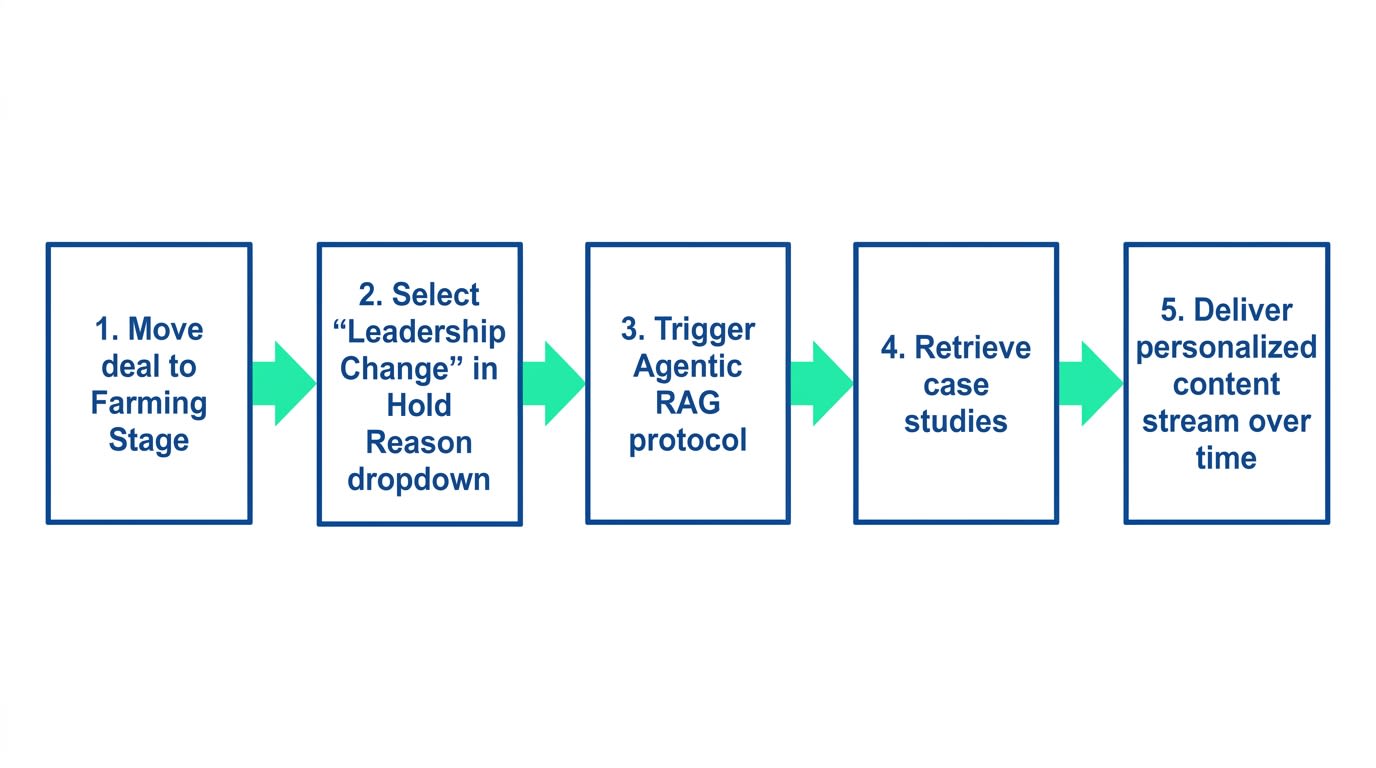
What does that look like in practice?
Instead of relying on a representative to remember to follow up in six months, the system takes over. The representative moves the deal to the Farming Stage and selects "Leadership Change" from the 'Hold Reason' dropdown.
This specific property update triggers the Agentic RAG protocol.
The AI agent retrieves the 'Hold Reason'. It searches your approved content repository for case studies detailing successful implementations during executive transitions. It then constructs a personalized, value-based content stream delivered over several months, keeping the brand relevant without requiring manual sales effort.
The representative maintains complete oversight of this automated nurturing, stepping back in only when the prospect re-engages with the AI-delivered content.
Enforcing High-Velocity Deals in the Qualified Stage
A formal diagnostic phase requires more than a simple calendar invite.
For high-value transactions, you cannot rely on AI to blindly push prospects through the pipeline. You must use AI to equip your human representatives with overwhelming contextual intelligence.
This occurs in the Qualified Stage.
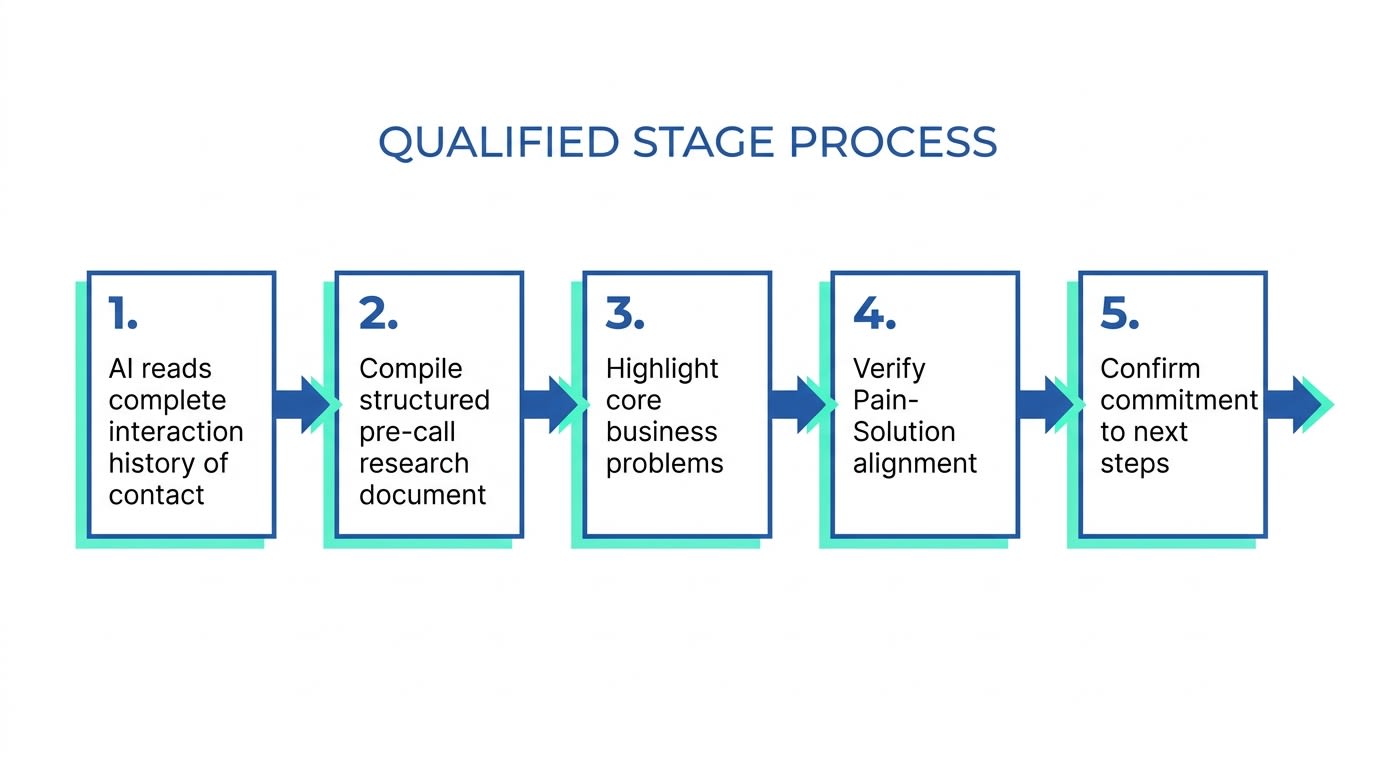
The Qualified Stage is a formal diagnostic phase requiring a scheduled discovery call, pre-call research documentation, and champion identification before advancement.
Crucially, advancement out of this stage requires verified Pain-Solution alignment, meaning the solution must map directly to two or three core business problems. It also requires confirmed commitment to next steps.
Here is how Agentic RAG manages this process.
Before the discovery call, the AI agent reads the complete interaction history of the contact. It reviews every web page visited, every email clicked, and every form submitted. It compiles this data into a structured pre-call research document, highlighting the exact two or three core business problems the prospect is trying to solve.
In our own implementation for Bunting, an industrial magnetics manufacturer, we configured this exact named pipeline methodology.
We built the Farming Stage and the Qualified Stage into a dual-portal HubSpot implementation. By requiring verified Pain-Solution alignment before deal advancement, the sales team gained absolute clarity on pipeline health.
Treating Retention Data as Acquisition Intelligence
A standard HubSpot implementation activates basic software features, leaving marketing, sales, and service departments operating in isolated silos.
Our RevOps engagement dismantles organizational data silos to build a unified, high-velocity revenue engine.
If you want Agentic RAG to execute sales follow-ups intelligently, it must understand the post-sale customer experience. True Revenue Operations requires customer retention data.
This is why we embed HubSpot Service Hub as the foundational core of every RevOps engagement. This model connects the complete customer lifecycle, linking marketing lead capture, sales pipeline velocity, and post-sale service delivery in a single closed loop.
Service metrics such as ticket resolution times and customer satisfaction scores are wired directly back into acquisition pipelines.
But here is where it gets interesting:
Traditional single-hub or two-hub implementations completely ignore this post-sale loop. When you connect an AI agent to a system that ignores service data, the AI operates blindly.
An Agentic RAG tool designed to identify cross-sell opportunities must query Service Hub first. If the AI detects an open, high-priority support ticket associated with an account, it immediately aborts the cross-sell sequence. It suppresses the promotional email and flags the account for human intervention.
By treating retention data as acquisition intelligence, the AI learns which customer segments produce the highest lifetime value based on churn signals and health metrics.
Validating AI Output With Executive Attribution Reporting
When you delegate sales follow-up to artificial intelligence, the Chief Revenue Officer will demand immediate proof that the system is generating revenue, not just busywork.
We configure advanced multi-touch revenue attribution frameworks in HubSpot Professional and Enterprise.
These frameworks track the complete buyer path from the first social, organic search, or email touchpoint to the closed-won deal.
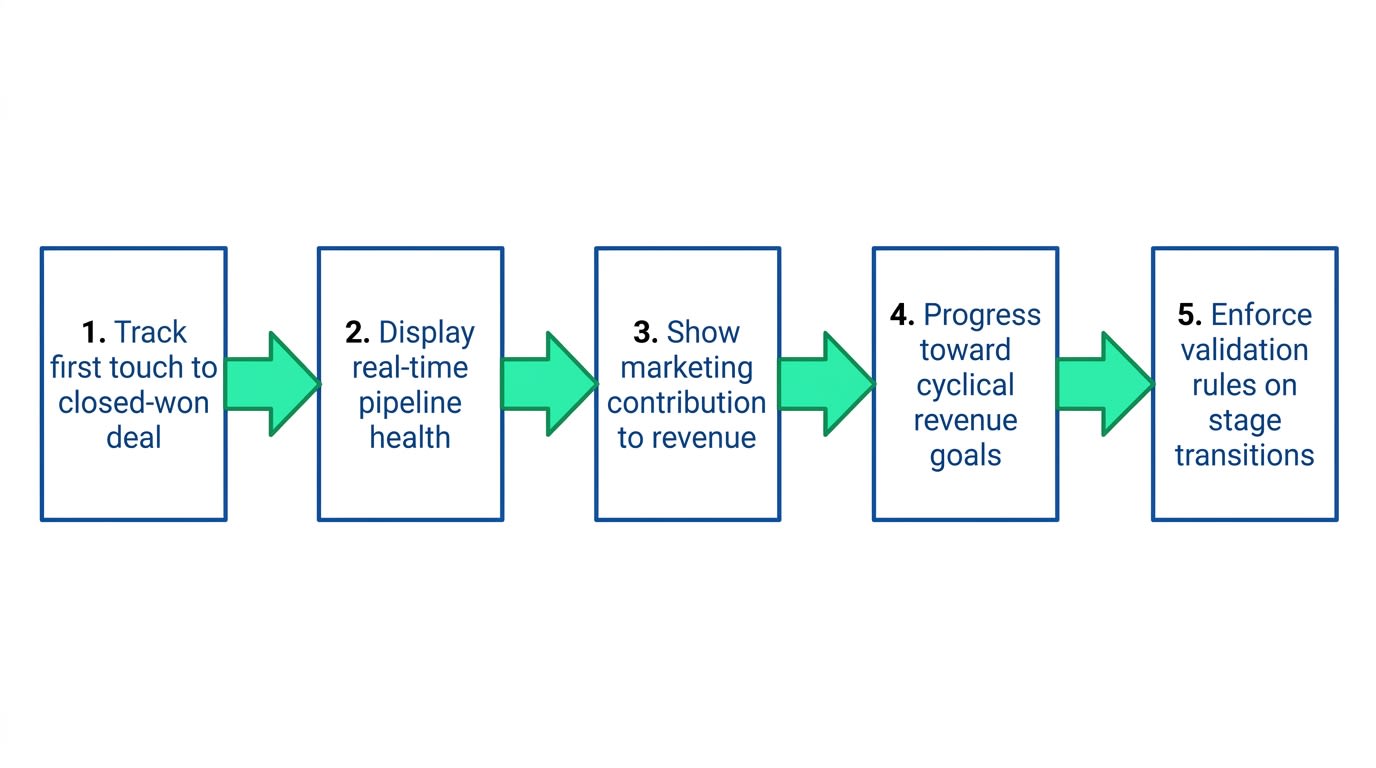
Executive dashboards display real-time pipeline health, marketing contribution to revenue, and progress toward cyclical revenue goals.
Rigorous validation rules at every lifecycle stage transition gate enforce data validity. This setup tracks macro-metrics including Opportunity Status, distinguishing between Open and Won deals, and Customer Status, distinguishing between Active and Churned accounts.
This is not a standard HubSpot dashboard configuration.
It requires enforcing data governance upstream before the attribution data is reliable enough for a financial leader to trust for resource allocation decisions.
When the database is organized and governed, the results multiply rapidly.
For a local-government software company, we raised top landing page conversion rates from 1.42% to 12.41% with over 500 lead submissions, through HubSpot CMS migration and A/B testing of high-impact landing pages.
The client evaluated the impact of this structured approach explicitly.
"They're the machine that makes our HubSpot go. You're not likely to find someone at this price with their level of expertise."
Mark Friesen, Marketing Director, Local-Government Software Company
This outcome was achieved on a retainer averaging $4,000 per month.
Now:
Imagine feeding that volume of qualified demand into an Agentic RAG system that instantly drafts highly contextual follow-ups for every single submission.
Funding the Long-Term Artificial Intelligence Strategy
Building the technical foundation for Agentic RAG is not a one-time project. It requires continuous feeding of high-quality content and ongoing system optimization.
Post-implementation, the transition to ongoing maintenance follows a natural progression. The implementation establishes the data infrastructure, and an ongoing retainer runs advanced programs on top of it.
We offer structured Inbound Marketing and RevOps Retainers in two distinct tiers to support this continuous operation.
Content Marketing Retainers range from $5,000 to $10,000 per month. This tier provides continuous content production and campaign optimization. For Agentic RAG, this is critical. The AI needs fresh, relevant case studies, whitepapers, and industry insights in its database to retrieve and send to prospects in the Farming Stage.
The Full Inbound plus Advanced Revenue Analytics Advisory tier ranges from $10,000 to $20,000 per month. This tier provides comprehensive demand generation, attribution modeling, and high-level RevOps strategy.
These retainers are designed to continuously optimize the HubSpot environment and scale acquired revenue long after the initial implementation investment.
Clients in the retainer track maintain the exact same dedicated team that built their initial system.
The bottom line?
You cannot buy an AI tool to bypass the hard work of organizing your customer data.
Agentic RAG is a multiplier. If your HubSpot instance is filled with subjective data, missing stage requirements, and broken handoffs, AI will simply multiply the chaos.
If you build a rigid 5-Stage Funnel Model, enforce strict transition gates, and connect your post-sale service data to your acquisition pipeline, AI will multiply your revenue velocity.
Audit Your HubSpot Portal Right Now
Open your HubSpot portal and navigate to Sales > Deals.
Filter your view to show deals marked as "Closed Lost" in the past ninety days. Click into the three most recent records. If your sales representatives moved those deals to Closed Lost without selecting a specific, documented 'Hold Reason' property, your CRM is not ready for Agentic RAG.
Fix your data governance first, then you can safely automate your follow-up.
No Comments Yet
Let us know what you think