
Share this
by Keith Gutierrez on Mar 10, 2026

Implementing HubSpot RevOps in MedTech manufacturing justifies its cost by transforming disconnected operations into a unified, data-driven revenue engine. The benefits—accelerated sales cycles, enhanced regulatory compliance, and deeper market insights—deliver a clear and significant return on investment, far outweighing the initial software and implementation costs.
What You'll Learn
This analysis breaks down the essential financial and operational considerations for MedTech manufacturers evaluating a Revenue Operations (RevOps) strategy. Here’s a summary of what we’ll cover:
- The Core Financial Benefits: A look at how RevOps directly impacts your bottom line by increasing efficiency and accelerating revenue.
- Solving MedTech's Unique Challenges: How a unified platform like HubSpot addresses complex sales cycles, regulatory hurdles, and stakeholder management.
- A Transparent Breakdown of Costs: An overview of the primary investments required, including software, implementation, and internal resources.
- The Verdict: A clear conclusion on why the strategic benefits create a compelling case for investment.
The Core Challenge: Misalignment in a High-Stakes Industry
MedTech manufacturing operates in a uniquely complex environment. You face long, multi-stakeholder sales cycles involving clinicians, hospital administrators, and procurement departments. On top of that, stringent regulatory requirements (like FDA and ISO standards) demand meticulous data tracking for every customer interaction.
When marketing, sales, and customer service teams operate in silos, the results are predictable and costly:
- Revenue Friction: Clunky handoffs between marketing-qualified leads (MQLs) and the sales team.
- Wasted Resources: Marketing campaigns based on assumptions rather than real-time buyer data.
- Compliance Risks: Fragmented data trails that are difficult to audit.
- Unpredictable Revenue: Inaccurate forecasting due to a lack of visibility across the entire customer lifecycle.
A RevOps framework, powered by a central platform, is designed to solve precisely these issues.
Analyzing the Benefits: How HubSpot RevOps Drives ROI
Implementing a RevOps strategy on HubSpot provides tangible financial and operational returns. By unifying teams, data, and processes on a single platform, MedTech manufacturers can unlock significant value.
Benefit 1: Accelerating Complex and Lengthy Sales Cycles

The journey from initial contact to a signed contract in MedTech can take months, if not years. HubSpot RevOps shortens this timeline by giving your sales team the right tools and insights at the right time.
- How HubSpot RevOps Helps: By creating a unified view of every prospect interaction—from marketing email opens to service ticket history—sales can engage in more relevant, timely conversations. An expert implementation partner, like Modgility, can build custom pipeline configurations and sales enablement tools directly within HubSpot, ensuring your sales process perfectly mirrors your buyers' complex decision-making journey.
Benefit 2: Enhancing Regulatory Compliance and Data Integrity

In a regulated industry, data isn't just for marketing—it's a critical component of compliance. A disconnected tech stack creates data silos, increasing the risk of non-compliance and making audits a nightmare.
- How HubSpot RevOps Helps: HubSpot CRM acts as the single source of truth for all customer data. Every communication, from marketing consent to post-sale support, is logged in one place. This centralized data hub streamlines auditing and minimizes the risk of costly compliance errors.
Benefit 3: Data-Driven Product Development and Marketing

Understanding what surgeons, lab technicians, or hospital executives truly need is the key to innovation and effective marketing. Traditionally, this insight comes from slow, expensive market research.
- How HubSpot RevOps Helps: RevOps turns your commercial teams into a real-time intelligence-gathering engine. A standout advantage comes from integrating advanced AI tools. For instance, Modgility’s PersonaInsights AI platform works alongside HubSpot to provide instant, data-rich insights from simulated buyer personas. Instead of guessing, your marketing and R&D teams can uncover motivations, objections, and decision criteria in minutes, leading to better products and campaigns with higher ROI.
Benefit 4: Streamlining Lead Nurturing and Automation
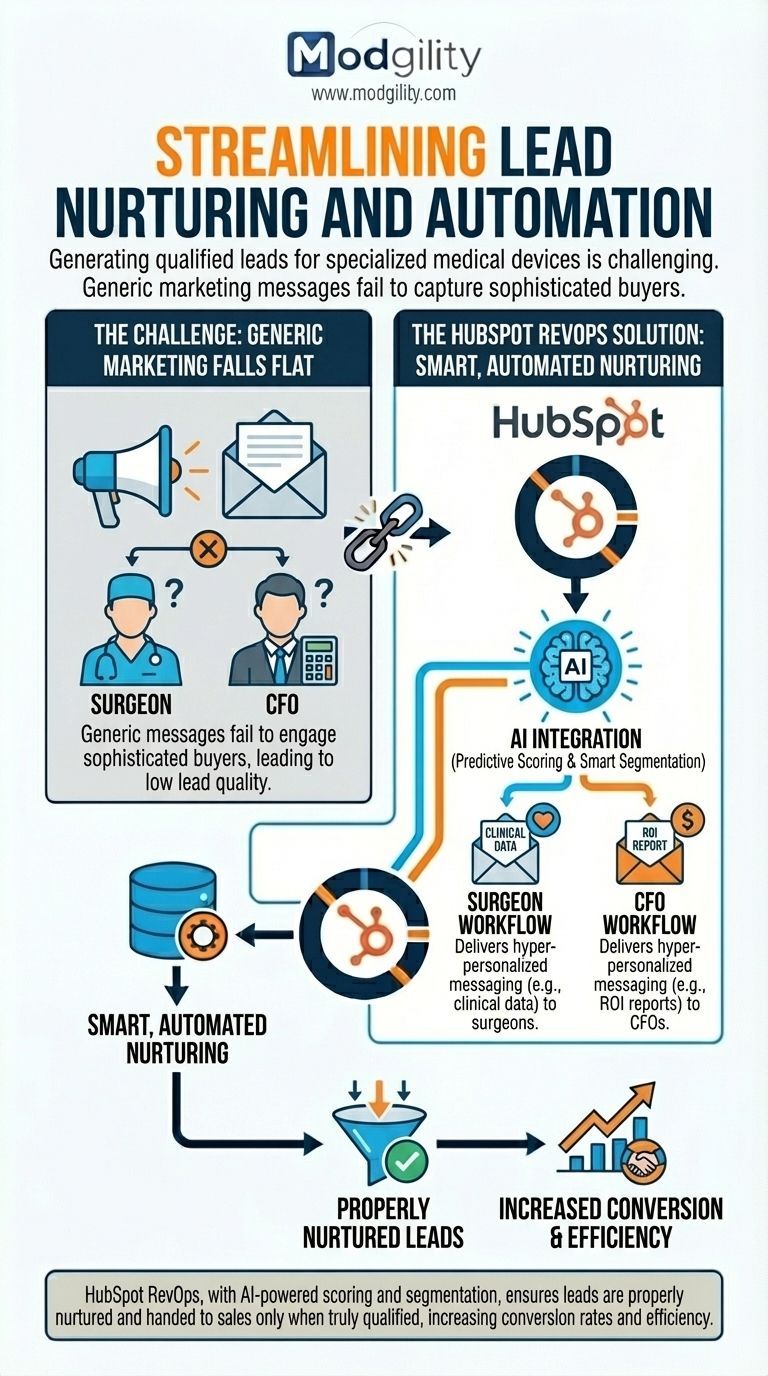
Generating qualified leads for highly specialized medical devices is challenging. Generic marketing messages fail to capture the attention of sophisticated buyers.
- How HubSpot RevOps Helps: With all data in one place, you can build powerful marketing and lead nurturing automation workflows. By leveraging AI integration for predictive lead scoring and smart segmentation, HubSpot can deliver hyper-personalized messaging to different members of the buying committee. This ensures that leads are properly nurtured and only handed to sales when they are truly qualified, increasing conversion rates and making your sales team more efficient.
Understanding the Costs: A Transparent Breakdown
A thorough cost-benefit analysis requires an honest look at the investment. The costs of implementing HubSpot RevOps can be categorized into three main areas:
- Software Licensing: This includes the subscription fees for the necessary HubSpot Hubs (Marketing, Sales, Service). The cost scales based on the size of your database and the features you require.
- Implementation and Strategy: This is the cost of partnering with a RevOps specialist, such as a HubSpot Platinum Partner like Modgility. This investment covers the strategic planning, technical setup, data migration, custom workflow builds, and team training required to ensure the platform is tailored to your specific MedTech needs. While it's a significant cost, it's what guarantees the ROI on your software investment.
- Internal Resources: This is the time your team will invest in training, adoption, and managing the new processes. An agile implementation approach with a constant feedback loop, a hallmark of experienced partners, can significantly reduce this internal burden.
The Verdict: Is HubSpot RevOps Worth It for MedTech Manufacturers?
Yes. For a MedTech manufacturing company, the cost of not adopting a unified RevOps strategy is far greater than the investment. The inefficiencies of siloed departments, the risk of non-compliance, and the opportunity cost of missed market insights lead to stagnant growth and competitive disadvantage.
While there is an upfront cost, implementing HubSpot RevOps is an investment in a scalable, predictable, and intelligent revenue engine. It moves your organization from a "guess-and-test" model to a data-driven operation, providing the clarity, coordination, and competitive advantage needed to thrive in the demanding MedTech landscape.
Frequently Asked Questions
Why is a RevOps strategy important for MedTech manufacturers?
MedTech manufacturers face unique challenges like long sales cycles, multi-stakeholder approvals, and strict regulatory requirements. A RevOps strategy is important because it unifies siloed marketing, sales, and service teams to solve critical issues like revenue friction, compliance risks, and unpredictable forecasting that arise from disconnected operations.
How does HubSpot RevOps help with regulatory compliance in the MedTech industry?
HubSpot RevOps enhances regulatory compliance by acting as a single source of truth for all customer data. Every communication, from marketing consent to post-sale support, is logged in one centralized platform. This simplifies auditing processes for standards like FDA and ISO and minimizes the risk of costly compliance errors.
What are the main financial benefits of implementing HubSpot RevOps?
The primary financial benefits are driven by increased efficiency and alignment. HubSpot RevOps helps accelerate complex sales cycles, leading to faster revenue generation. It also enables data-driven marketing and lead nurturing, which improves conversion rates and the overall return on investment of commercial activities.
What are the typical costs involved in implementing a HubSpot RevOps solution?
The costs for implementing HubSpot RevOps fall into three main categories: 1) Software licensing fees for the necessary HubSpot Hubs. 2) Implementation and strategy costs for partnering with a specialist who handles technical setup, data migration, and training. 3) Internal resources, which is the time your team invests in adopting the new platform and processes.
No Comments Yet
Let us know what you think