
Share this
by Keith Gutierrez on Mar 26, 2026
Integrating HubSpot Marketing Hub with legacy ERPs and CRMs in industrial distribution presents challenges like data silos, API limitations, and mismatched data structures. However, these are overcome with a strategic, phased implementation partner who manages data mapping, migration, and custom API connections.
What You'll Learn
This article breaks down the primary integration challenges for industrial distributors and provides a clear, strategic path forward. Here’s a summary of what we'll cover:
- The Core Conflict: Why modern marketing platforms like HubSpot naturally conflict with older, legacy systems.
- Unique Hurdles: Specific integration challenges common in the industrial distribution sector, from custom ERPs to homegrown databases.
- The Solution: A step-by-step guide to a successful integration using a structured HubSpot Marketing Hub Implementation service.
- The Payoff: The tangible benefits of bridging the gap between your old and new systems, creating a unified data ecosystem.
The Core Challenge: Why Legacy Systems Clash with Modern MarTech
At their core, modern marketing platforms like HubSpot are built for agility, open communication via APIs, and real-time data flow. Legacy systems, particularly those in established sectors like industrial distribution, were often designed for stability, internal record-keeping, and operational consistency.
This fundamental difference in design philosophy creates several friction points:
- Data Silos: Information in your ERP, CRM, or inventory management system is often locked away, inaccessible to your marketing team.
- Limited APIs: Many older systems lack the robust Application Programming Interfaces (APIs) needed for seamless, two-way data exchange.
- Data Incompatibility: Data formats, field names, and structures rarely match between a decades-old database and a modern platform like HubSpot.
For a technical decision-maker, these aren't minor issues. They represent real risks of data corruption, system downtime, and a failed software investment.
Specific HubSpot Integration Hurdles for Industrial Distributors
Industrial distributors face a unique set of challenges because their business operations rely heavily on specific, often customized, legacy systems.
- Custom ERPs and Databases: Your business may run on a heavily modified ERP or even a completely homegrown system for managing inventory, pricing, and customer order history. These systems rarely have off-the-shelf connectors.
- Product Information Management (PIM): Distributors with vast and complex product catalogs often use specialized PIM systems that must sync with marketing channels to ensure data accuracy.
- Lack of Internal API Expertise: Your internal IT team are experts at keeping your core operational systems running. They are not, however, dedicated HubSpot API specialists. This skills gap can stall an integration project indefinitely.
The Strategic Solution: A Phased HubSpot Marketing Hub Implementation
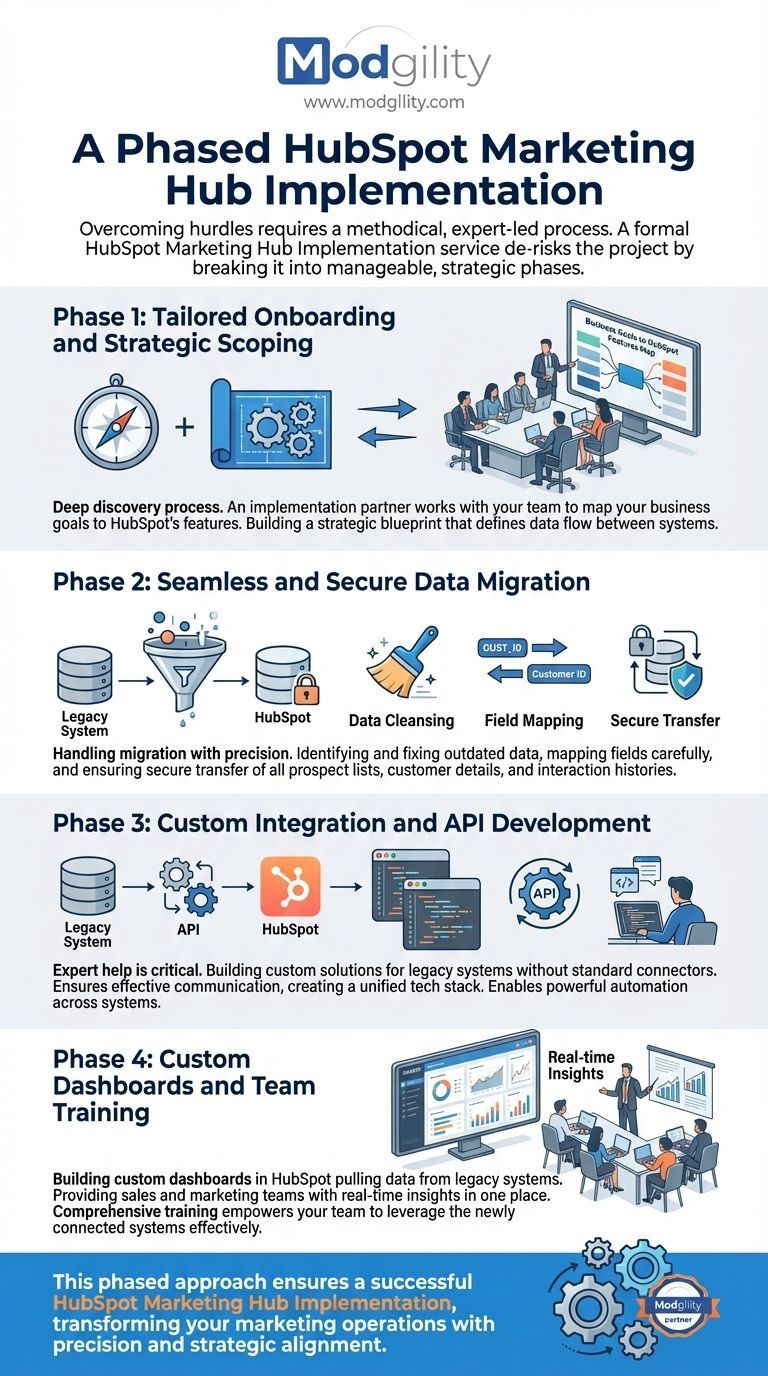
Overcoming these hurdles isn't about finding a magic "connect" button. It requires a methodical, expert-led process. A formal HubSpot Marketing Hub Implementation service de-risks the entire project by breaking it down into manageable, strategic phases.
Phase 1: Tailored Onboarding and Strategic Scoping
Before any data is moved, the first step is a deep discovery process. An implementation partner works with your team to map your business goals to HubSpot's features. This isn't just a technical setup; it's about building a strategic blueprint that defines exactly which data needs to flow between which systems and why.
Phase 2: Seamless and Secure Data Migration
The thought of migrating decades of customer data is daunting. A key function of a HubSpot Marketing Hub Implementation is to handle this with precision. This involves:
- Data Cleansing: Identifying and fixing outdated or inconsistent data in your legacy system before it's moved.
- Field Mapping: Carefully mapping data fields from your old system (e.g.,
CUST_ID) to their new homes in HubSpot (e.g.,Customer ID). - Secure Transfer: Ensuring all prospect lists, customer details, and interaction histories are transferred securely and accurately.
Phase 3: Custom Integration and API Development
This is the most technical phase and where expert help is critical. For legacy systems without standard connectors, an implementation partner builds custom solutions. This service ensures that your HubSpot Marketing Hub Implementation can communicate effectively with your other critical business systems, creating a unified tech stack. This allows for powerful automation, like enrolling a customer in a follow-up sequence in HubSpot the moment their order is processed in your ERP.
Phase 4: Custom Dashboards and Team Training
Technology is only useful if your team uses it. A comprehensive implementation includes building custom dashboards in HubSpot that pull in data from your legacy systems. This gives your sales and marketing teams real-time insights in one place. Paired with comprehensive training, this phase empowers your team to leverage the newly connected systems effectively from day one.
The Payoff: Benefits of a Properly Integrated HubSpot Hub
When done correctly, integrating HubSpot with your legacy systems transforms your business operations. A successful HubSpot Marketing Hub Implementation delivers clear, measurable results.
- A 360-Degree Customer View: Your marketing team can see a customer's entire purchase history from the ERP right alongside their website activity and email engagement in HubSpot. This enables hyper-relevant personalization.
- Streamlined Sales and Marketing Automation: Sales reps are automatically notified in HubSpot when a key account visits the pricing page. Customers who haven't ordered in six months can be automatically added to a re-engagement campaign.
- Data-Driven Decision Making: With sales, marketing, and operational data in one place, you can generate reports that provide a holistic view of business performance, leading to smarter, more profitable decisions.
In conclusion, while the challenges of integrating HubSpot with legacy systems are real, they are far from insurmountable. By engaging a partner for a structured HubSpot Marketing Hub Implementation, industrial distributors can bridge the technology gap, unlock the value hidden in their data, and build a powerful engine for growth.
Frequently Asked Questions
Why is it difficult to integrate a modern platform like HubSpot with older legacy systems?
The difficulty stems from a fundamental difference in design. Modern platforms like HubSpot are built for agility and open communication via APIs, while legacy systems were often designed for internal stability and record-keeping. This creates friction points like data silos, limited or non-existent APIs, and incompatible data structures between the systems.
What specific integration challenges do industrial distributors face?
Industrial distributors often face unique challenges due to their reliance on heavily customized or homegrown ERPs and databases that lack standard connectors. They may also use specialized Product Information Management (PIM) systems that need to be synced, and their internal IT teams may lack the specific expertise required for HubSpot API development.
What is the recommended solution for integrating HubSpot with a legacy system?
The recommended solution is a strategic, phased HubSpot Marketing Hub Implementation service led by an expert partner. This methodical process de-risks the project by breaking it down into manageable phases, including strategic scoping, secure data migration, custom API development, and team training.
What are the key benefits of successfully integrating HubSpot with legacy systems?
A successful integration delivers a 360-degree customer view by combining purchase history with marketing activity, enables streamlined sales and marketing automation, and facilitates better data-driven decision-making by creating holistic reports from a unified data source.
No Comments Yet
Let us know what you think