
Share this
by Keith Gutierrez on Mar 3, 2026
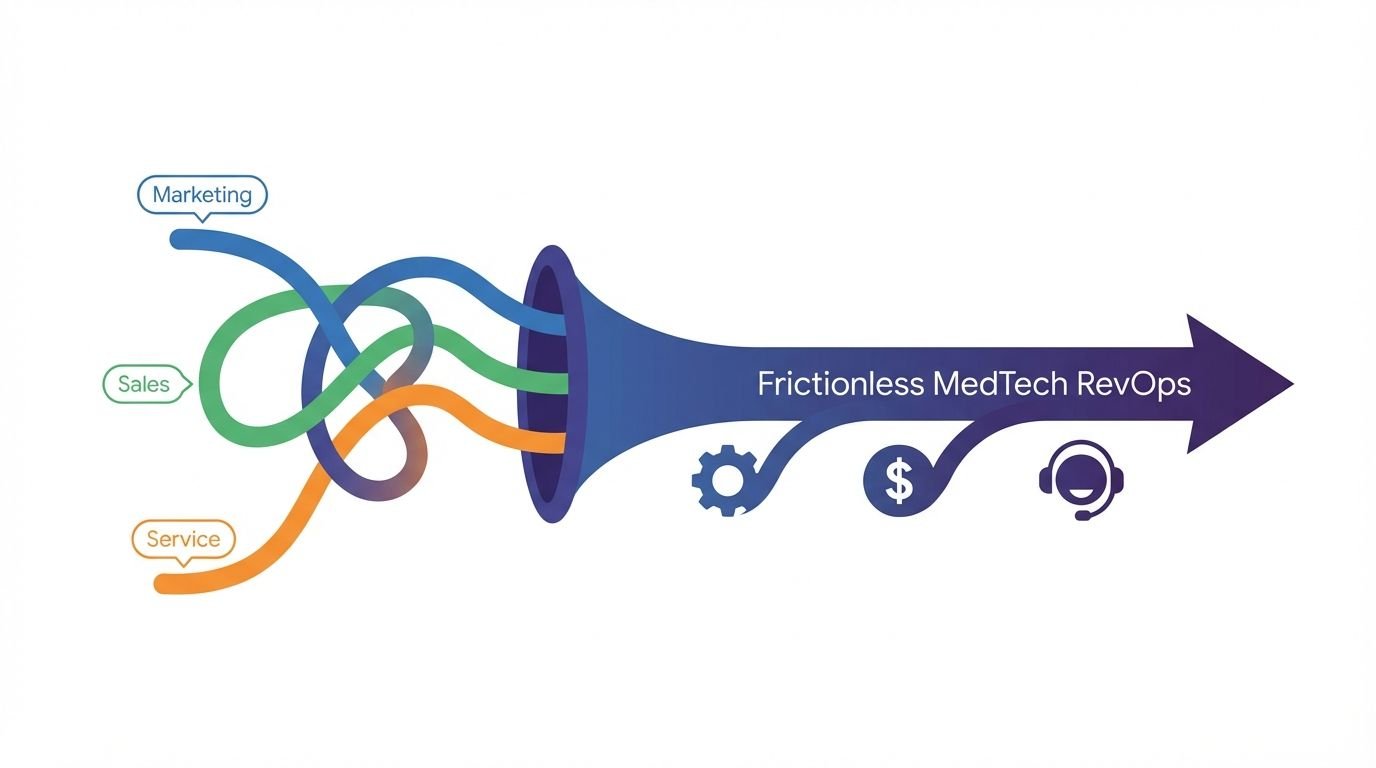
Migrating your MedTech CRM to HubSpot RevOps requires a phased approach. Focus on a meticulous data migration plan, stakeholder alignment across all revenue teams, and configuring custom pipelines that reflect the unique, multi-stage MedTech sales cycle. Prioritize regulatory compliance and system integration from day one.
What You'll Learn
This guide provides a comprehensive framework for MedTech companies planning a CRM migration to a HubSpot-powered RevOps model. Here’s a summary of the best practices we’ll cover:
- The Strategic Advantage: Why a HubSpot RevOps model is uniquely suited for the complexities of the MedTech industry.
- A 3-Phase Migration Framework: A step-by-step guide covering strategic planning, technical execution, and post-launch optimization.
- Key Best Practices: Actionable tips for data cleansing, pipeline configuration, workflow automation, and team enablement.
- Leveraging AI: How to integrate AI tools to accelerate your migration and enhance your new RevOps strategy.
Why HubSpot RevOps is a Game-Changer for MedTech
The MedTech industry operates with unique challenges: long and complex sales cycles, multi-person buying committees (clinicians, hospital administrators, procurement), and strict regulatory and compliance demands. A traditional, siloed CRM often fails to provide the necessary visibility across marketing, sales, and customer service.
This is where a Revenue Operations (RevOps) framework, built on a powerful platform like HubSpot, creates a significant competitive advantage. RevOps aligns all revenue-generating departments under a single strategy, unified data set, and shared goals.
By migrating to HubSpot RevOps, MedTech companies can:
- Create a Single Source of Truth: Eliminate data silos and give every team—from marketing to sales to service—a complete view of the customer lifecycle.
- Map Complex Buyer Journeys: Accurately track interactions with every stakeholder involved in a purchasing decision.
- Automate for Efficiency: Streamline lead nurturing, sales handoffs, and customer onboarding to shorten sales cycles and reduce friction.
- Ensure Predictable Revenue: Move from a "guess-and-test" model to a data-driven operation with clear, actionable insights and reporting.
The 3-Phase Framework for a Successful MedTech CRM Migration
A successful migration isn’t just about moving data; it’s about transforming your operations. Follow this agile, three-phase framework for a seamless transition.
Phase 1: Strategic Planning & Alignment
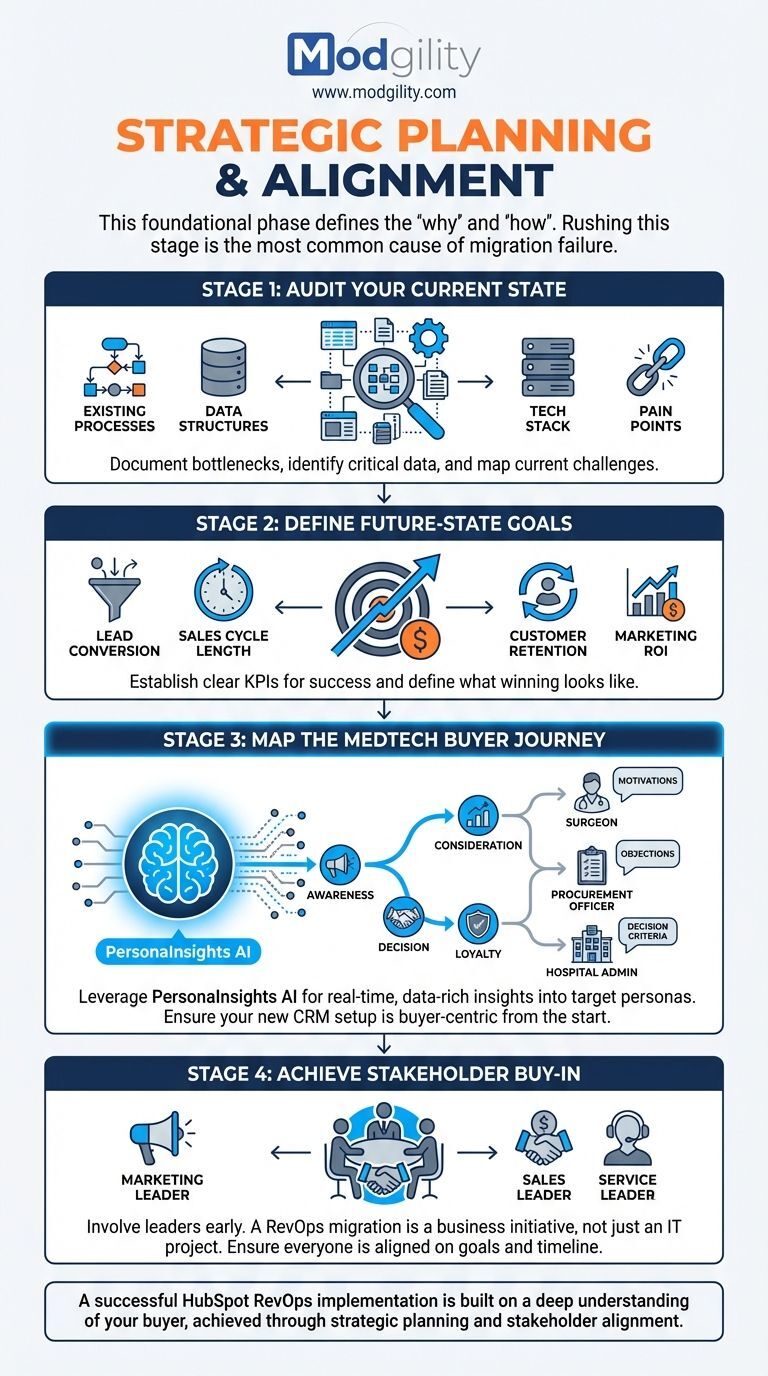
This foundational phase is about defining the "why" and "how" before any technical work begins. Rushing this stage is the most common cause of migration failure.
- Audit Your Current State: Document your existing processes, data structures, tech stack, and pain points. Where are the bottlenecks? What data is critical?
- Define Future-State Goals: What does success look like? Establish clear KPIs for lead conversion, sales cycle length, customer retention, and marketing ROI.
- Map the MedTech Buyer Journey: A successful HubSpot RevOps implementation is built on a deep understanding of your buyer. Instead of using static templates, leverage advanced tools like PersonaInsights AI to generate real-time, data-rich insights into the motivations, objections, and decision criteria of your target personas. This ensures your new CRM setup is buyer-centric from the start.
- Achieve Stakeholder Buy-In: Involve leaders from marketing, sales, and service early. A RevOps migration is a business initiative, not just an IT project. Ensure everyone is aligned on the goals and timeline.
Phase 2: Technical Migration & Configuration
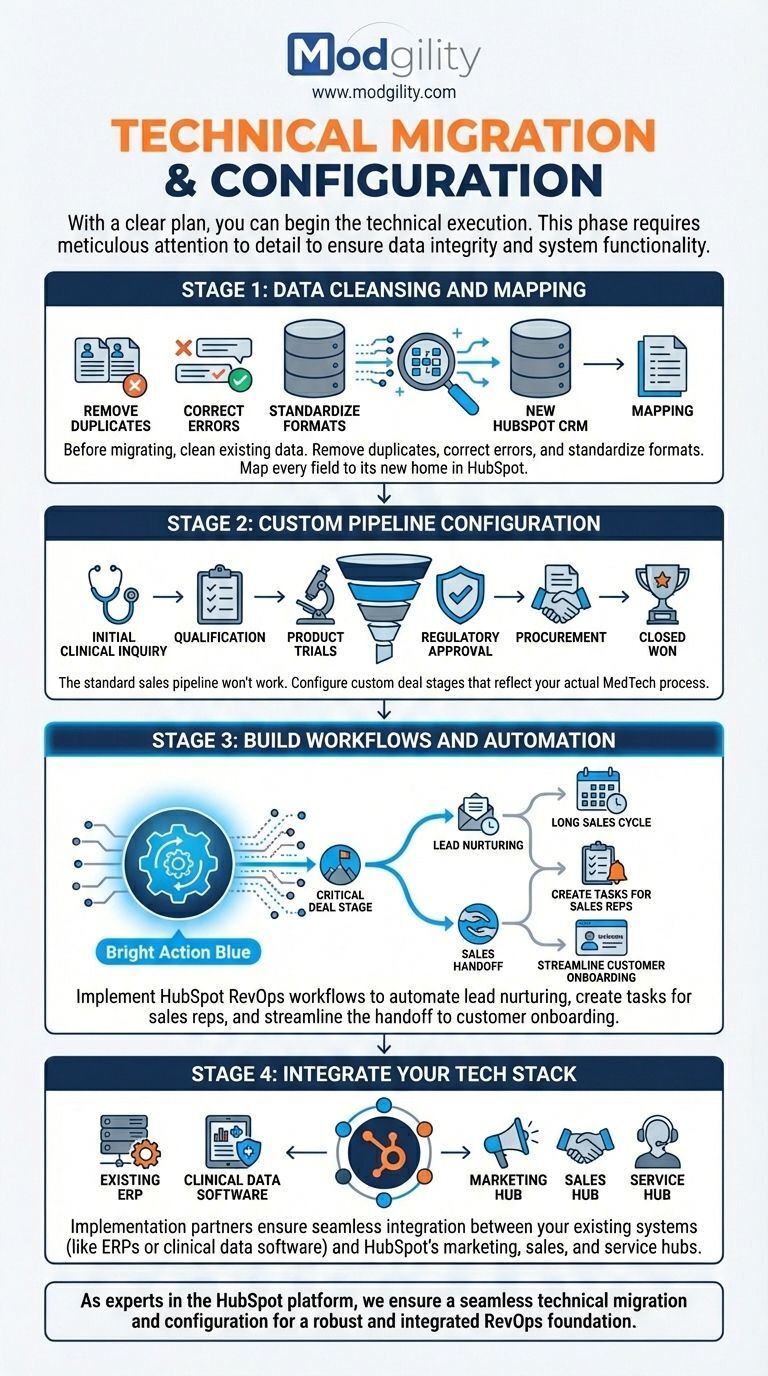
With a clear plan, you can begin the technical execution. This phase requires meticulous attention to detail to ensure data integrity and system functionality.
- Data Cleansing and Mapping: Before migrating, clean your existing data. Remove duplicates, correct errors, and standardize formats. Map every field from your old CRM to its new home in HubSpot.
- Custom Pipeline Configuration: The standard sales pipeline won't work for MedTech. A specialized HubSpot RevOps service can configure custom deal stages that reflect your actual process—from initial clinical inquiry and product trials to regulatory approval and procurement.
- Build Workflows and Automation: This is where efficiency gains are realized. Implement HubSpot RevOps workflows to automate lead nurturing for long sales cycles, create tasks for sales reps at critical deal stages, and streamline the handoff from sales to customer onboarding.
- Integrate Your Tech Stack: As experts in the HubSpot platform, implementation partners ensure seamless integration between your existing systems (like ERPs or clinical data software) and HubSpot’s marketing, sales, and service hubs.
Phase 3: Adoption, Optimization & Enablement
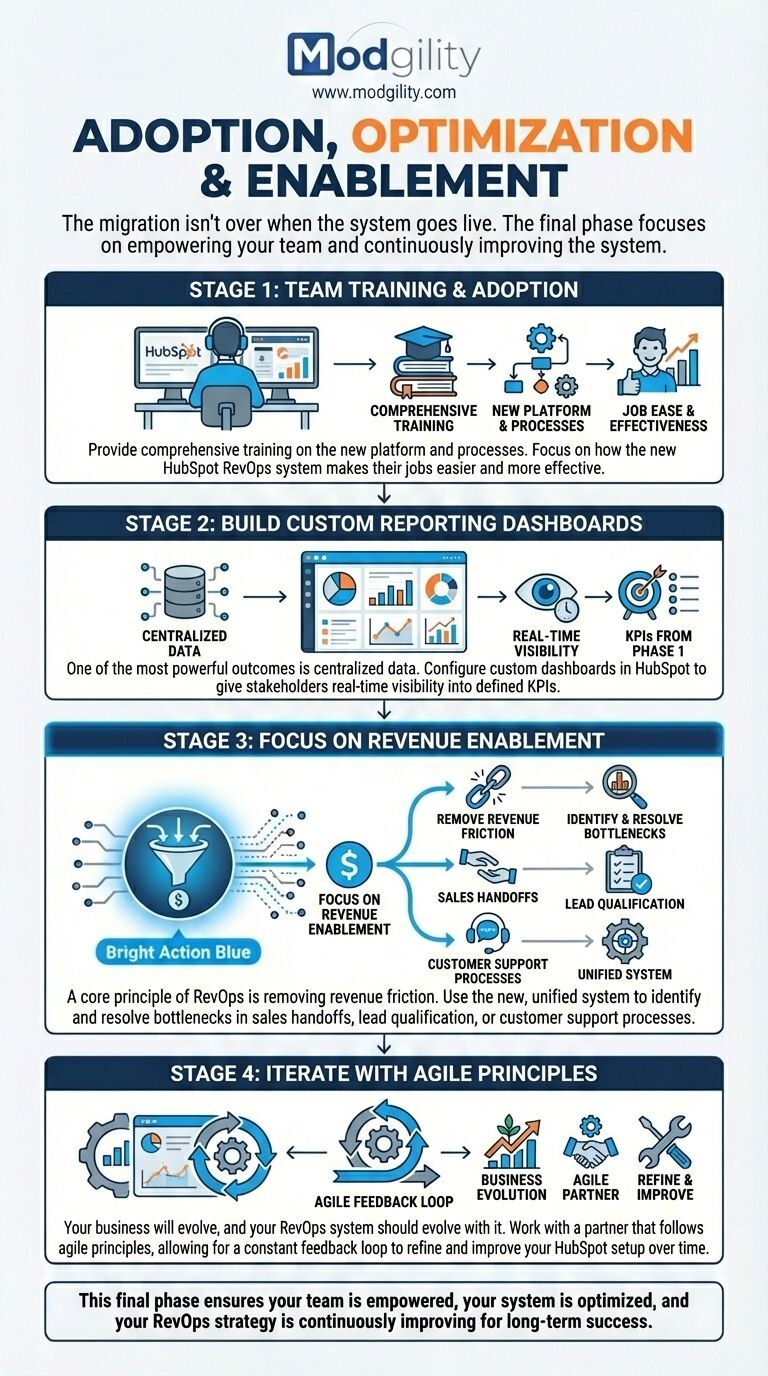
The migration isn't over when the system goes live. The final phase focuses on empowering your team and continuously improving the system.
- Team Training & Adoption: Provide comprehensive training on the new platform and processes. Focus on how the new HubSpot RevOps system makes their jobs easier and more effective.
- Build Custom Reporting Dashboards: One of the most powerful outcomes of this migration is centralized data. Configure custom dashboards in HubSpot to give stakeholders real-time visibility into the KPIs defined in Phase 1.
- Focus on Revenue Enablement: A core principle of RevOps is removing revenue friction. Use the new, unified system to identify and resolve bottlenecks in your sales handoffs, lead qualification, or customer support processes.
- Iterate with Agile Principles: Your business will evolve, and your RevOps system should evolve with it. Work with a partner that follows agile principles, allowing for a constant feedback loop to refine and improve your HubSpot setup over time.
Leveraging AI to Accelerate Your HubSpot RevOps Success
A modern RevOps strategy integrates AI to build a smarter, more efficient operation. When migrating, consider how AI can enhance your new system from day one.
- Smarter Strategy with PersonaInsights AI: As mentioned, this proprietary tool helps you build your entire RevOps strategy on a foundation of deep buyer understanding, uncovering insights in minutes that used to take weeks of research.
- Enhanced Customer Engagement: By integrating AI tools like ChatGPT or Google Gemini into your HubSpot RevOps instance, you can power advanced chatbots for instant support, enable hyper-personalized messaging at scale, and even assist with predictive lead scoring.
From Fragmented to Frictionless: Your Path Forward
Migrating your MedTech company’s CRM to HubSpot RevOps is a transformative step toward scalable, predictable growth. By following a structured, three-phase approach focused on strategic alignment, meticulous technical execution, and continuous optimization, you can replace fragmented systems with a frictionless revenue engine.
This process ensures your teams are aligned, your data is actionable, and your business is perfectly positioned to meet the unique demands of the MedTech market.
Frequently Asked Questions
Why is HubSpot RevOps a good choice for MedTech companies?
HubSpot RevOps is uniquely suited for MedTech because it addresses challenges like long sales cycles and complex buying committees. It creates a single source of truth by eliminating data silos, allows for accurate mapping of the entire buyer journey, automates processes to improve efficiency, and provides data-driven insights for predictable revenue.
What are the main phases of a MedTech CRM migration to HubSpot?
A successful migration follows a three-phase framework: 1. Strategic Planning & Alignment, which involves auditing current systems and defining goals. 2. Technical Migration & Configuration, which includes data cleansing, building custom pipelines, and automation. 3. Adoption, Optimization & Enablement, which focuses on team training, reporting, and continuous improvement.
What are some key technical steps during the migration process?
Key technical steps in the migration phase include data cleansing and mapping to ensure data integrity, configuring custom pipelines that reflect the multi-stage MedTech sales cycle, building workflows to automate tasks like lead nurturing, and integrating the tech stack to connect HubSpot with other systems like ERPs.
How does AI help in a HubSpot RevOps migration for MedTech?
AI can accelerate success by building a smarter RevOps strategy from the start, using tools like PersonaInsights AI to gain deep buyer understanding. Integrating other AI tools can also power advanced chatbots for instant support, enable hyper-personalized messaging, and assist with predictive lead scoring within the new system.
No Comments Yet
Let us know what you think