
Share this
by Keith Gutierrez on Mar 13, 2026
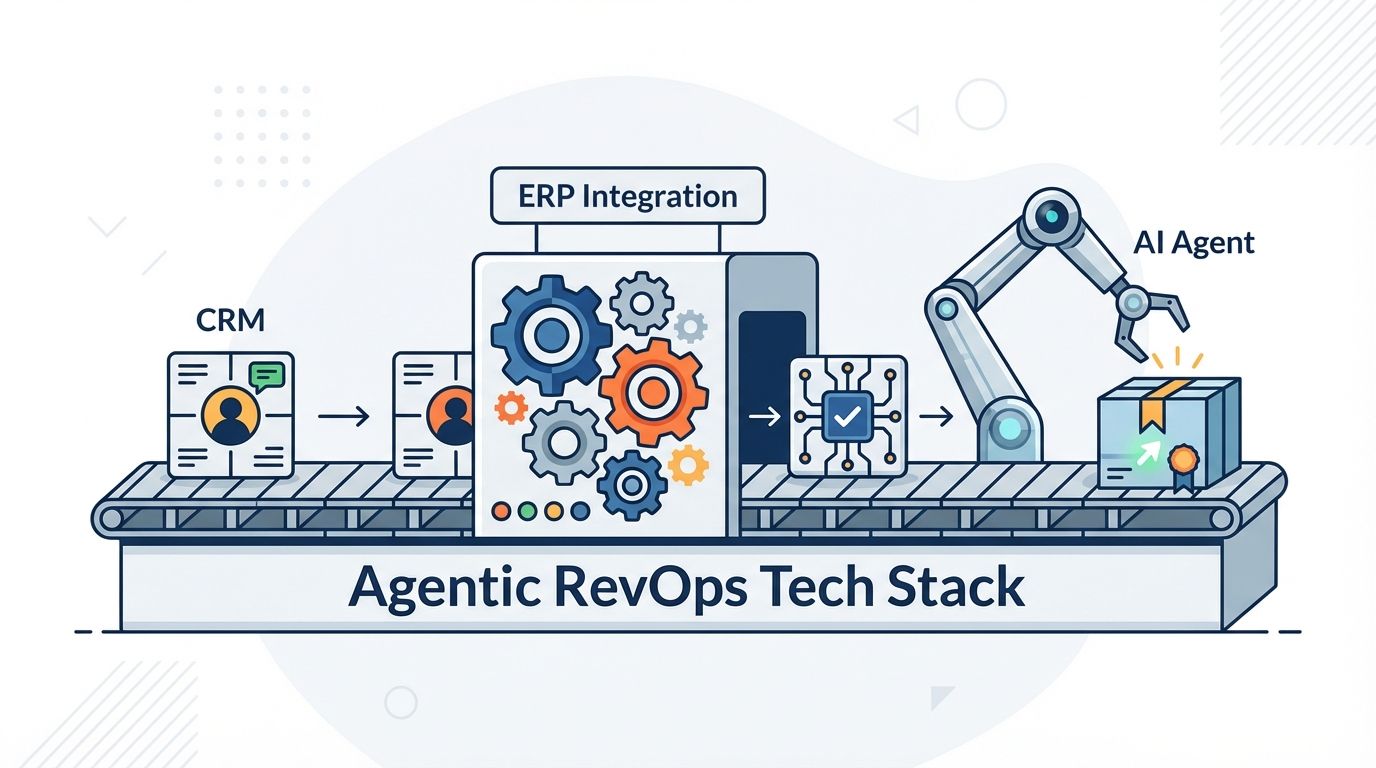
For a mid-sized manufacturer, the ideal Agentic RevOps tech stack centers on a unified CRM like HubSpot, integrated with their ERP. This foundation is augmented by specialized AI agent platforms and a data warehouse for robust analytics and business intelligence.
What You'll Learn
This article breaks down the essential technology stack for implementing Agentic RevOps in a mid-sized manufacturing company. Here’s a quick overview:
- The Core 3-Layer Architecture: Understand the foundational, integration, and agent layers of the stack.
- Why a Unified CRM is Non-Negotiable: Learn why platforms like HubSpot serve as the essential system of record.
- The Critical Role of ERP Integration: Discover how connecting front-office and back-office data unlocks autonomous action.
- The Power of the Agent Layer: See how AI agents execute tasks across your go-to-market systems.
- Key Use Cases for Manufacturers: Explore how this stack automates everything from lead-to-order to aftermarket services.
The Core Stack: A 3-Layer Architecture for Agentic RevOps
Implementing Agentic RevOps isn’t about buying a single piece of software; it’s about architecting a system where AI agents can reliably take action. For a mid-sized manufacturer, this architecture consists of three distinct but interconnected layers.
Layer 1: The System of Record (The Foundational CRM)
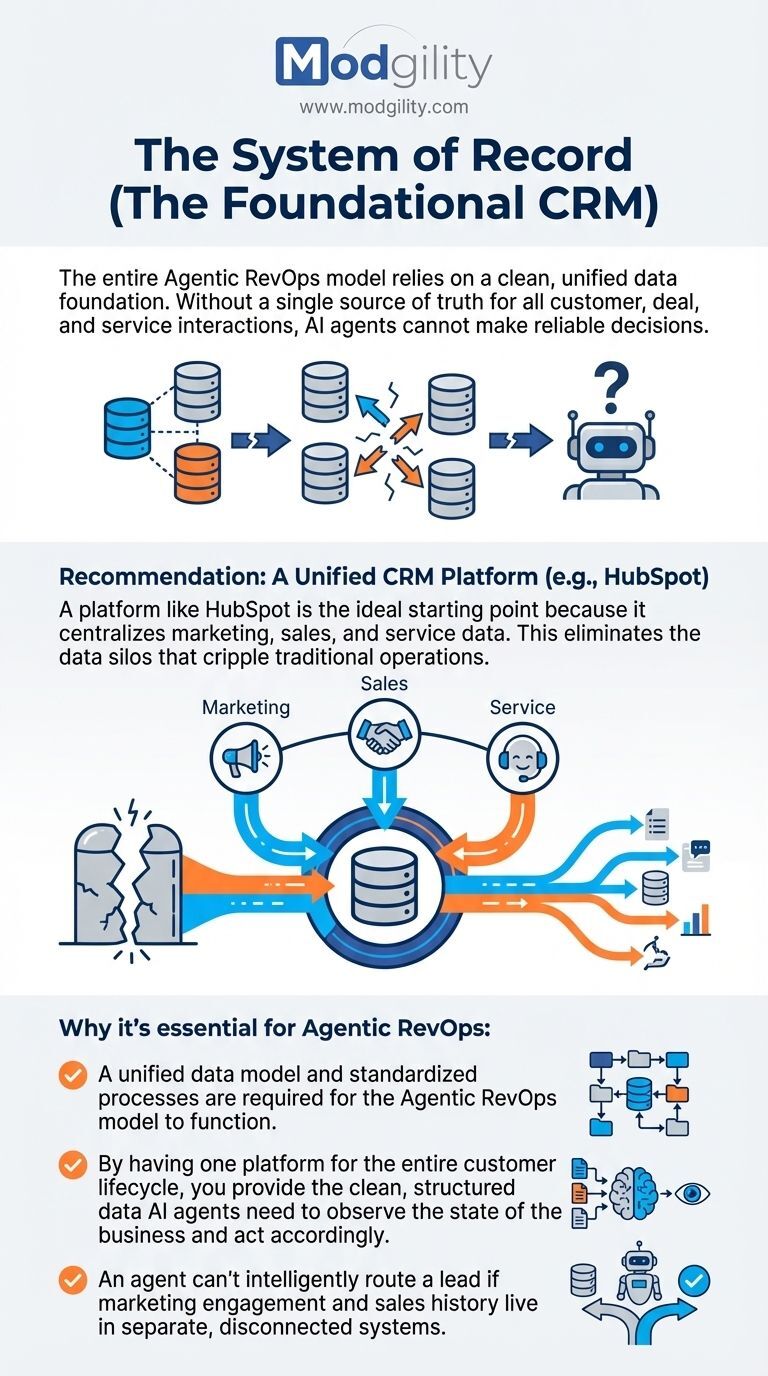
The entire Agentic RevOps model relies on a clean, unified data foundation. Without a single source of truth for all customer, deal, and service interactions, AI agents cannot make reliable decisions.
Recommendation: A Unified CRM Platform (e.g., HubSpot)
A platform like HubSpot is the ideal starting point because it centralizes marketing, sales, and service data. This eliminates the data silos that cripple traditional operations.
- Why it's essential for Agentic RevOps: The Agentic RevOps model requires a "unified data model" and "standardized processes" to function. By having one platform for the entire customer lifecycle, you provide the clean, structured data AI agents need to observe the state of the business and act accordingly. An agent can't intelligently route a lead if marketing engagement and sales history live in separate, disconnected systems.
Layer 2: The Integration and Logic Layer (Connecting the Factory to the Front Office)
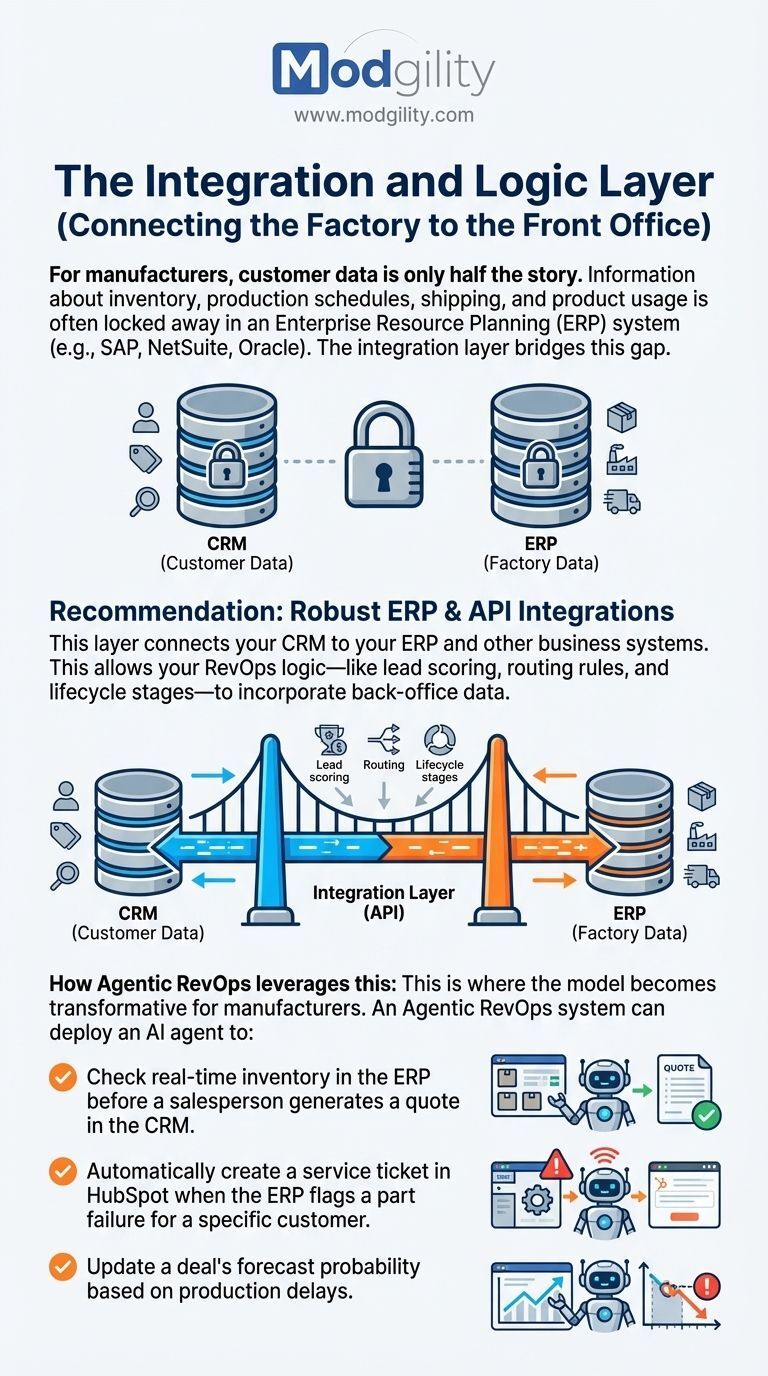
For manufacturers, customer data is only half the story. Information about inventory, production schedules, shipping, and product usage is often locked away in an Enterprise Resource Planning (ERP) system (e.g., SAP, NetSuite, Oracle). The integration layer bridges this gap.
Recommendation: Robust ERP & API Integrations
This layer connects your CRM to your ERP and other business systems. This allows your RevOps logic—like lead scoring, routing rules, and lifecycle stages—to incorporate back-office data.
- How Agentic RevOps leverages this: This is where the model becomes transformative for manufacturers. An Agentic RevOps system can deploy an AI agent to:
- Check real-time inventory in the ERP before a salesperson generates a quote in the CRM.
- Automatically create a service ticket in HubSpot when the ERP flags a part failure for a specific customer.
- Update a deal's forecast probability based on production delays.
Layer 3: The Agent Layer (The Engine of Autonomous Action)
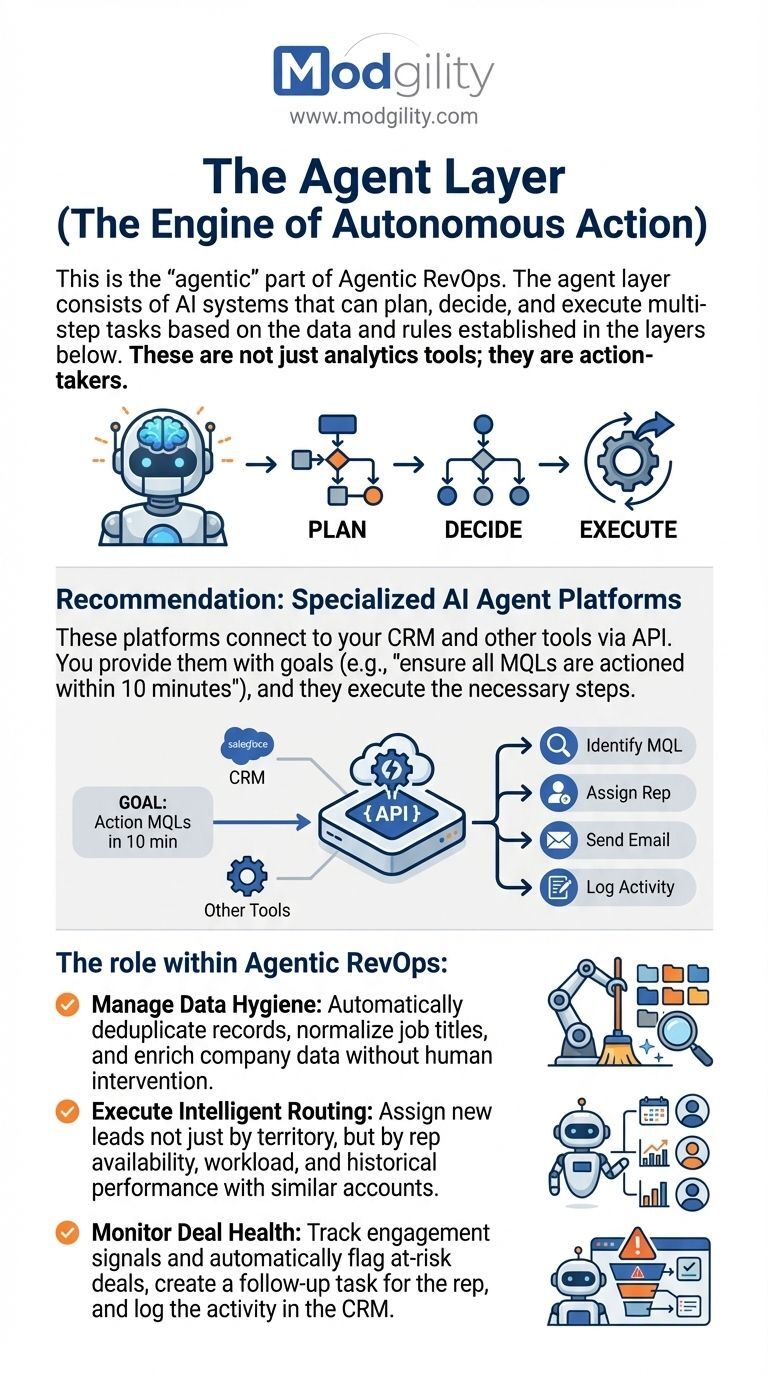
This is the "agentic" part of Agentic RevOps. The agent layer consists of AI systems that can plan, decide, and execute multi-step tasks based on the data and rules established in the layers below. These are not just analytics tools; they are action-takers.
Recommendation: Specialized AI Agent Platforms
These platforms connect to your CRM and other tools via API. You provide them with goals (e.g., "ensure all MQLs are actioned within 10 minutes"), and they execute the necessary steps.
- The role within Agentic RevOps: This layer is where agents perform the tasks that previously consumed countless hours. For example, an Agentic RevOps platform can deploy agents to:
- Manage Data Hygiene: Automatically deduplicate records, normalize job titles, and enrich company data without human intervention.
- Execute Intelligent Routing: Assign new leads not just by territory, but by rep availability, workload, and historical performance with similar accounts.
- Monitor Deal Health: Track engagement signals and automatically flag at-risk deals, create a follow-up task for the rep, and log the activity in the CRM.
Why This Stack is a Game-Changer for Manufacturers
Adopting this architecture moves a manufacturer from reactive, manual processes to a proactive, automated go-to-market engine. The benefits are tangible and address industry-specific challenges.
Automating Lead-to-Order Processes
The journey from a qualified lead to a fulfilled order is often slow and riddled with manual handoffs. Agentic RevOps streamlines this entire workflow. An AI agent can manage the process from end-to-end: qualifying a new lead, routing it to the right sales rep or channel partner, generating a draft quote based on CRM and ERP data, and creating a follow-up sequence.
- Benefit: This drastically reduces response times and administrative overhead, leading to faster sales cycles and a better customer experience.
Proactive Aftermarket and Service Management
For many manufacturers, a significant portion of revenue comes from parts, service, and consumables. An Agentic RevOps system turns this into a predictable, automated revenue stream.
- Use Case: An AI agent can monitor product usage data and contract renewal dates. When a customer's contract is 90 days from expiring or their product usage indicates a need for new parts, the agent can automatically trigger a renewal playbook, create an upsell opportunity for the account manager, and enroll the customer in an educational email sequence.
Enhancing Channel Partner Engagement
Manufacturers that sell through distributors or partners face the constant challenge of keeping them engaged and informed. Agentic RevOps provides a scalable way to manage these relationships.
- Use Case: AI agents can automate partner onboarding, intelligently route leads to the best-fit partner based on their certifications and performance, and monitor partner deal progression, nudging them when an opportunity stalls.
Getting Started: Your First Steps with Agentic RevOps
Adopting this stack doesn't have to be an overwhelming, all-at-once initiative. The key is to follow a structured, incremental approach.
- Build the Foundation First: Before deploying AI agents, ensure your data is clean and your processes are standardized. Solidifying HubSpot as your central system of record is the critical first step.
- Identify a High-Impact Pilot: Start with a narrow, well-defined workflow. Automated lead routing or data hygiene are excellent candidates, as they provide clear ROI and build trust in the system.
- Deploy with Guardrails and Measure: Implement your first AI agent with clear rules and escalation paths for when a human needs to be involved. Closely monitor its performance against key metrics like speed-to-lead or data accuracy to prove the value and refine the process.
Frequently Asked Questions
What is the core architecture of an Agentic RevOps tech stack for manufacturers?
The core architecture for an Agentic RevOps tech stack consists of three interconnected layers: 1) The Foundational Layer, a unified CRM like HubSpot that acts as the system of record. 2) The Integration Layer, which connects the CRM to the ERP system, bridging front-office and back-office data. 3) The Agent Layer, which includes specialized AI platforms that execute autonomous tasks based on the data from the other layers.
Why is a unified CRM like HubSpot essential for Agentic RevOps?
A unified CRM is essential because it serves as a single source of truth for all customer, deal, and service interactions. This centralizes data and eliminates silos, providing the clean, structured information and standardized processes that AI agents require to make reliable decisions and take action. Without it, an agent cannot function effectively.
What are some key use cases for Agentic RevOps in manufacturing?
For manufacturers, key use cases include: automating the entire lead-to-order process to reduce response times; proactively managing aftermarket services by having AI agents monitor product usage and trigger renewal playbooks; and enhancing channel partner engagement by automating partner onboarding, intelligent lead routing, and deal progression monitoring.
What is the first step to implementing Agentic RevOps?
The critical first step is to build the foundation. Before deploying any AI agents, you must ensure your data is clean and your processes are standardized. This means solidifying a unified CRM like HubSpot as your central system of record.
No Comments Yet
Let us know what you think