
Share this
by Keith Gutierrez on Mar 17, 2026
When implementing Agentic RevOps in a manufacturing company, focus on tracking Lead Response Time, Quote-to-Cash Cycle Time, CRM Data Accuracy, Sales Cycle Length, and Mean Time to Resolution (MTTR) for service tickets. These KPIs directly measure speed, efficiency, and revenue impact.
What You'll Learn
This article provides a definitive guide to the essential metrics for measuring the success of Agentic RevOps in a manufacturing context. You will learn:
- A clear, concise definition of Agentic RevOps and how it differs from traditional AI.
- The eight core metrics to track, broken down by operational efficiency, speed, sales effectiveness, and customer success.
- How Agentic RevOps specifically acts to improve each of these key metrics.
- The foundational prerequisites for a successful implementation.
First, What Is Agentic RevOps?
Before we dive into metrics, it’s crucial to understand what we're measuring. Agentic RevOps is Revenue Operations where AI agents don’t just surface insights—they take action across your go-to-market system. These AI agents autonomously execute multi-step workflows to drive revenue, such as updating your CRM, routing leads, and triggering follow-ups.
This is a significant leap from older AI models.
The Difference: AI-Assisted vs. Agentic
Understanding the distinction is key to setting the right goals and metrics.
- AI-Assisted RevOps analyzes data and recommends a next step. It might say, "Here is a deal at risk and a suggested email." A human must then decide to act and click send.
- Agentic RevOps executes the next step. An agent flags the risk, updates the deal status in HubSpot, creates a task for the account manager, and sends the initial nudge email—escalating to a human only when a reply is received or the situation requires strategic intervention.
This ability to act is what makes Agentic RevOps so transformative for manufacturing companies, where speed and accuracy are paramount.
The Core Metrics for Manufacturing: Measuring What Matters
For manufacturers, the revenue cycle often involves complex quotes, long sales cycles, and critical post-sale service. The right metrics reveal how Agentic RevOps is streamlining this entire process.
1. Operational Efficiency & Data Hygiene Metrics
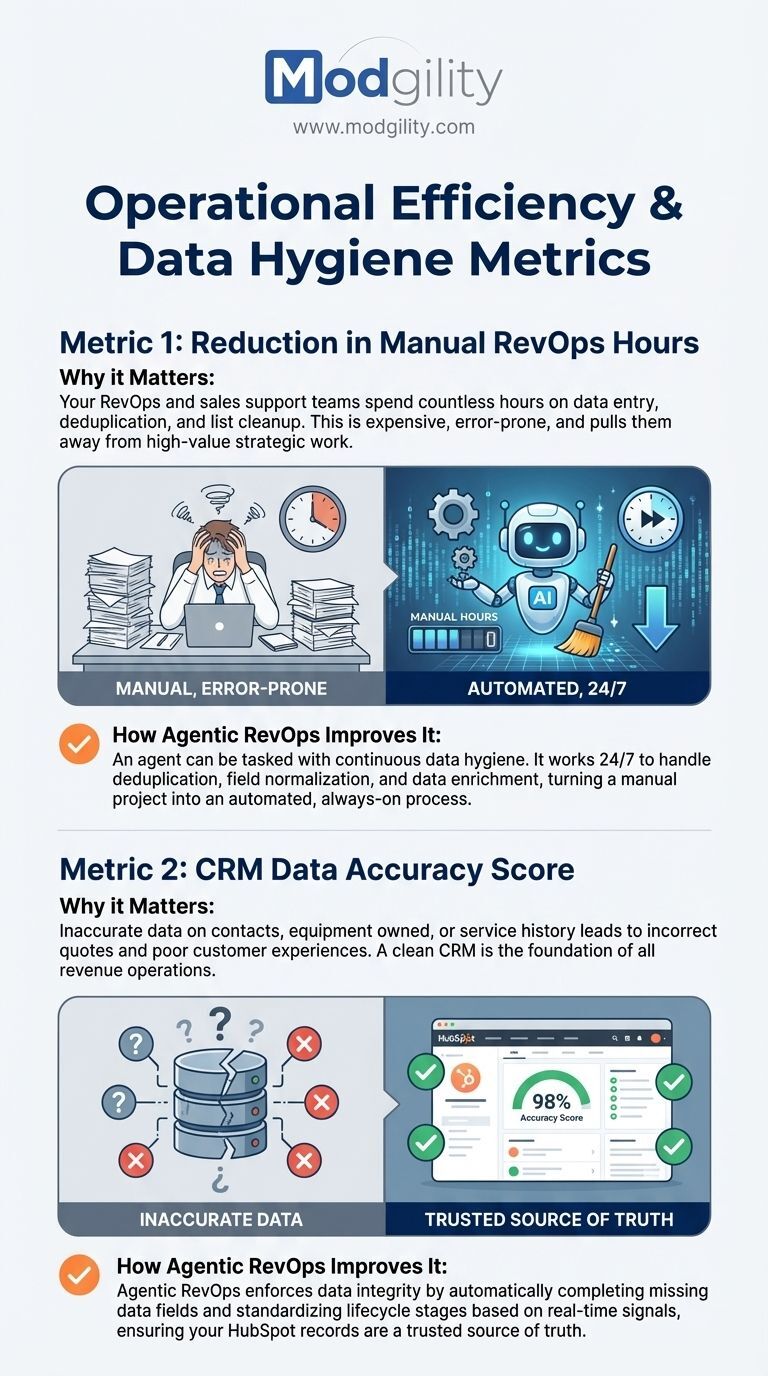
These metrics measure the reduction of manual, repetitive work that slows down your revenue team.
- Metric 1: Reduction in Manual RevOps Hours
- Why it Matters: Your RevOps and sales support teams spend countless hours on data entry, deduplication, and list cleanup. This is expensive, error-prone, and pulls them away from high-value strategic work.
- How Agentic RevOps Improves It: An agent can be tasked with continuous data hygiene. It works 24/7 to handle deduplication, field normalization, and data enrichment, turning a manual project into an automated, always-on process.
- Metric 2: CRM Data Accuracy Score
- Why it Matters: Inaccurate data on contacts, equipment owned, or service history leads to incorrect quotes and poor customer experiences. A clean CRM is the foundation of all revenue operations.
- How Agentic RevOps Improves It: Agentic RevOps enforces data integrity by automatically completing missing data fields and standardizing lifecycle stages based on real-time signals, ensuring your HubSpot records are a trusted source of truth.
2. Speed-to-Revenue Metrics
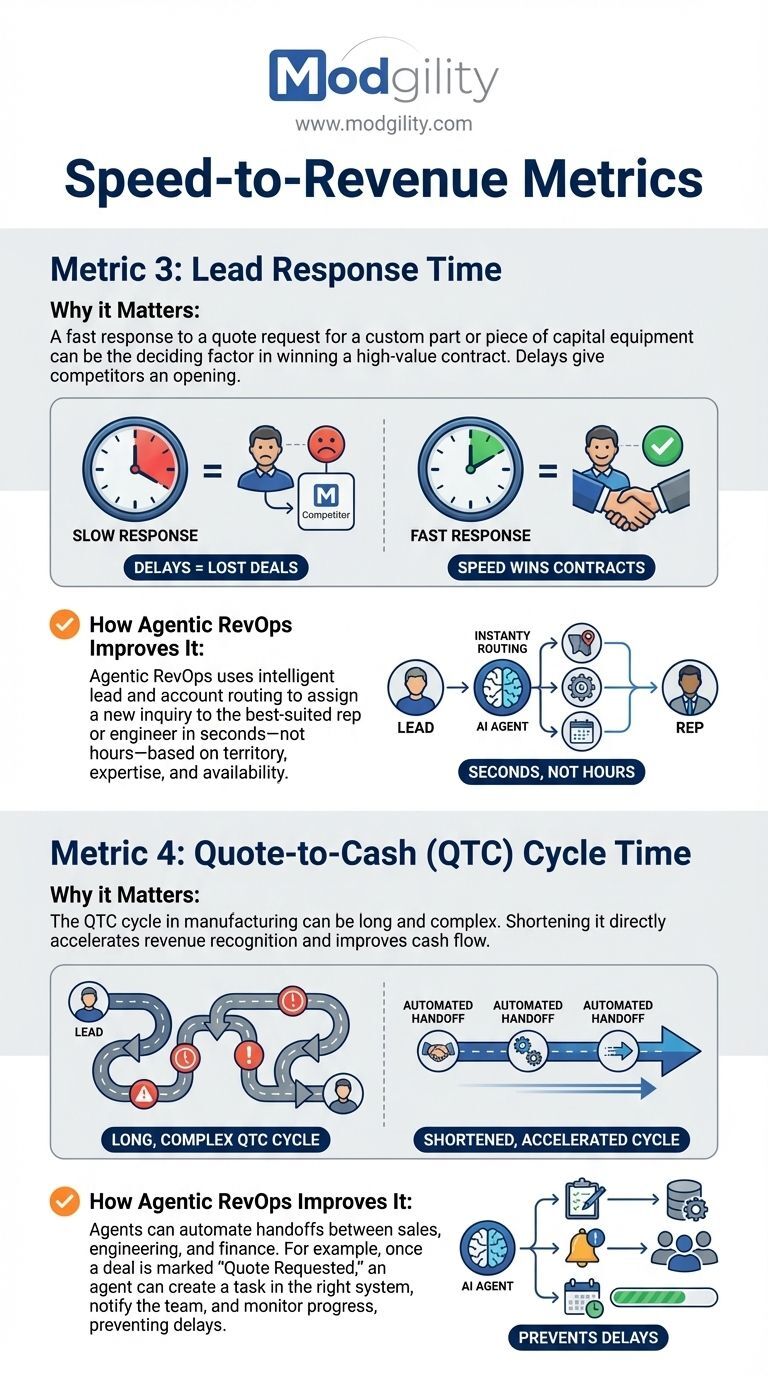
Time is money, especially when a competitor is one click away. These metrics track how quickly your organization can move from initial interest to a closed deal.
- Metric 3: Lead Response Time
- Why it Matters: A fast response to a quote request for a custom part or piece of capital equipment can be the deciding factor in winning a high-value contract. Delays give competitors an opening.
- How Agentic RevOps Improves It: Agentic RevOps uses intelligent lead and account routing to assign a new inquiry to the best-suited rep or engineer in seconds—not hours—based on territory, expertise, and availability.
- Metric 4: Quote-to-Cash (QTC) Cycle Time
- Why it Matters: The QTC cycle in manufacturing can be long and complex. Shortening it directly accelerates revenue recognition and improves cash flow.
- How Agentic RevOps Improves It: Agents can automate handoffs between sales, engineering, and finance. For example, once a deal is marked "Quote Requested," an agent can create a task in the right system, notify the team, and monitor progress, preventing delays.
3. Sales Effectiveness & Conversion Metrics
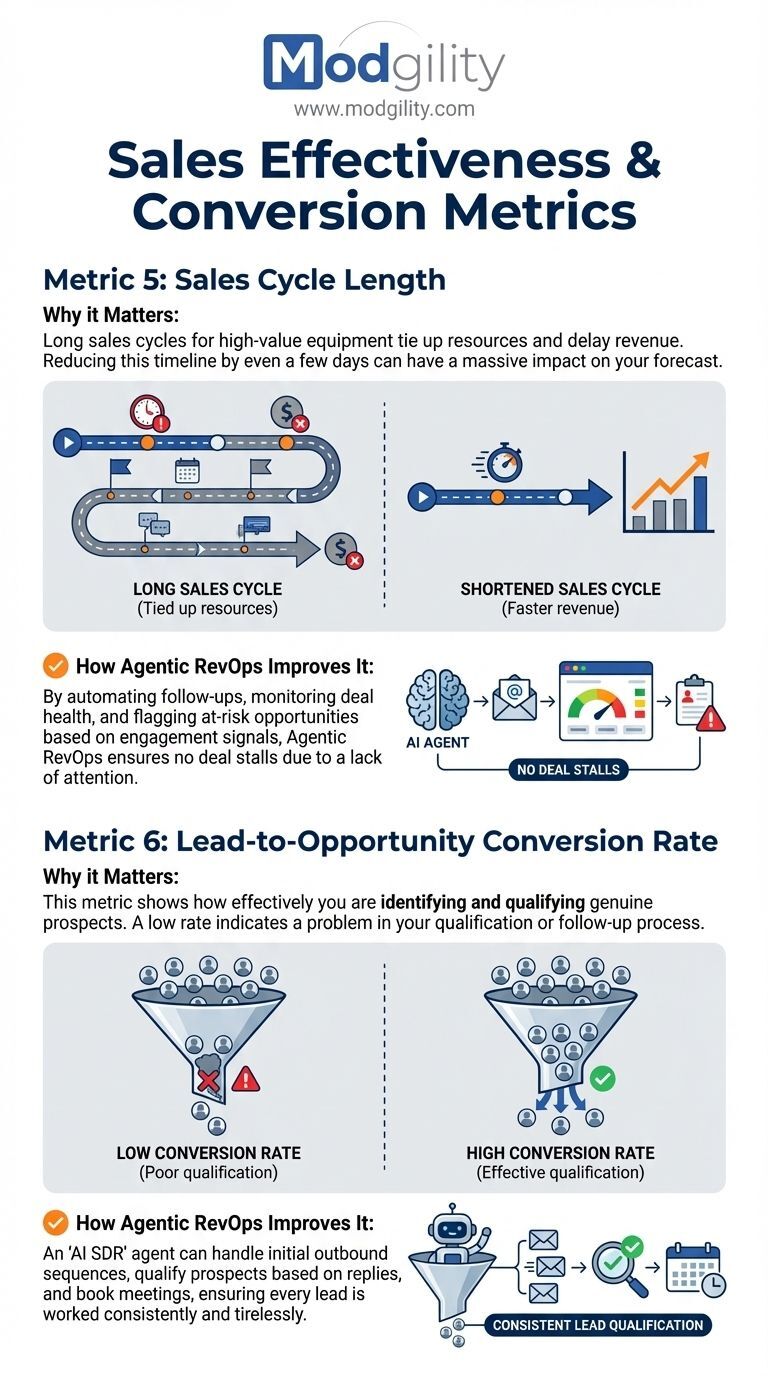
These KPIs measure how well your sales team is converting interest into revenue, a process that Agentic RevOps directly supports.
- Metric 5: Sales Cycle Length
- Why it Matters: Long sales cycles for high-value equipment tie up resources and delay revenue. Reducing this timeline by even a few days can have a massive impact on your forecast.
- How Agentic RevOps Improves It: By automating follow-ups, monitoring deal health, and flagging at-risk opportunities based on engagement signals, Agentic RevOps ensures no deal stalls due to a lack of attention.
- Metric 6: Lead-to-Opportunity Conversion Rate
- Why it Matters: This metric shows how effectively you are identifying and qualifying genuine prospects. A low rate indicates a problem in your qualification or follow-up process.
- How Agentic RevOps Improves It: An "AI SDR" agent can handle initial outbound sequences, qualify prospects based on replies, and book meetings, ensuring every lead is worked consistently and tirelessly.
4. Customer Success & Service Metrics
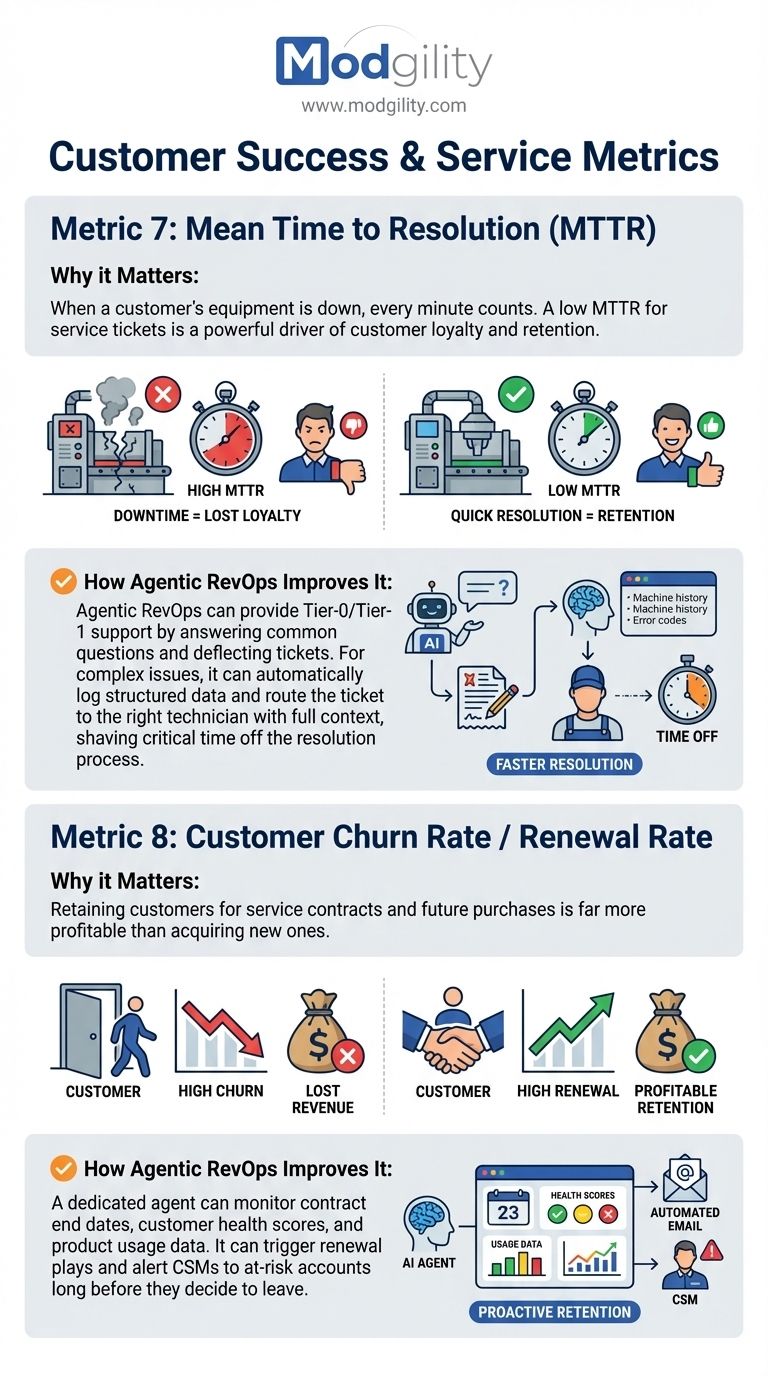
For manufacturers, revenue doesn't stop at the initial sale. Service, parts, and renewals are critical profit centers.
- Metric 7: Mean Time to Resolution (MTTR)
- Why it Matters: When a customer's equipment is down, every minute counts. A low MTTR for service tickets is a powerful driver of customer loyalty and retention.
- How Agentic RevOps Improves It: Agentic RevOps can provide Tier-0/Tier-1 support by answering common questions and deflecting tickets. For complex issues, it can automatically log structured data and route the ticket to the right technician with full context, shaving critical time off the resolution process.
- Metric 8: Customer Churn Rate / Renewal Rate
- Why it Matters: Retaining customers for service contracts and future purchases is far more profitable than acquiring new ones.
- How Agentic RevOps Improves It: A dedicated agent can monitor contract end dates, customer health scores, and product usage data. It can trigger renewal plays and alert CSMs to at-risk accounts long before they decide to leave.
Getting Started: Foundation First
Implementing Agentic RevOps is not "set it and forget it." Its power to act autonomously requires a strong, well-defined foundation. Before deployment, ensure you have:
- A Unified Data Model: Your data in a central platform like HubSpot must be clean, with consistent lifecycle stages and clear sources of truth.
- Standardized Processes: You need documented funnels, handoffs, and service-level agreements (SLAs) across marketing, sales, and service. The agents need to know the rules of the road.
- A Connected Tech Stack: Your CRM, ERP, and support systems must be integrated to allow agents to read and write data safely across platforms.
- Clear Governance and Guardrails: You must define the rules, escalation paths, and approval processes that control agent behavior to prevent errors at scale.
By focusing on these foundational elements and tracking the right metrics, manufacturing companies can move beyond simple automation and build a truly autonomous, efficient, and scalable revenue engine with Agentic RevOps.
Frequently Asked Questions
What is Agentic RevOps?
Agentic RevOps is a form of Revenue Operations where AI agents autonomously take action and execute multi-step workflows to drive revenue. Instead of just providing insights, these agents can perform tasks like updating your CRM, routing leads, and triggering follow-up communications.
How is Agentic RevOps different from AI-Assisted RevOps?
The key difference is execution versus recommendation. AI-Assisted RevOps analyzes data and recommends an action for a human to take. Agentic RevOps executes the action itself—updating a deal status, creating a task, or sending an email—and only escalates to a human when a reply is received or strategic intervention is needed.
What are the most important metrics to track for Agentic RevOps in manufacturing?
In manufacturing, key metrics should focus on speed, efficiency, and customer service. The most critical KPIs include Lead Response Time, Quote-to-Cash (QTC) Cycle Time, CRM Data Accuracy, Sales Cycle Length, and Mean Time to Resolution (MTTR) for service tickets.
What is required to implement Agentic RevOps successfully?
A successful implementation requires a strong foundation, including a unified data model with clean data, standardized processes and SLAs, a connected and integrated tech stack, and clear governance with rules and escalation paths to control agent behavior.
No Comments Yet
Let us know what you think