
Share this
by Keith Gutierrez on Aug 5, 2026
Most RevOps engagements end with a Zoom call and a Google Drive link. That is not a deliverable. That is a shrug.
If you have ever sat through a project "wrap-up" and walked away unsure what your team actually owns now, you are not imagining the problem. A real RevOps project end should hand you documented, testable, revenue-connected deliverables, not a folder of slides nobody opens again.
Below is what those deliverables should actually look like, why vague ones quietly wreck adoption, and what to demand before you sign off on any RevOps project as complete.
Why "We'll Send Over Some Docs" Is the Sentence That Should End the Meeting
Here's the thing: vague deliverables are not a documentation problem. They are a control problem.
When a project ends without a specific, itemized list of what you now own, you have no way to hold the partner accountable and no way to hold your own team accountable either. Nobody can point to a document and say "this is what was promised, this is what we got."
That gap is exactly where a lot of underperforming campaigns start. Not with bad targeting or a weak offer, but with a rollout nobody fully understood because the handoff was never formalized.
Think about it this way: if you cannot point to a single document and say "this defines success," your project did not actually end. It just stopped.
The cost of ignoring this shows up later, not immediately. Three months after launch, when a report breaks or a workflow stops firing, there is no reference point to diagnose what changed versus what was never configured correctly in the first place.
The RevOps Project Deliverables List That Actually Protects Your Pipeline
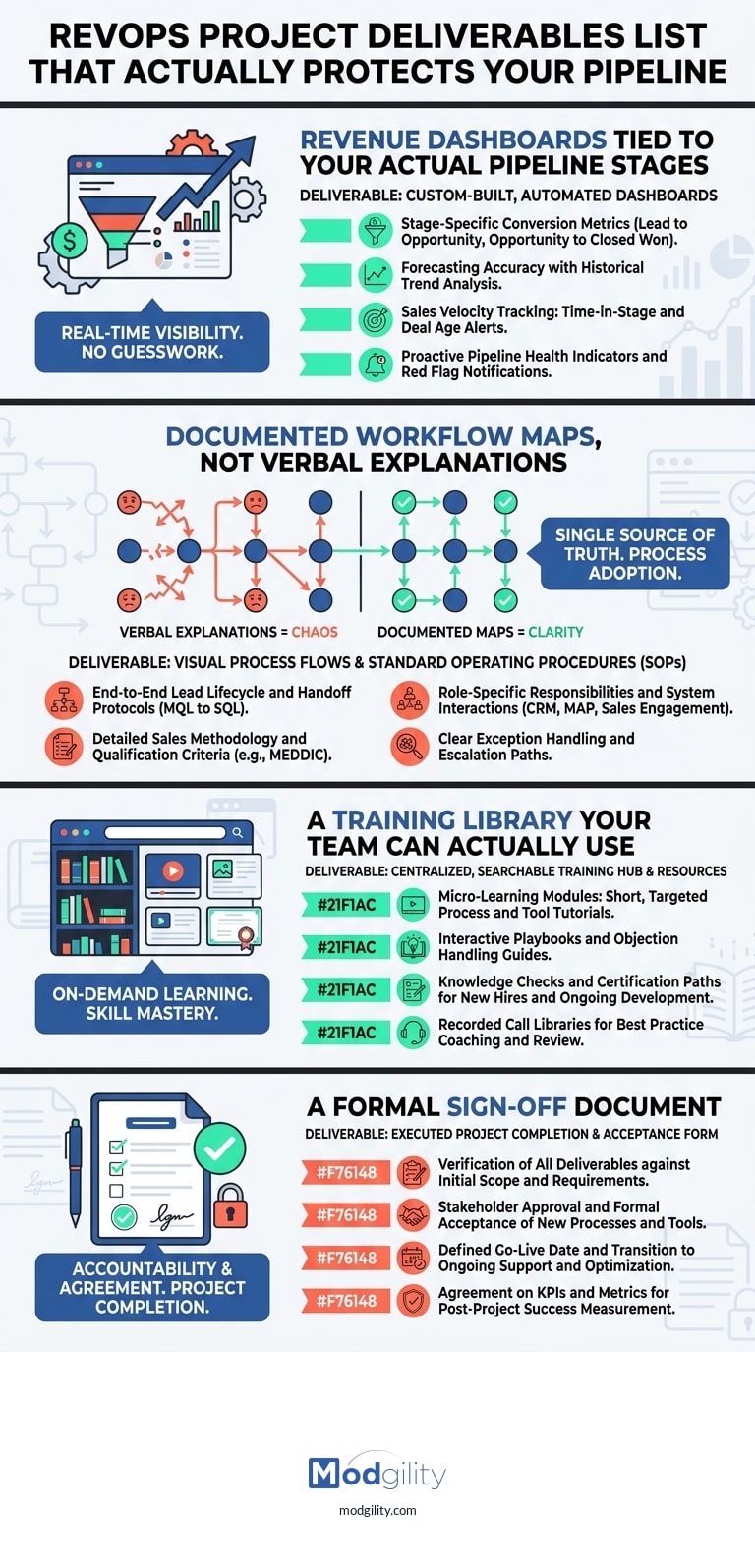
Every RevOps engagement is different. But the deliverables that matter do not vary much, because they map to the same four failure points: reporting, process, people, and accountability.
A partner that has done this well before will hand you something in each of these categories, not a generic PDF that could apply to any client.
1. Revenue Dashboards Tied to Your Actual Pipeline Stages
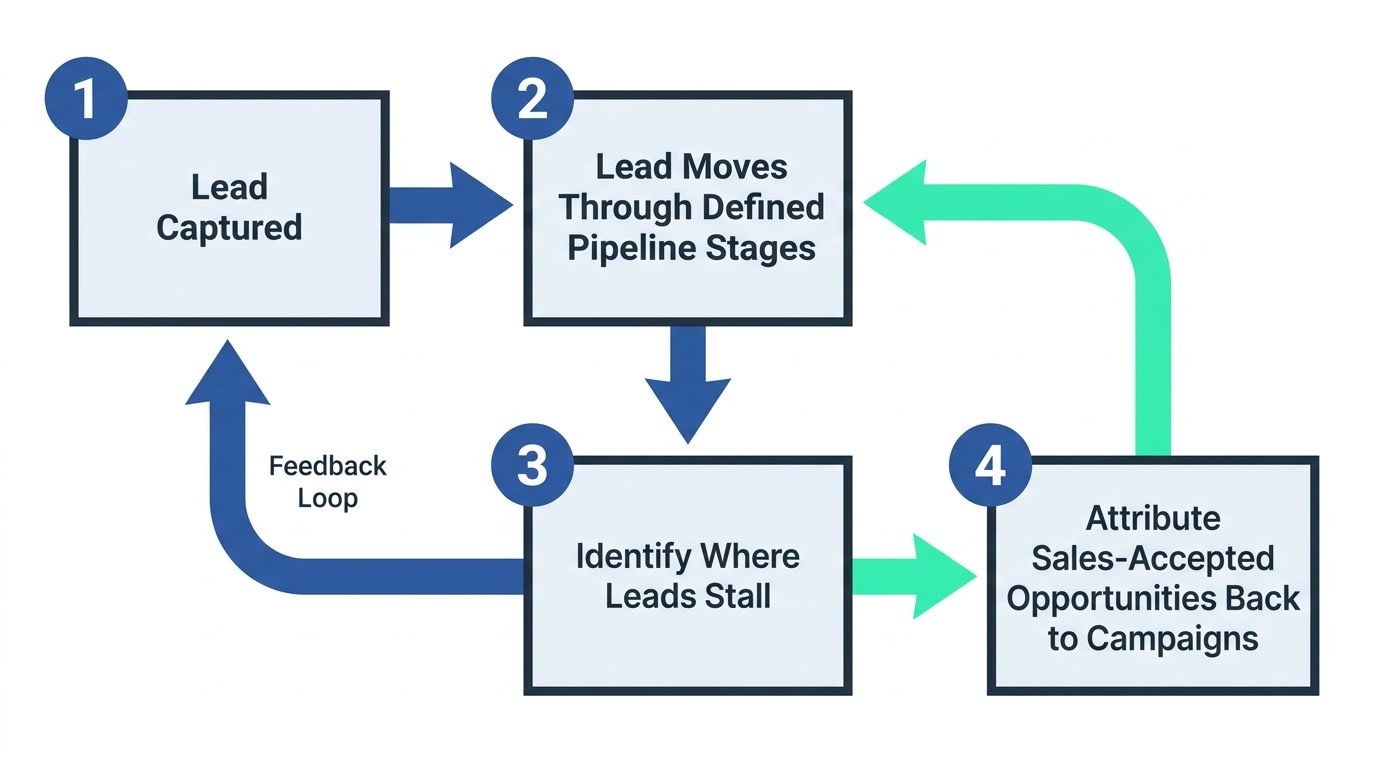
A dashboard that shows traffic and form fills is a marketing dashboard. A revenue dashboard shows how leads move through stages, where they stall, and which campaigns produced sales-accepted opportunities, not just contacts.
The deliverable here is not "a dashboard exists." It is a dashboard built on your actual stage definitions, with attribution logic your CFO can follow without a translator.
2. Documented Workflow Maps, Not Verbal Explanations
If the only place your lead routing logic lives is inside one consultant's head, you do not have a workflow. You have a dependency.
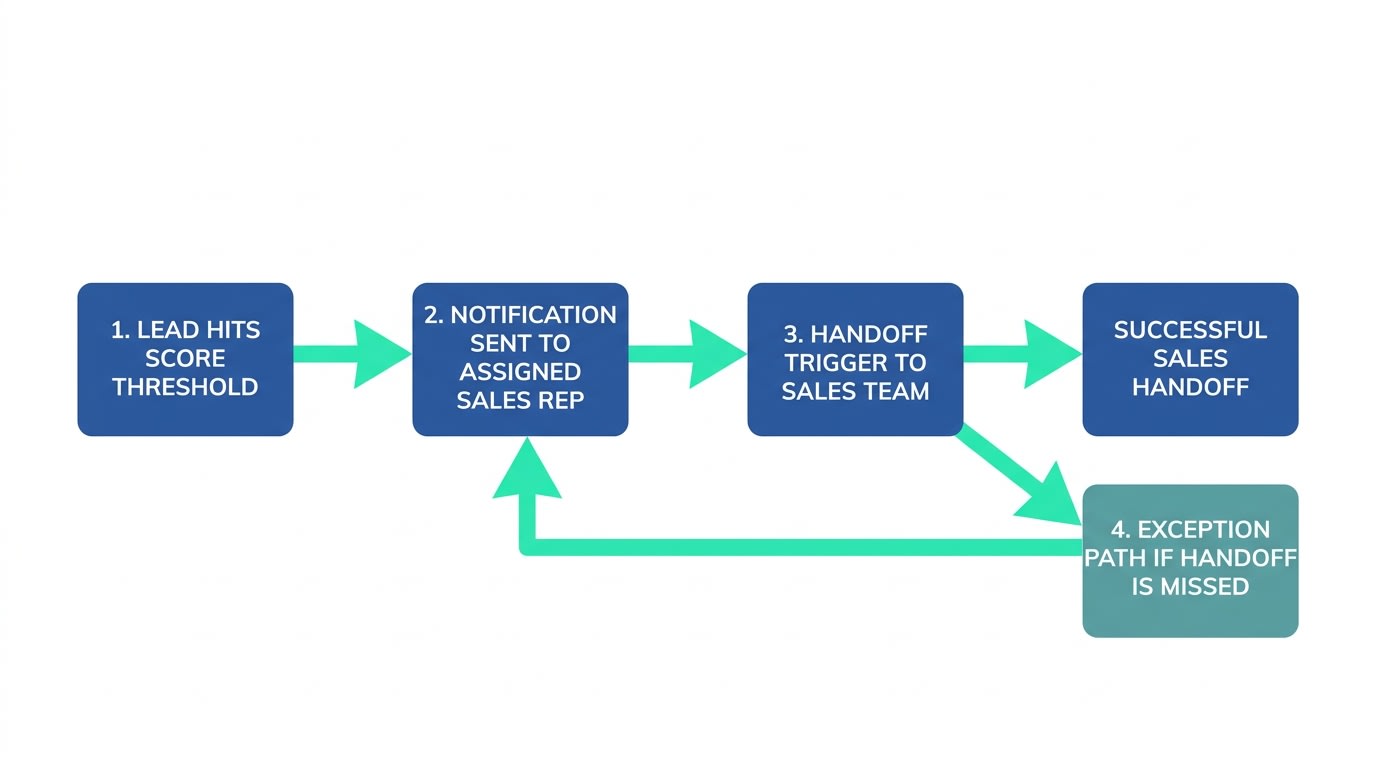
A real deliverable is a visual map: what happens when a lead hits a score threshold, who gets notified, what triggers a handoff to sales, and what happens if that handoff is missed.
3. A Training Library Your Team Can Actually Use
Training that happens live and once, with no recording and no reference doc, is not training. It is a demo.
The deliverable here should be a library: short recorded walkthroughs, written step-by-step guides, and a place your team can go back to in week six when the person who ran the live session has moved on to another account.
4. A Formal Sign-Off Document
This is the deliverable most agencies skip, and it is the one that matters most.
A sign-off document lists every deliverable, states clearly whether it was completed, and gives both sides a shared record of what "project complete" actually means. Without it, "complete" is just an opinion.
- Revenue dashboard built on your actual stage definitions, not generic templates
- Workflow map covering every marketing-to-sales handoff, including exception paths
- Recorded and written training library, accessible without the vendor present
- Formal sign-off document itemizing every deliverable and its completion status
- Attribution model documentation explaining how a closed-won deal traces back to its source
Why Adoption Is the Deliverable Nobody Puts on the Statement of Work
Here's what most contracts miss: a finished implementation and an adopted implementation are not the same thing.
You can hand a team a perfectly configured dashboard and a beautifully mapped workflow, and if nobody logs in, none of it moved the needle. Adoption is the deliverable that actually determines whether the other deliverables were worth building.
And the best part? Adoption is measurable. It should not be a vague promise. A serious partner will define what active adoption looks like, at what point after launch it gets measured, and how it will be reported back to you.
If a proposal never mentions adoption tracking, that is worth asking about directly. A project that ends at "go-live" without a follow-up measurement window is a project that ends before anyone knows if it worked.
What does that look like in practice? Usage metrics pulled at a defined interval after launch, cross-referenced against pipeline performance, not just login counts. Logging in is not the same as using a tool correctly.
The Handoff Failure That Costs You in Month Two
So what went wrong in most of the underperforming projects Amanda-type buyers describe when they go looking for a new partner? It is almost never the technology.
It is the handoff. The project team that built the system moves on, the internal team that inherits it was never given a real reference document, and small breakages start compounding quietly.
A lead scoring rule gets edited by someone who does not understand why it was built that way. A workflow silently stops firing because a form field got renamed. Nobody notices for weeks because there was never a documented baseline to compare against.
Here's why that matters: by the time the gap shows up in a pipeline report, it is often a full sales cycle old. The fix is not just technical. It is going back and rebuilding institutional knowledge that should have been documented the first time.
Warning signs to watch for before that happens:
- No written documentation of why specific automation rules exist, only verbal explanations from one person
- No defined owner for maintaining dashboards after the vendor exits
- Training that happened once, live, with no recording or reference material
- No agreed-upon check-in point 30 to 60 days post-launch to confirm adoption and catch drift early

What to Ask For Before You Sign
If you are currently evaluating a RevOps partner, the strongest thing you can do is push for specificity before the contract is signed, not after the project ends.
Ask for a sample sign-off document from a past project, with names redacted if needed. If a partner cannot show you what "done" looked like for someone else, they likely have not defined it clearly enough for you either.
Ask how adoption gets measured, and at what point after launch that measurement happens. A partner without an answer here is telling you the project ends at go-live, not at outcomes.
Ask to see a sample training library from a prior engagement. Static PDFs are a red flag. A mix of short recorded walkthroughs and searchable written guides is what teams actually return to.
Ask how workflow documentation is delivered. A verbal walkthrough on a final call is not documentation. A shareable, visual map that a new hire could follow without a live explanation is.
The bottom line? The quality of a RevOps partner is not visible in the demo. It is visible in what is left behind after they leave.

Where This Leaves Your Next Evaluation
Open your calendar and look at the last RevOps or agency project your team closed out. Can you find a single document that lists every promised deliverable and its completion status? If you cannot, pause your current vendor evaluation and require a sample sign-off document before you authorize the next contract.
No Comments Yet
Let us know what you think