
Share this
by Keith Gutierrez on Mar 24, 2026
To measure ROI from HubSpot in B2B manufacturing, you must connect marketing activities directly to sales outcomes. Focus on tracking metrics like Customer Acquisition Cost (CAC), lead-to-customer conversion rates, and sales cycle length, all of which require a properly configured platform for accurate reporting.
Quantifying this return is crucial for justifying technology adoption and expenditure to key stakeholders. A well-executed HubSpot Marketing Hub Implementation transforms the platform from a simple tool into a robust, data-driven engine for proving marketing’s value.
What You'll Learn
- The core framework for connecting marketing activities to revenue in a long sales cycle environment.
- The five essential metrics every B2B manufacturer must track in HubSpot to prove ROI.
- How a professional HubSpot Marketing Hub Implementation is the critical first step for accurate measurement.
- Why custom dashboards and system integrations are non-negotiable for a clear ROI picture.
Why Measuring Marketing ROI is Critical for Manufacturers
B2B manufacturing is unique. Sales cycles are long, buying committees are complex, and a single deal can be worth millions. In this environment, marketing can’t be a "cost center"; it must be a predictable and measurable revenue driver.
The challenge is attributing a closed deal back to the marketing touchpoints that occurred months or even years earlier. This is precisely where HubSpot shines, but only if it's set up to track the entire customer journey from the very first interaction.
The Five Essential Metrics to Track in HubSpot for Manufacturing ROI
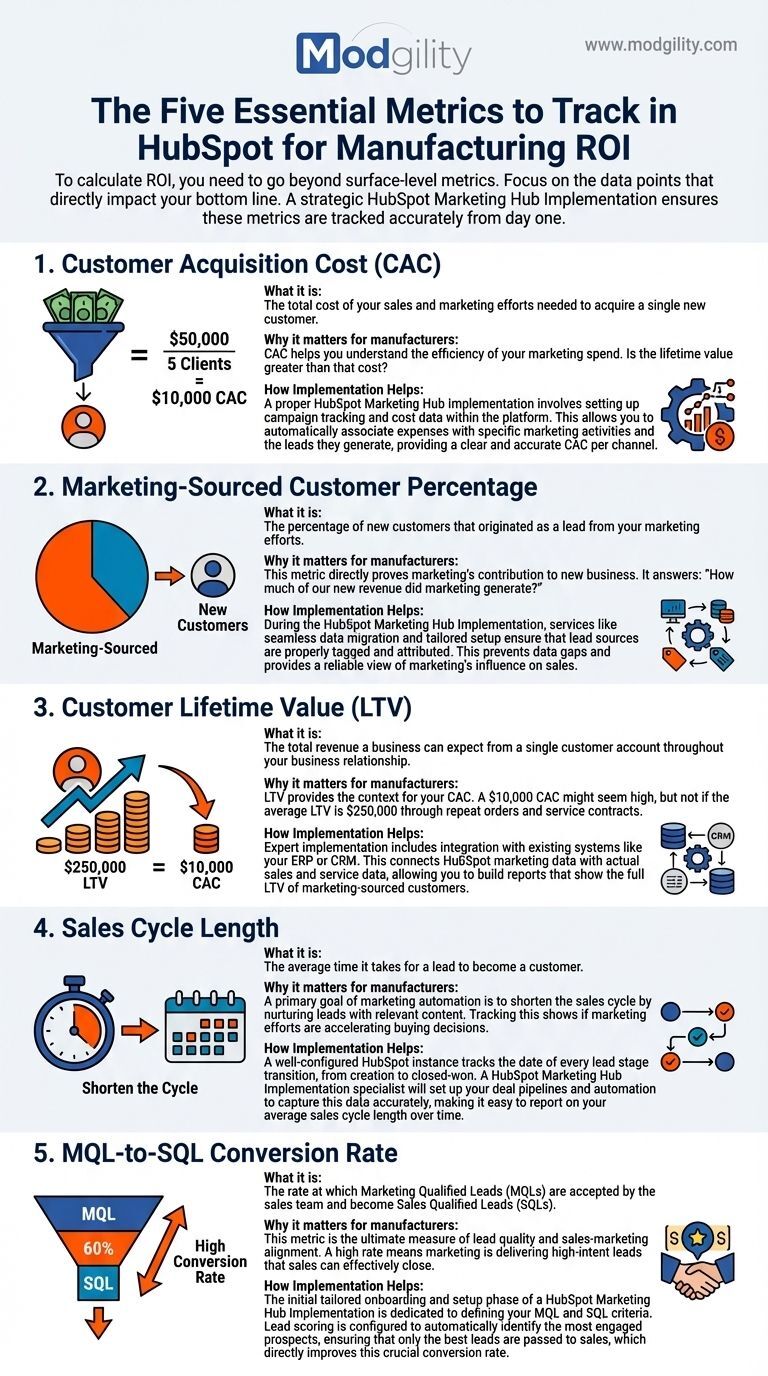
To calculate ROI, you need to go beyond surface-level metrics like website traffic or email open rates. Focus on the data points that directly impact your bottom line. A strategic HubSpot Marketing Hub Implementation ensures these metrics are tracked accurately from day one.
1. Customer Acquisition Cost (CAC)
- What it is: The total cost of your sales and marketing efforts needed to acquire a single new customer.
- Why it matters for manufacturers: CAC helps you understand the efficiency of your marketing spend. If you spend $50,000 on a trade show and a supporting digital campaign to acquire five new clients, your CAC is $10,000. Is the lifetime value of those clients greater than that cost?
- How Implementation Helps: A proper HubSpot Marketing Hub Implementation involves setting up campaign tracking and cost data within the platform. This allows you to automatically associate expenses with specific marketing activities and the leads they generate, providing a clear and accurate CAC per channel.
2. Marketing-Sourced Customer Percentage
- What it is: The percentage of new customers that originated as a lead from your marketing efforts.
- Why it matters for manufacturers: This metric directly proves marketing’s contribution to new business. It answers the simple but powerful question: "How much of our new revenue did marketing generate?"
- How Implementation Helps: During the HubSpot Marketing Hub Implementation, services like seamless data migration and tailored setup ensure that lead sources are properly tagged and attributed. This prevents data gaps and provides a reliable view of marketing’s influence on sales.
3. Customer Lifetime Value (LTV)
- What it is: The total revenue a business can expect from a single customer account throughout your business relationship.
- Why it matters for manufacturers: LTV provides the context for your CAC. A $10,000 CAC might seem high, but not if the average LTV of that customer is $250,000 through repeat orders, service contracts, and parts.
- How Implementation Helps: Expert implementation includes integration with existing systems like your ERP or CRM. This connects HubSpot marketing data with actual sales and service data, allowing you to build reports that show the full LTV of marketing-sourced customers.
4. Sales Cycle Length
- What it is: The average time it takes for a lead to become a customer.
- Why it matters for manufacturers: A primary goal of marketing automation is to shorten the sales cycle by nurturing leads with relevant content. Tracking this metric shows whether your marketing efforts are effectively educating prospects and accelerating their buying decision.
- How Implementation Helps: A well-configured HubSpot instance tracks the date of every lead stage transition, from creation to closed-won. A HubSpot Marketing Hub Implementation specialist will set up your deal pipelines and automation to capture this data accurately, making it easy to report on your average sales cycle length over time.
5. MQL-to-SQL Conversion Rate
- What it is: The rate at which Marketing Qualified Leads (MQLs) are accepted by the sales team and become Sales Qualified Leads (SQLs).
- Why it matters for manufacturers: This metric is the ultimate measure of lead quality and sales-marketing alignment. A high conversion rate means marketing is delivering high-intent leads that sales can effectively close.
- How Implementation Helps: The initial tailored onboarding and setup phase of a HubSpot Marketing Hub Implementation is dedicated to defining your MQL and SQL criteria. Lead scoring is configured to automatically identify the most engaged prospects, ensuring that only the best leads are passed to sales, which directly improves this crucial conversion rate.
The Role of Expert HubSpot Marketing Hub Implementation
You cannot measure what you do not correctly track. The accuracy of every metric listed above depends entirely on the initial setup and configuration of your HubSpot portal.
Attempting to measure ROI with a poorly implemented system leads to inaccurate data, frustrated teams, and an inability to prove marketing’s value. This is why a professional HubSpot Marketing Hub Implementation is not a luxury, but a necessity for B2B manufacturers serious about growth.
Benefits of a professional implementation include:
- Accurate Data from Day One: Through seamless data migration and precise configuration, you can trust the numbers you see in your reports.
- Custom Dashboards and Reporting: An implementation specialist builds reports tailored to your specific manufacturing KPIs, giving stakeholders a real-time view of marketing performance.
- Full System Integration: By connecting HubSpot to your other business systems, you get a holistic view of the customer journey and can accurately calculate complex metrics like LTV.
- An Empowered Team: Comprehensive training ensures your team knows how to use the platform and its reports to make data-driven decisions that propel growth.
Conclusion: From Cost Center to Revenue Driver
For B2B manufacturers, HubSpot Marketing Hub is a powerful tool for generating and nurturing high-value leads. However, its greatest value lies in its ability to prove marketing's return on investment.
By focusing on revenue-centric metrics and ensuring your platform is set up for success with a professional HubSpot Marketing Hub Implementation, you can confidently demonstrate how every marketing dollar contributes to the bottom line. You can finally transform your marketing department from a perceived cost center into an undeniable revenue driver.
Frequently Asked Questions
Why is measuring marketing ROI important for B2B manufacturers?
For B2B manufacturers, measuring ROI is critical because of long sales cycles and complex buying committees. It proves marketing's value by attributing closed deals to specific touchpoints, transforming the marketing department from a "cost center" into a predictable and measurable revenue driver.
What are the key metrics for measuring HubSpot ROI in manufacturing?
The five essential metrics to track in HubSpot for manufacturing ROI are: Customer Acquisition Cost (CAC), Marketing-Sourced Customer Percentage, Customer Lifetime Value (LTV), Sales Cycle Length, and the MQL-to-SQL Conversion Rate. These focus on data points that directly impact the bottom line.
How does a professional HubSpot implementation lead to accurate ROI measurement?
A professional HubSpot Marketing Hub implementation ensures accurate ROI measurement because you cannot measure what you do not correctly track. It guarantees accurate data from day one by properly setting up campaign tracking, lead source attribution, system integrations (e.g., with an ERP for LTV), and deal pipelines. This foundational setup is necessary for reliable reporting on all key ROI metrics.
No Comments Yet
Let us know what you think