
Share this
by Keith Gutierrez on Oct 19, 2026
Trying to budget for a RevOps architecture implementation can feel like asking, "how long is a piece of string?"
You get vague answers, ballpark figures that change overnight, and proposals that hide the real work in confusing line items.
So let's cut through the noise. A practical way to scope the cost of a B2B SaaS RevOps architecture is to examine data complexity, process maturity, and tech stack integration depth, while recognizing that other project variables may also affect the final scope.
In this guide, we'll break down the cost drivers you can control and give you a framework to assess your starting point. You'll walk away knowing how to have an intelligent conversation with any implementation partner.
Let's dive right in.
The Core Problem: Why Most RevOps Quotes Are Useless
Most RevOps quotes are based on guesswork, not diagnosis.
An agency or consultant wants to get a foot in the door, so they throw out a number without truly understanding the state of your systems. This can lead to scope changes, missed expectations, and a final bill that bears little resemblance to the initial quote.
The bottom line?
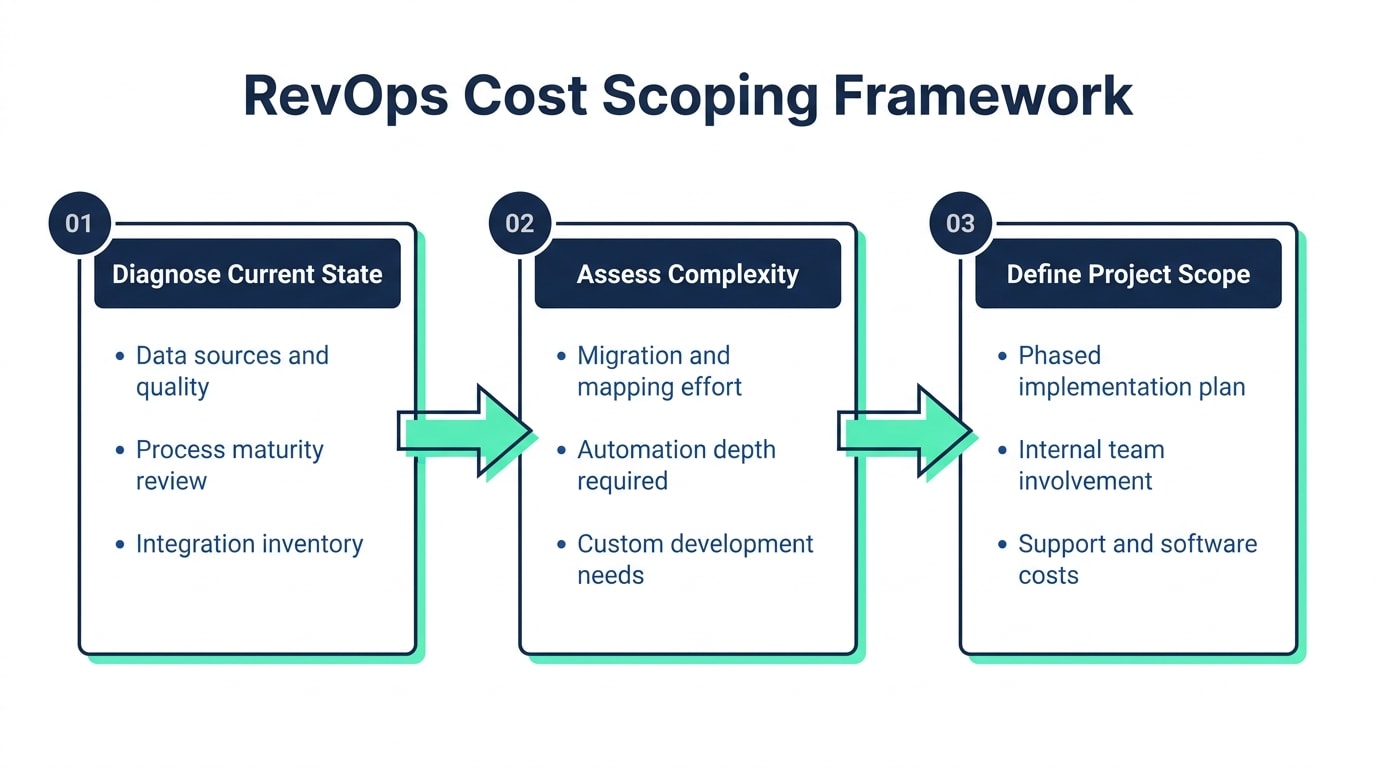
A credible partner may need a current-state audit before providing a firm price. The cost is in the work, and the work is shaped by the complexity of the problem.
To get an accurate number, you need to understand the variables that define that complexity.
The RevOps Cost Matrix: 3 Levers That Determine Your Price
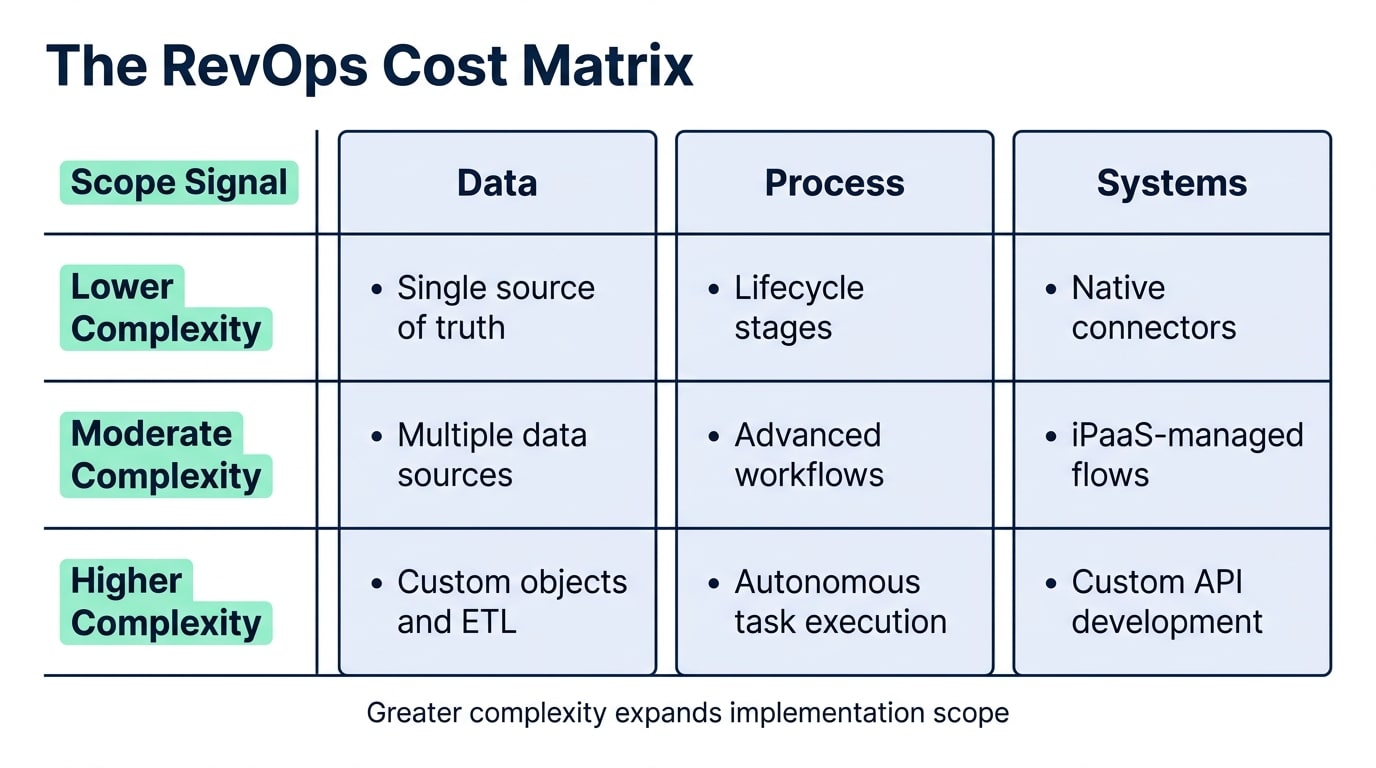
Instead of thinking about a single price, think about three practical scoping levers. The more work required across each lever to reach your desired state, the broader the potential project scope.
These levers are Data, Process, and Systems.
Lever 1: Data Complexity & Migration Scope
This is often a significant cost driver. It is an assessment of where your revenue data lives today and how much work may be required to centralize it into a Single Source of Truth (SSOT).
Here’s how to assess your starting point:
Scenario A: Clean & Centralized
Your data primarily lives in one system, like HubSpot, with maybe a few supplementary spreadsheets. You don't have multiple CRMs or conflicting data sources. The work here may focus on optimization rather than a broad migration.
Potential activities could include reviewing data properties, defining validation rules, and structuring a data model for reporting.
This scenario may require less implementation work when the existing foundation is usable.
Scenario B: Multiple Disparate Systems
This is one possible operating condition for a B2B SaaS company. You may have a CRM, a separate marketing automation platform, and customer data in a support tool.
Possible scope items include data mapping, de-duplication, and migration planning to consolidate information. Choosing the right partner for HubSpot RevOps SSOT for spreadsheet consolidation can help clarify requirements and data risks.
Scenario C: Enterprise Sprawl & Custom Objects
This scenario can occur after mergers and acquisitions or periods of growth. Examples may include multiple CRM instances, custom objects, and point-to-point integrations.
Depending on the environment, implementation may involve data architecture work, ETL processes, or custom middleware. This scenario can require more complex and costly implementation work.
Lever 2: Process Architecture & Automation Depth
Once your data house is in order, you need to build the plumbing. This lever is about translating your revenue process into automated, enforceable rules within the system.
Here's the deal:
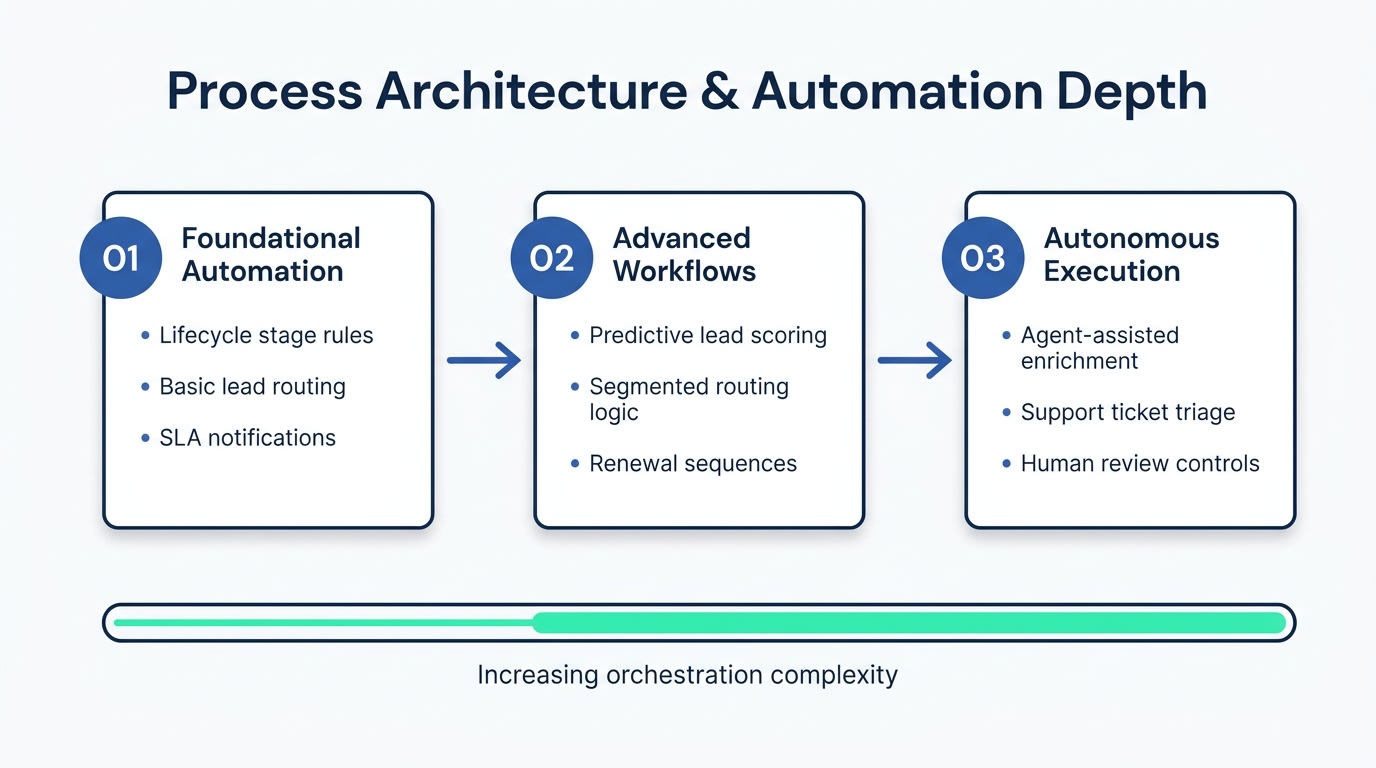
Level A: Foundational Automation
This is about establishing basic guardrails for your go-to-market teams. Illustrative scope items may include defining lead lifecycle stages, setting up basic lead routing, and creating notifications related to sales service levels.
These examples provide a possible baseline for operational consistency and relate to lead management and conversion rates.
Level B: Advanced Workflow Automation
This article's proposed maturity model treats advanced automation as a possible extension of foundational workflows. Illustrative scope items could include predictive lead scoring, routing based on product interest and company size, or renewal and upsell sequences based on product usage data.
These workflows may support cross-departmental workflow coordination, depending on the requirements and system design.
Level C: Autonomous Agent Execution
This is a potential operating model that moves beyond simple "if-this-then-that" workflows. Autonomous AI agents may be configured to execute selected tasks that previously required human action.
Hypothetical examples could include data enrichment from third-party sources or support-ticket triage before human review. One possible implementation pattern may use an orchestration layer with a HubSpot SSOT, subject to the client's requirements and technical design.
Lever 3: System Integration & Tech Stack Scope
As a scoping consideration, review how the proposed RevOps architecture needs to connect with the GTM tech stack, including systems such as advertising platforms or an ERP.
The cost here depends on the type of connection required:
Tier 1: Native Integrations
These are pre-built connectors provided by software vendors, such as a native HubSpot-Salesforce connector. Native integrations can reduce custom development work when their coverage meets the requirements, though configuration, field mapping, and testing may still be needed.
Tier 2: iPaaS-Managed Integrations
When native connectors do not meet the requirements, an iPaaS such as Make.com is one possible implementation option. The project may include configuration and maintenance of integration scenarios, depending on the systems and workflows involved.
Tier 3: Custom API Development
Custom API development may be considered for proprietary internal systems, legacy platforms, or tools without a suitable integration path. This tier can require more development effort and may increase project cost and duration.
A Phased Implementation Model That Controls Costs
A large-scale RevOps build can feel overwhelming. A phased approach can help organize the project and clarify the work assigned to each stage.
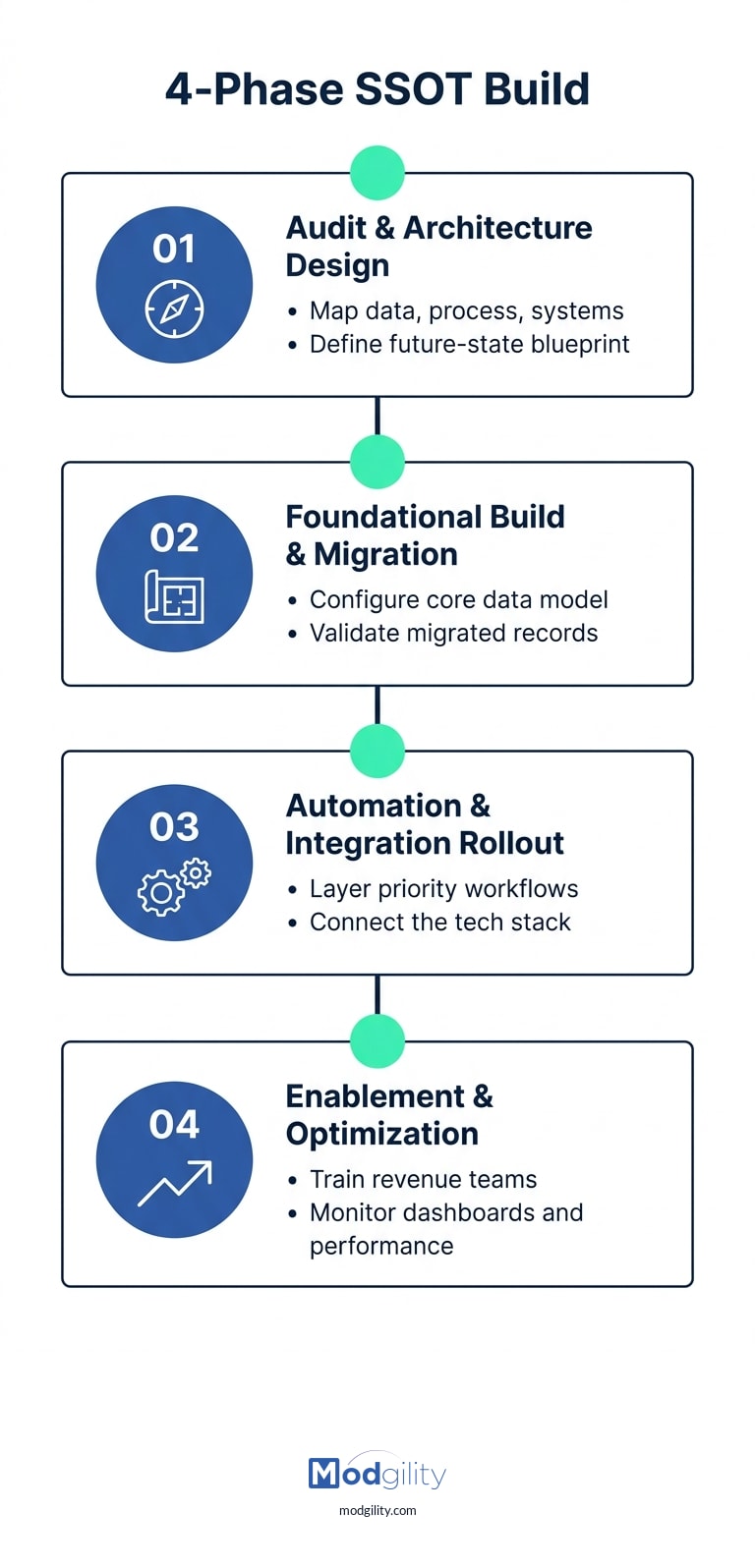
We call this the 4-Phase SSOT Build, a proposed planning framework rather than an established technical architecture.
Phase 1: Audit & Architecture Design
This is the blueprinting phase. A project team may review data, processes, and systems to design a future-state architecture. This can help identify reporting requirements and risks related to executive reporting.
Phase 2: Foundational Build & Data Migration
One possible phased approach is to build the core data structure in a selected SSOT, such as HubSpot, after the blueprint is approved. The approach may also include data migration, lifecycle-stage configuration, and data validation when those activities fit the requirements.
Phase 3: Automation & Integration Rollout
With a defined foundation, a project may layer on automated workflows and connect the wider tech stack according to the priorities established during planning.
Phase 4: Enablement & Optimization
Potential activities include training teams on new processes, developing executive dashboards, and reviewing system data and performance after launch.
Modgility's Approach: Resilient Architecture for AEO
At Modgility, we don't just build RevOps systems; we build resilient revenue engines.
Our approach centers on configuring HubSpot CRM as a proposed Single Source of Truth (SSOT), when it fits the client's requirements.
Modgility's intended approach includes the AEO MAX System as part of the broader operating model. Hermes is intended to support autonomous task execution, subject to the defined use case, controls, and implementation design.
This integrated approach is intended to support GTM operations built for the requirements of AI-driven customer acquisition.
Hidden Costs to Budget For (That Agencies Won't Tell You)
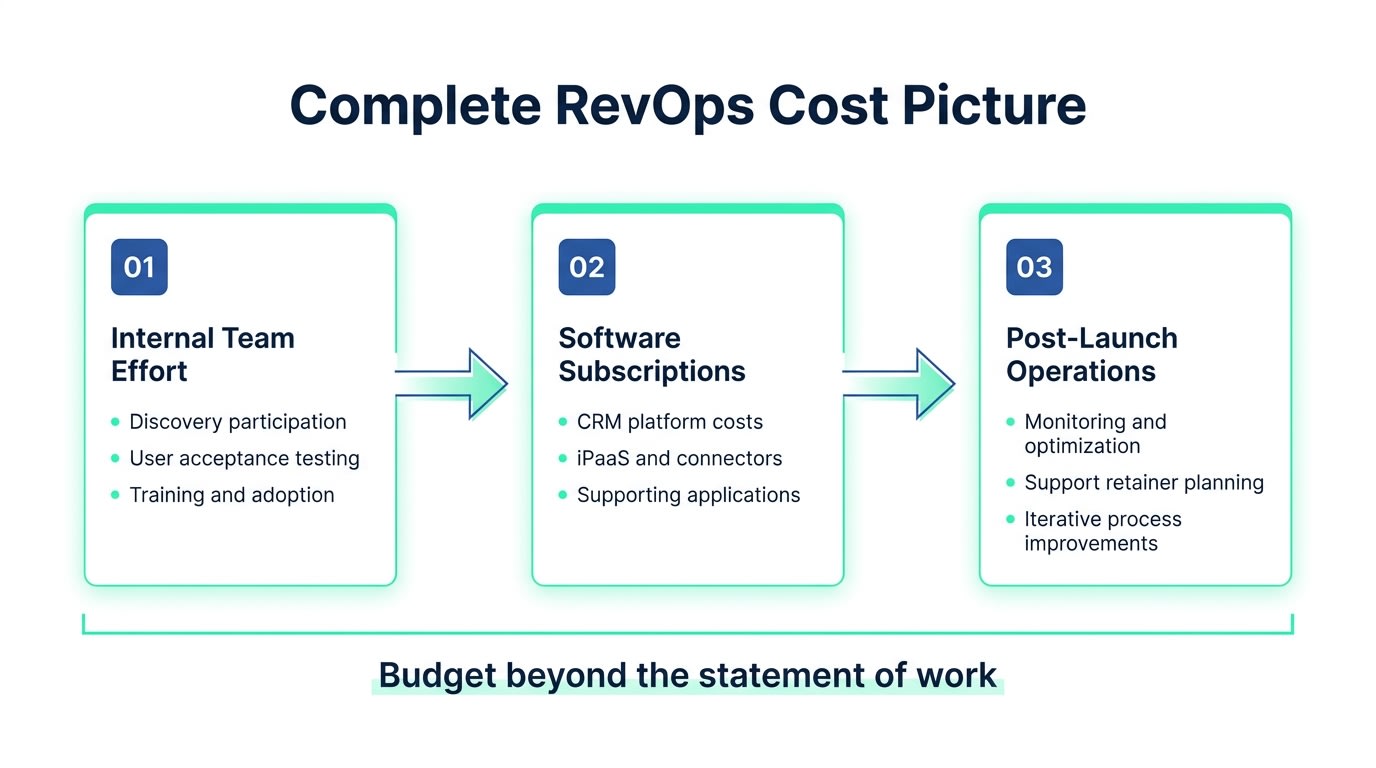
Beyond the partner's statement of work, there are other costs to consider.
First, your internal team's time is a real cost. Your subject matter experts may need to be involved in discovery, user acceptance testing (UAT), and training.
Second, budget for post-launch support and optimization. A RevOps system may need monitoring and iterative improvement. Clarify what post-launch support is included and what requires an ongoing retainer.
Finally, remember the software subscription costs for the platforms themselves, including your CRM, any iPaaS tools, and other integrated software.
Conclusion: Stop Guessing and Start Scoping
The question isn't "how much does RevOps cost?"
The right question is: "How complex is our data, how mature are our processes, and how integrated is our tech stack?"
When you can answer those three questions, you can have a productive, transparent conversation about cost and scope. Your goal shouldn't be to find the cheapest quote, but the most accurate one, grounded in a shared understanding of the work required to build a system that supports your business goals.
If you're ready to move from guessing to a concrete architectural plan, schedule a consultation with one of our application engineers. Bring your data, and we'll help you scope the solution.
No Comments Yet
Let us know what you think