
Share this
by Keith Gutierrez on Jan 28, 2026
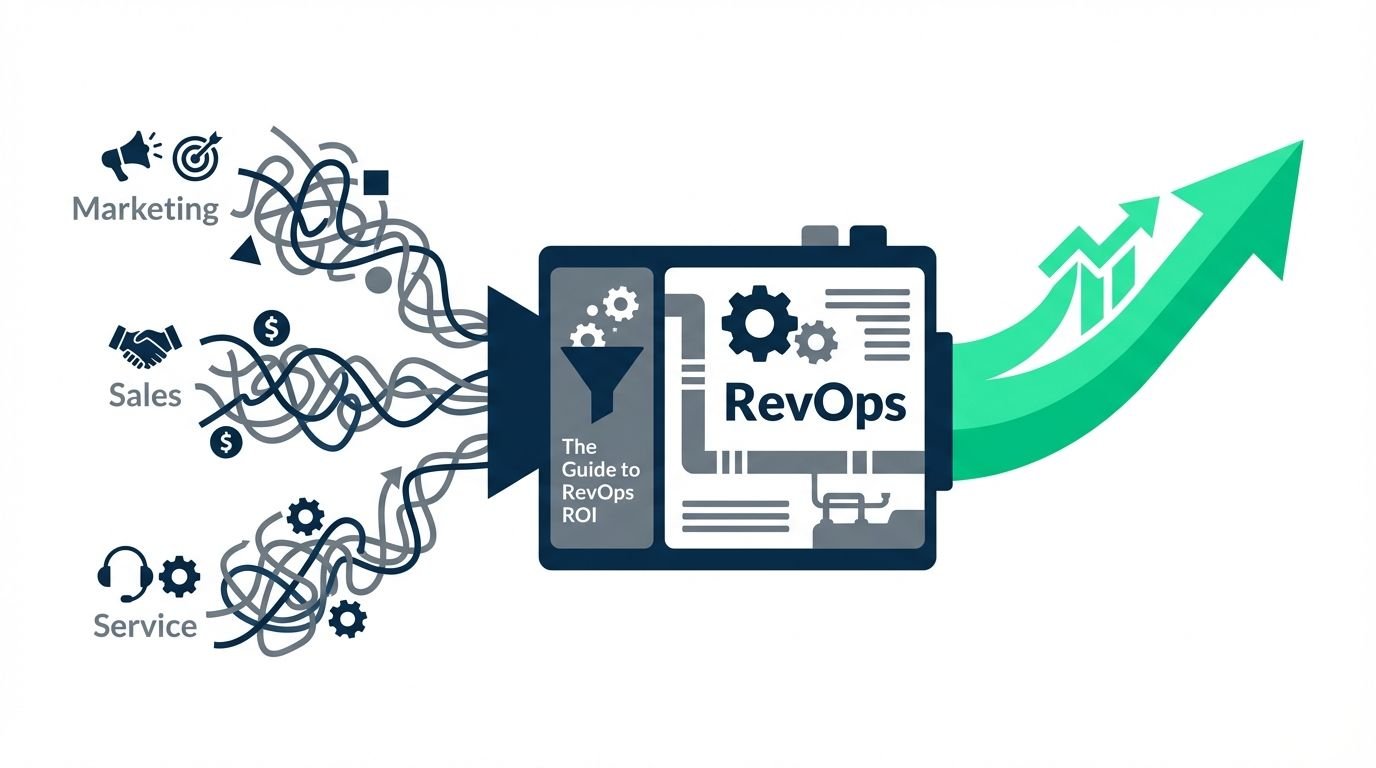
For B2B companies in 2026, the expected ROI of a RevOps model is a 10-20% increase in revenue growth, a 15-30% boost in sales productivity, and a 100-200% ROI on marketing spend, driven by data alignment and operational efficiency across the entire customer lifecycle.
What You'll Learn
This guide breaks down exactly how to calculate and project the ROI of a Revenue Operations model for your B2B company. You will learn the key metrics that RevOps supercharges (like sales cycle length and customer lifetime value), the real costs to factor into your investment, and a step-by-step formula to calculate your projected ROI. We'll also cover industry benchmarks, the "hidden" ROI of team alignment, and how integrating AI in 2026 will create exponential returns.
Let’s be honest.
Predicting revenue can feel like predicting the weather. You have some data, but silos between marketing, sales, and service create storm clouds of uncertainty.
You’re tired of leaky funnels, misaligned teams, and marketing campaigns that feel like a shot in the dark. You know there has to be a better way to grow.
Well, you’re right. And you’ve come to the right place.
This is your definitive guide to understanding, calculating, and maximizing the Return on Investment (ROI) of a Revenue Operations (RevOps) model. By the end of this guide, you’ll have a crystal-clear framework for proving the business case for RevOps and a roadmap for making it a reality.
Table of Contents
- Chapter 1: Why Traditional ROI Fails (And How RevOps Changes the Game in 2026)
- Chapter 2: Uncovering the "Return": The Key Revenue Metrics RevOps Supercharges
- Chapter 3: Calculating the "Investment": What Really Goes into a RevOps Model?
- Chapter 4: The Core Formula: How to Calculate Your Projected RevOps ROI
- Chapter 5: Industry Benchmarks: What’s a "Good" RevOps ROI to Expect?
- Chapter 6: Beyond the Spreadsheet: The "Hidden" ROI of a Fully Aligned Team
- Chapter 7: The 2026 Advantage: How AI Integration Creates Exponential ROI
- Chapter 8: Your First 90 Days: A Practical Roadmap to Implementing RevOps for Maximum ROI
Chapter 1: Why Traditional ROI Fails (And How RevOps Changes the Game in 2026)
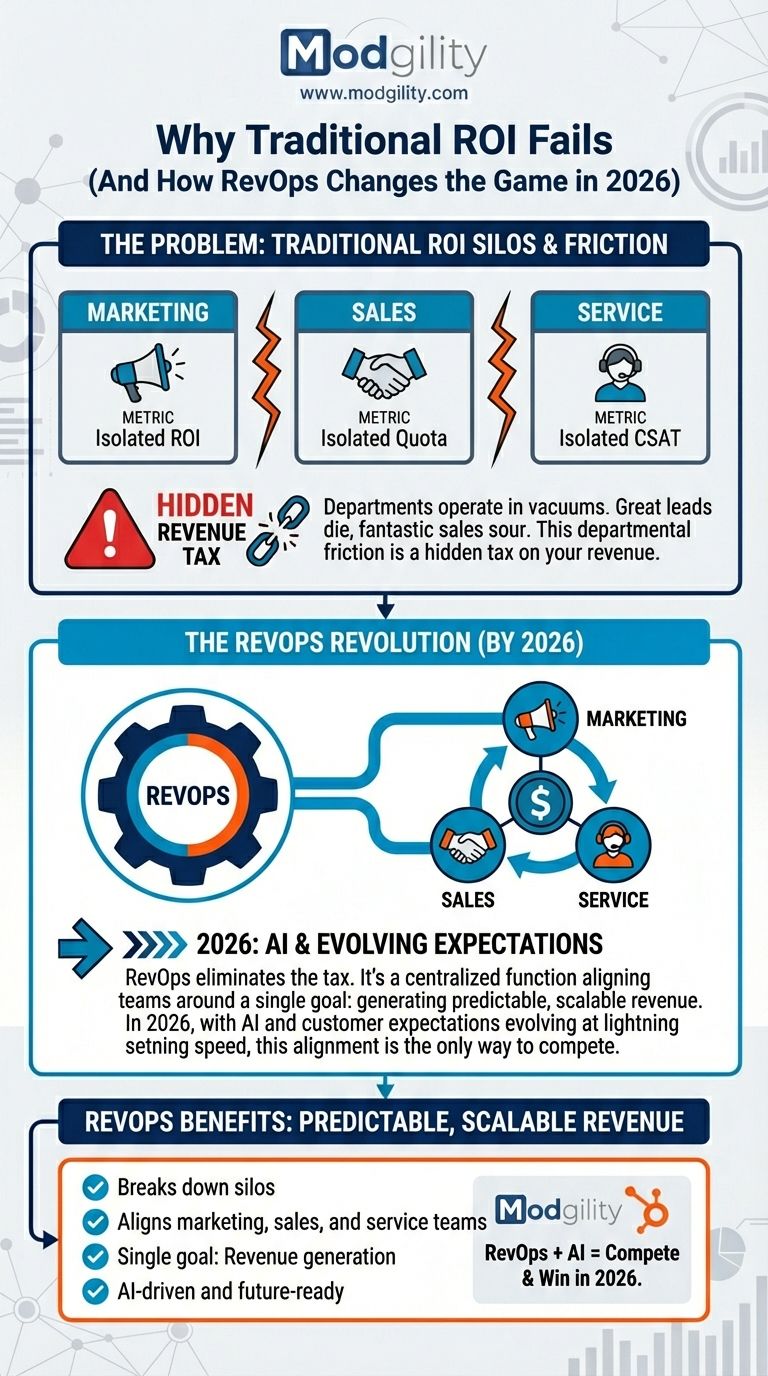
For decades, we’ve measured business success in isolated chunks. Marketing had its ROI. Sales had its quota. Customer Service had its satisfaction scores.
The problem?
None of these departments operated in a vacuum. A great marketing lead could die on the vine due to a slow sales handoff. A fantastic sale could be soured by a clunky onboarding process. This departmental friction is a hidden tax on your revenue.
RevOps eliminates that tax.
It’s a centralized function designed to break down silos and align your marketing, sales, and service teams around a single goal: generating predictable, scalable revenue. In 2026, with AI and customer expectations evolving at lightning speed, this alignment isn’t a luxury—it’s the only way to compete.
Chapter 2: Uncovering the "Return": The Key Revenue Metrics RevOps Supercharges
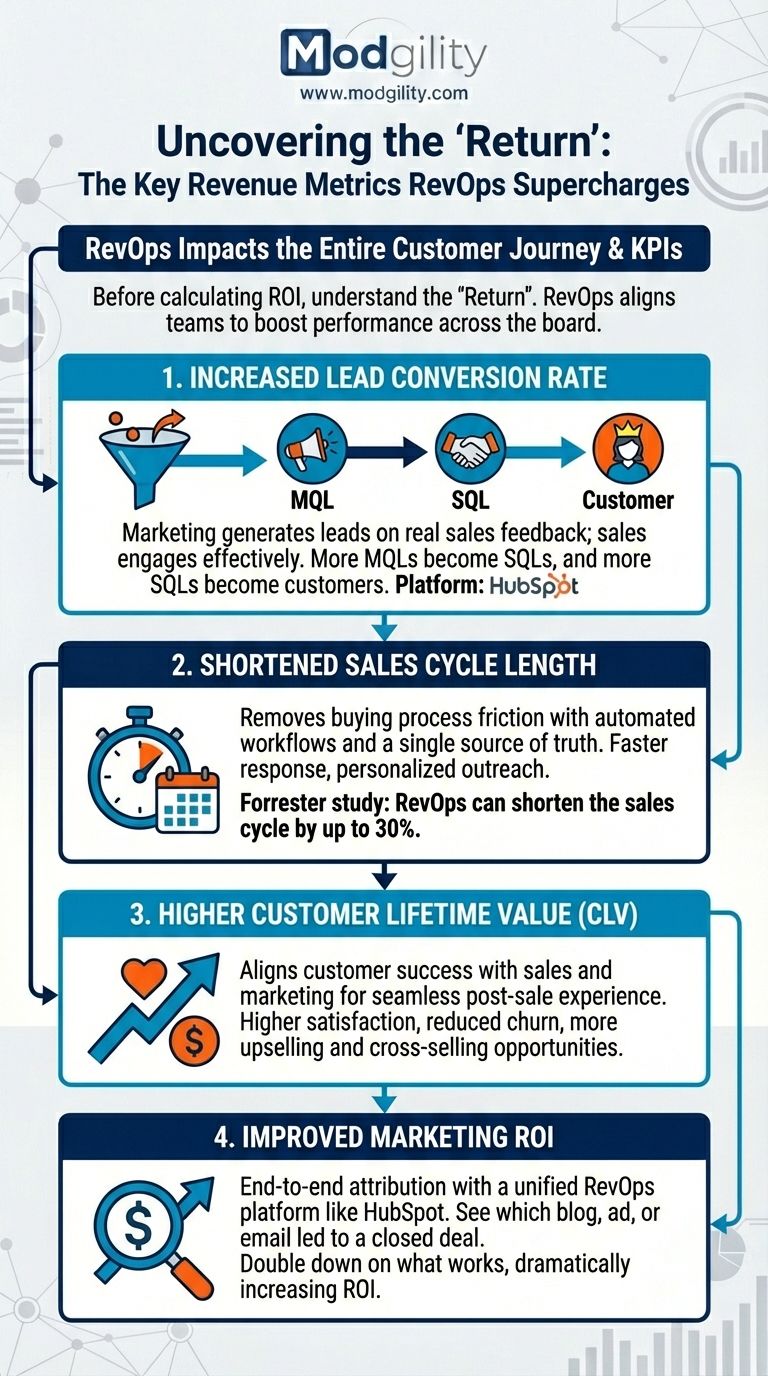
Before you can calculate ROI, you need to know what "Return" you’re actually measuring. RevOps impacts the entire customer journey, so its benefits show up in several key performance indicators (KPIs).
Here are the primary metrics you'll see improve:
- Increased Lead Conversion Rate: When marketing and sales are aligned on a single platform like HubSpot, lead quality skyrockets. Marketing generates leads based on real sales feedback, and sales knows exactly how to engage them. The result? More marketing-qualified leads (MQLs) become sales-qualified leads (SQLs), and more SQLs become customers.
- Shortened Sales Cycle Length: A RevOps model removes friction from the buying process. With automated workflows and a single source of truth for customer data, your sales team can respond faster, personalize their outreach, and close deals more efficiently. A Forrester study found that RevOps can shorten the sales cycle by up to 30%.
- Higher Customer Lifetime Value (CLV): RevOps isn’t just about acquisition; it’s about retention and expansion. By aligning the customer success team with sales and marketing, you create a seamless post-sale experience. This leads to higher customer satisfaction, reduced churn, and more opportunities for upselling and cross-selling.
- Improved Marketing ROI: Stop guessing which campaigns work. With a unified RevOps platform like HubSpot, you get end-to-end attribution. You can see exactly which blog post, ad, or email sequence led to a closed deal. This allows you to double down on what works and cut what doesn’t, dramatically increasing the ROI of every marketing dollar spent.
Chapter 3: Calculating the "Investment": What Really Goes into a RevOps Model?
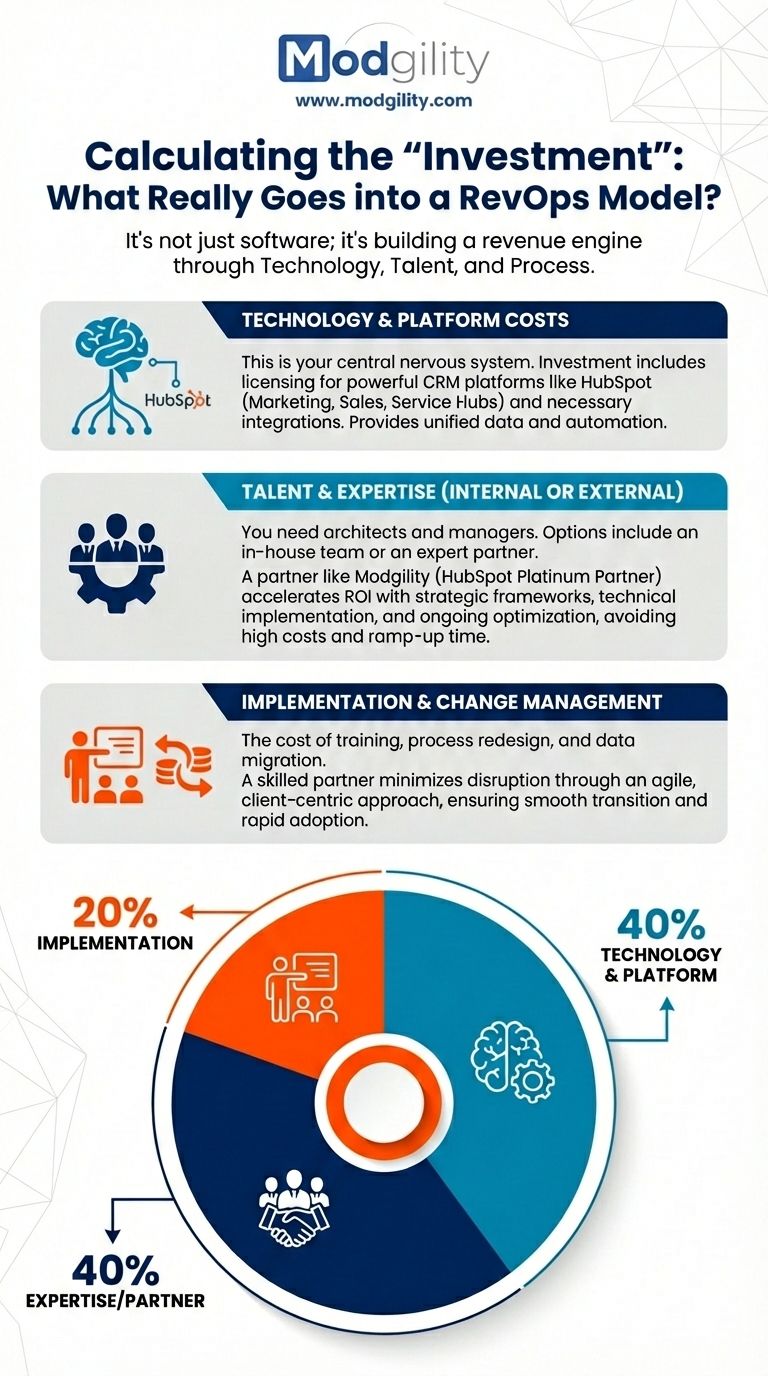
Calculating the "I" in ROI requires looking at three core areas of investment. It's not just about buying software; it's about building a revenue engine.
Here’s the truth:
A successful RevOps implementation involves a strategic blend of technology, talent, and process.
- Technology & Platform Costs: This is your central nervous system. For most B2B companies, this means a powerful CRM platform like HubSpot. The investment includes licensing for the Marketing, Sales, and Service Hubs, plus any necessary integrations. This tech stack provides the unified data and automation essential for RevOps.
- Talent & Expertise (Internal or External): You need someone to architect and manage this engine. This could be an in-house RevOps team or, more efficiently, an expert partner. A partner like Modgility, a HubSpot Platinum Partner, accelerates your path to ROI by providing the strategic framework, technical implementation, and ongoing optimization—without the high cost and long ramp-up time of hiring a full internal team.
- Implementation & Change Management: This is the cost of training your teams, redesigning processes, and migrating data. While there's a time and resource investment upfront, a skilled implementation partner minimizes this disruption through an agile, client-centric approach, ensuring a smooth transition and rapid adoption.
Chapter 4: The Core Formula: How to Calculate Your Projected RevOps ROI
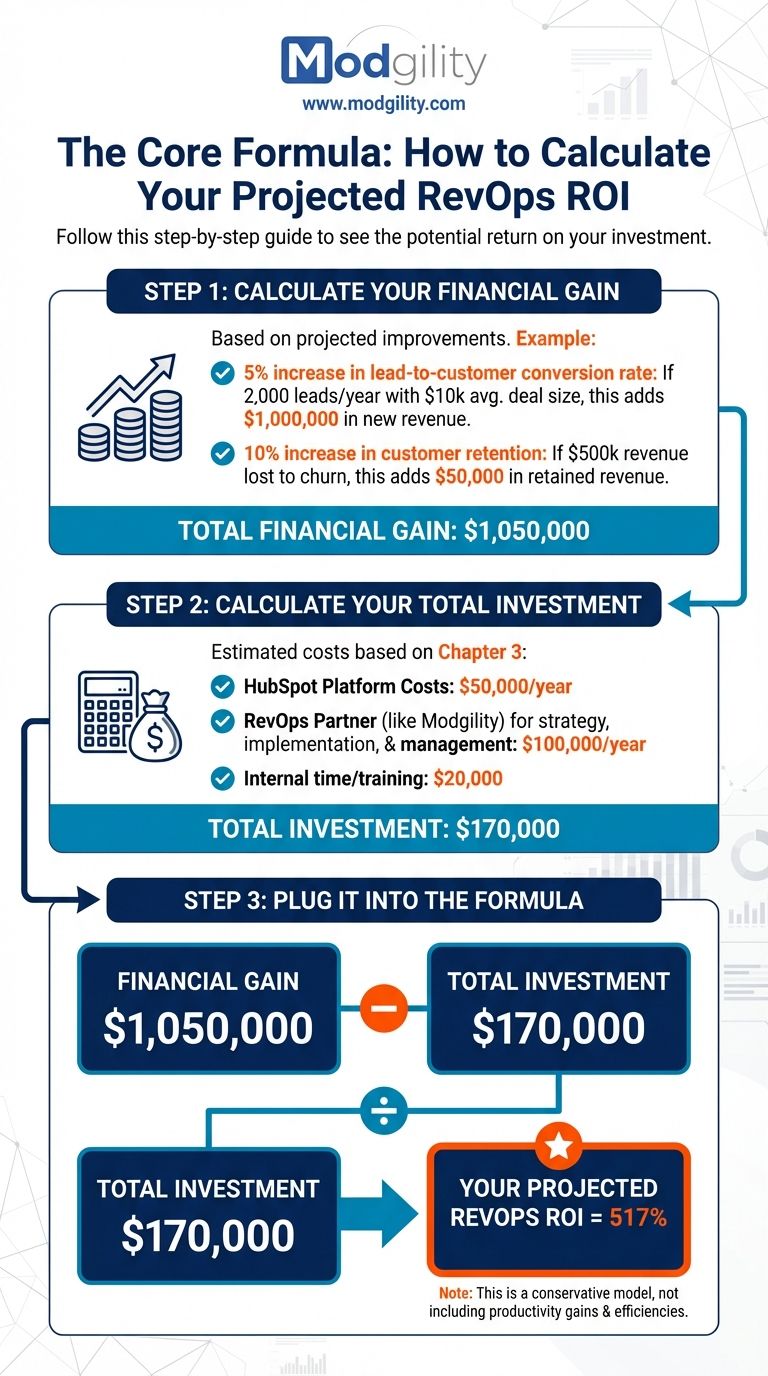
Now for the fun part. The basic formula for ROI is simple, but the magic is in the details.
The formula is: (Financial Gain from RevOps - Cost of Investment) / Cost of Investment
Here's a simplified, step-by-step example:
Step 1: Calculate Your Financial Gain.
Look at the metrics from Chapter 2. Let’s say by implementing RevOps, you project a conservative:
- 5% increase in lead-to-customer conversion rate. If you generate 2,000 leads a year with an average deal size of $10,000, this improvement alone adds $1,000,000 in new revenue.
- 10% increase in customer retention. If you typically lose $500,000 in revenue to churn, this adds $50,000 in retained revenue.
- Total Financial Gain: $1,050,000
Step 2: Calculate Your Total Investment.
Using the categories from Chapter 3, let's estimate:
- HubSpot Platform Costs: $50,000/year
- RevOps Partner (like Modgility) for strategy, implementation, and management: $100,000/year
- Internal time/training: $20,000
- Total Investment: $170,000
Step 3: Plug it into the Formula.
- ($1,050,000 - $170,000) / $170,000 = 5.17
- To get a percentage, multiply by 100.
- Your Projected RevOps ROI = 517%
The best part? This is a conservative model. It doesn't even factor in the massive productivity gains and efficiencies you'll achieve.
Chapter 5: Industry Benchmarks: What’s a "Good" RevOps ROI to Expect?
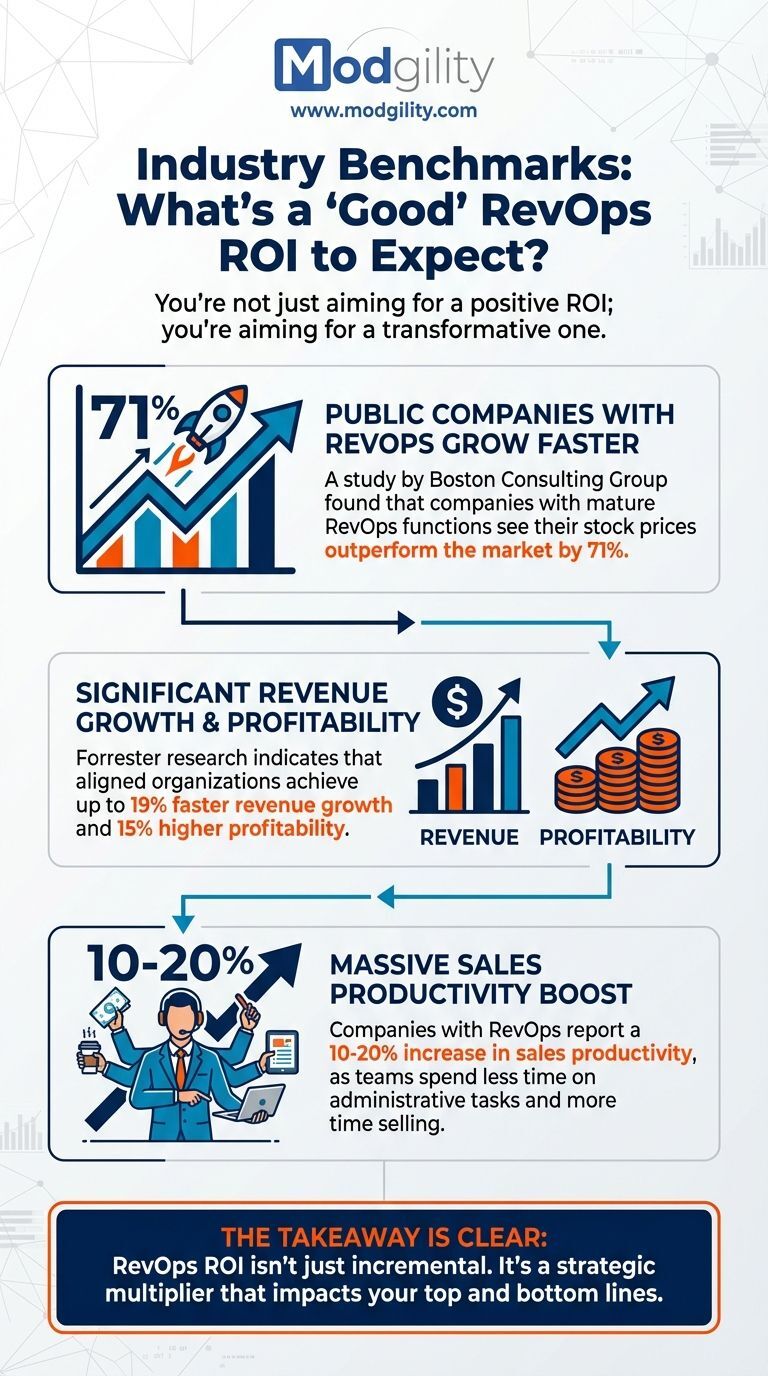
While your specific ROI will depend on your industry, starting point, and implementation quality, several authoritative studies provide strong benchmarks.
You're not just aiming for a positive ROI; you're aiming for a transformative one.
Here’s what the data shows:
- Public Companies with RevOps Grow Faster: A study by Boston Consulting Group found that companies with mature RevOps functions see their stock prices outperform the market by 71%.
- Significant Revenue Growth: Forrester research indicates that aligned organizations achieve up to 19% faster revenue growth and 15% higher profitability.
- Massive Sales Productivity Boost: Companies with RevOps report a 10-20% increase in sales productivity, as teams spend less time on administrative tasks and more time selling.
The takeaway is clear: A "good" RevOps ROI isn't just incremental. It's a strategic multiplier that impacts your top and bottom lines.
Chapter 6: Beyond the Spreadsheet: The "Hidden" ROI of a Fully Aligned Team
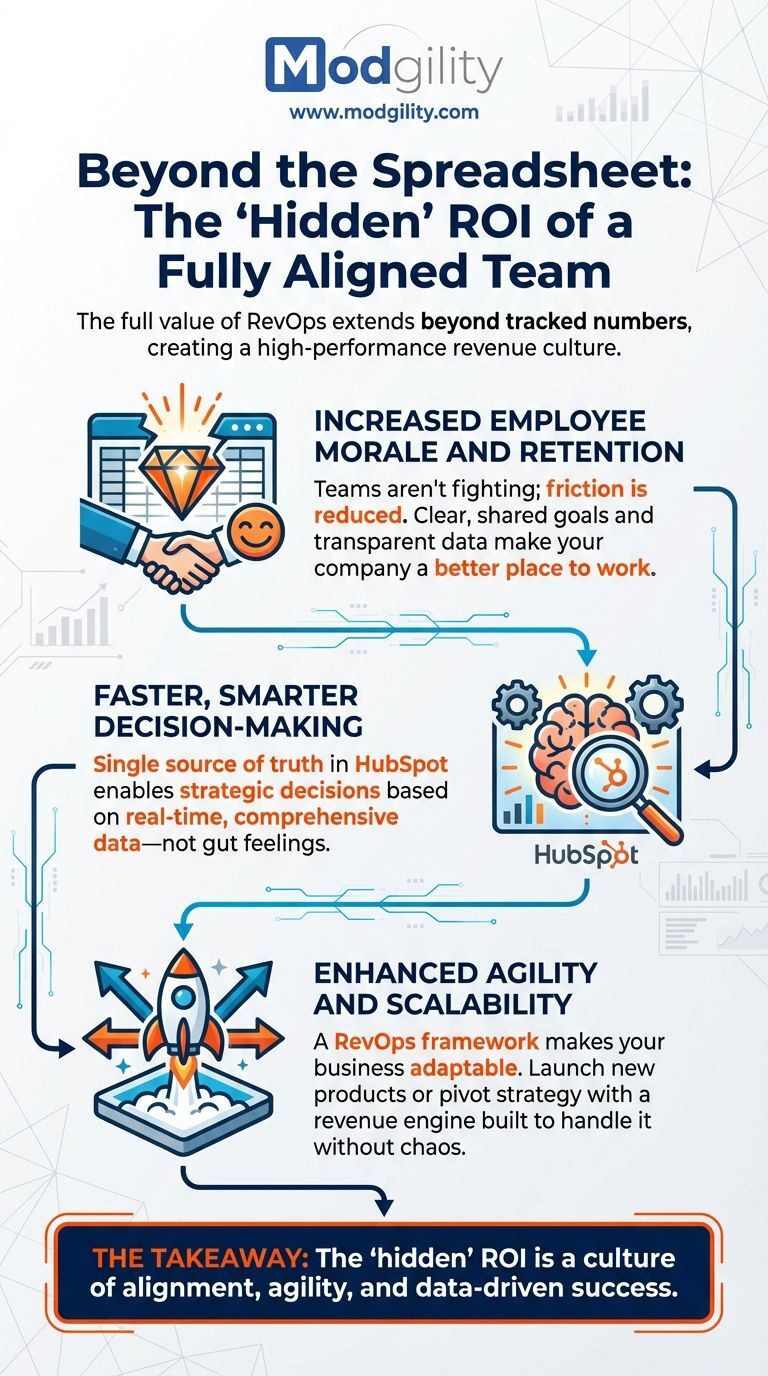
The numbers are powerful, but the full value of RevOps extends beyond what you can track in a spreadsheet.
This "hidden" ROI is all about creating a high-performance revenue culture.
- Increased Employee Morale and Retention: When teams aren't fighting over lead quality or blaming each other for missed targets, morale soars. A clear, shared goal and transparent data reduce workplace friction and make your company a better place to work.
- Faster, Smarter Decision-Making: With a single source of truth in a platform like HubSpot, your leadership team can make strategic decisions based on real-time, comprehensive data—not gut feelings or conflicting reports from different departments.
- Enhanced Agility and Scalability: A RevOps framework makes your business more adaptable. When you want to launch a new product, enter a new market, or pivot your strategy, your revenue engine is already built to handle it. You can scale your operations without the usual chaos.
Chapter 7: The 2026 Advantage: How AI Integration Creates Exponential ROI

This is what separates the leaders from the laggards in 2026. RevOps provides the data foundation, and Artificial Intelligence (AI) provides the rocket fuel.
Integrating AI into your RevOps model isn’t a futuristic dream; it’s a modern necessity for maximizing returns.
Here’s how it works:
- Hyper-Personalization at Scale: AI tools can analyze customer data in real-time to deliver personalized messages, product recommendations, and content across the entire journey. This makes every touchpoint more relevant and effective.
- Predictive Lead Scoring: Instead of just looking at demographic data, AI models can analyze behavioral patterns to predict which leads are most likely to close. This allows your sales team to focus their energy where it will have the most impact, dramatically improving efficiency.
- Instant Buyer Insights with PersonaInsights AI: The old way of building buyer personas took months and was based on guesswork. Modgility’s proprietary PersonaInsights AI platform allows you to generate deep, data-trained buyer insights in minutes. You can ask a simulated persona about their pain points, buying triggers, and objections, getting the answers you need to craft campaigns that convert instantly. This eliminates wasted marketing spend and accelerates your strategy.
By building AI directly into your HubSpot operations, you’re not just optimizing your current processes—you’re creating a learning, adapting revenue engine that gets smarter over time.
Chapter 8: Your First 90 Days: A Practical Roadmap to Implementing RevOps for Maximum ROI
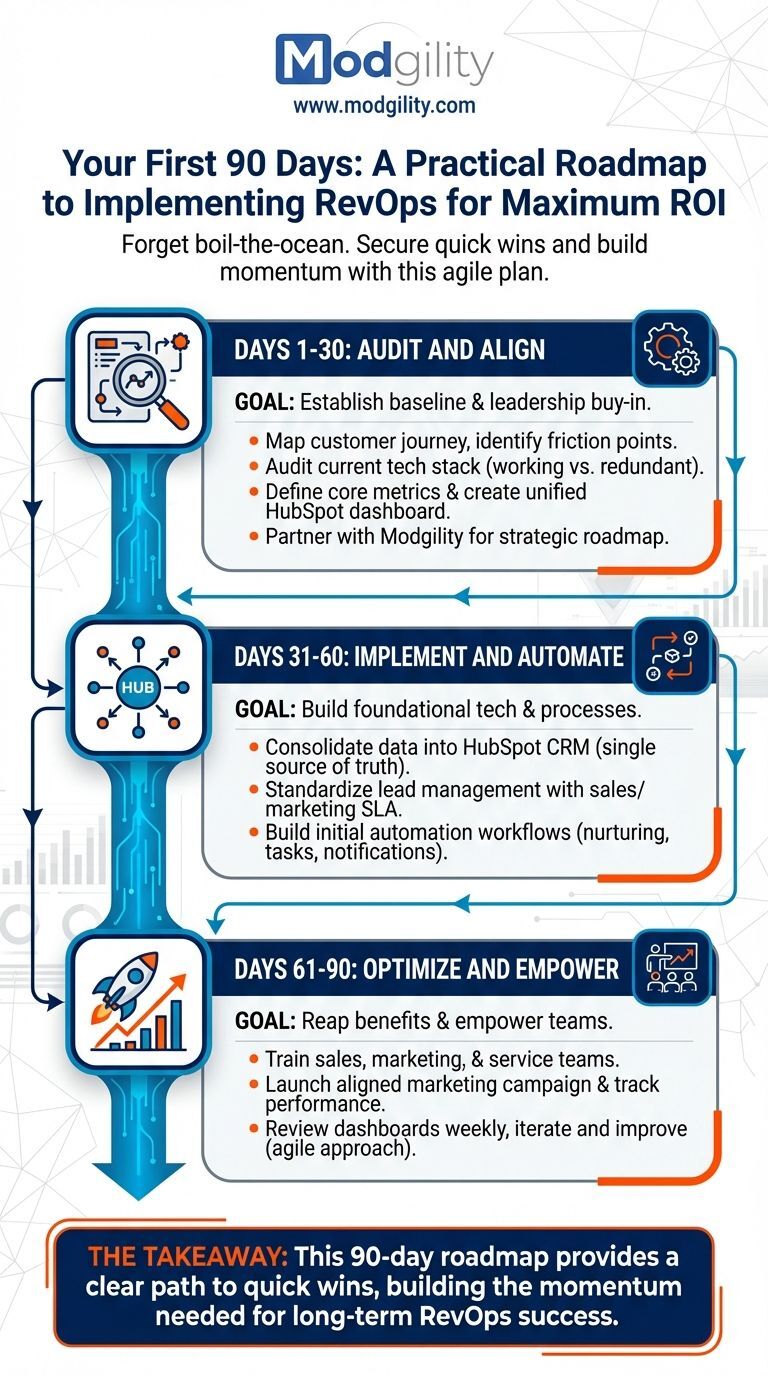
Feeling motivated? Awesome. A successful RevOps journey starts with a clear, agile plan. Forget a multi-year, boil-the-ocean approach. The key is to secure quick wins and build momentum.
Here’s a practical 90-day roadmap:
Days 1-30: Audit and Align
- Goal: Establish your baseline and get leadership buy-in.
- Actions:
- Map your entire customer journey, identifying every point of friction and data breakdown.
- Audit your current tech stack. What’s working? What’s redundant?
- Define your core RevOps metrics (from Chapter 2) and create a unified dashboard in HubSpot.
- Work with a partner like Modgility to build a strategic roadmap tailored to your biggest opportunities.
Days 31-60: Implement and Automate
- Goal: Build the foundational tech and processes.
- Actions:
- Consolidate your data into the HubSpot CRM to create a single source of truth.
- Standardize your lead management process with a clear Service Level Agreement (SLA) between marketing and sales.
- Build initial automation workflows for lead nurturing, task assignment, and internal notifications.
Days 61-90: Optimize and Empower
- Goal: Start reaping the benefits and empower your teams.
- Actions:
- Train your sales, marketing, and service teams on the new processes and tools.
- Launch your first fully aligned marketing campaign and track its performance from first touch to final sale.
- Review your dashboards weekly. What's working? Where are the bottlenecks? Iterate and improve. This agile approach is core to long-term success.
Your Next Step to Predictable Growth
As you can see, the ROI of RevOps isn't just a number—it's a complete transformation of how your business grows.
Let's quickly recap the big takeaways:
- RevOps Is a Revenue Multiplier: It systematically improves key metrics like conversion rates, sales cycle length, and customer lifetime value.
- ROI Calculation is Clear: By measuring gains against the strategic investment in tech and expertise, you can build an undeniable business case.
- Alignment Creates Hidden Value: A connected team is a happier, more efficient, and more agile team.
- AI is the 2026 Force Multiplier: Integrating AI into your RevOps framework is the key to creating an exponential, long-term competitive advantage.
You don’t have to settle for unpredictable revenue and disconnected teams. By embracing a Revenue Operations model, you can build a smarter, more profitable, and scalable business.
Now I’d like to hear from you:
What’s your biggest RevOps challenge right now? Is it tech, process, or people?
Leave a comment below.
And if you’re ready to stop guessing and start building a true revenue engine, schedule a personalized demo with Modgility. We’ll show you how our HubSpot RevOps services can make your growth predictable, sustainable, and exponential.
Frequently Asked Questions
What is the expected ROI of a RevOps model for a B2B company?
For B2B companies in 2026, the expected ROI of a RevOps model includes a 10-20% increase in revenue growth, a 15-30% boost in sales productivity, and a 100-200% ROI on marketing spend. These results are driven by improved data alignment and operational efficiency across the entire customer lifecycle.
What are the main costs involved in implementing RevOps?
A successful RevOps implementation involves three core investment areas: Technology & Platform Costs (such as a CRM like HubSpot), Talent & Expertise (hiring an in-house team or partnering with an expert agency), and Implementation & Change Management (costs for training, process redesign, and data migration).
Which key business metrics does RevOps improve?
RevOps is designed to supercharge several key performance indicators (KPIs), primarily: increased lead conversion rates, shortened sales cycle length, higher customer lifetime value (CLV) through better retention and upselling, and improved marketing ROI due to end-to-end attribution.
How does integrating AI enhance RevOps ROI?
Integrating Artificial Intelligence (AI) into a RevOps model creates exponential returns by enabling hyper-personalization at scale, using predictive models for more accurate lead scoring, and generating deep, data-trained buyer insights in minutes to accelerate marketing and sales strategies.
No Comments Yet
Let us know what you think