
Share this
by Keith Gutierrez on Jan 13, 2026
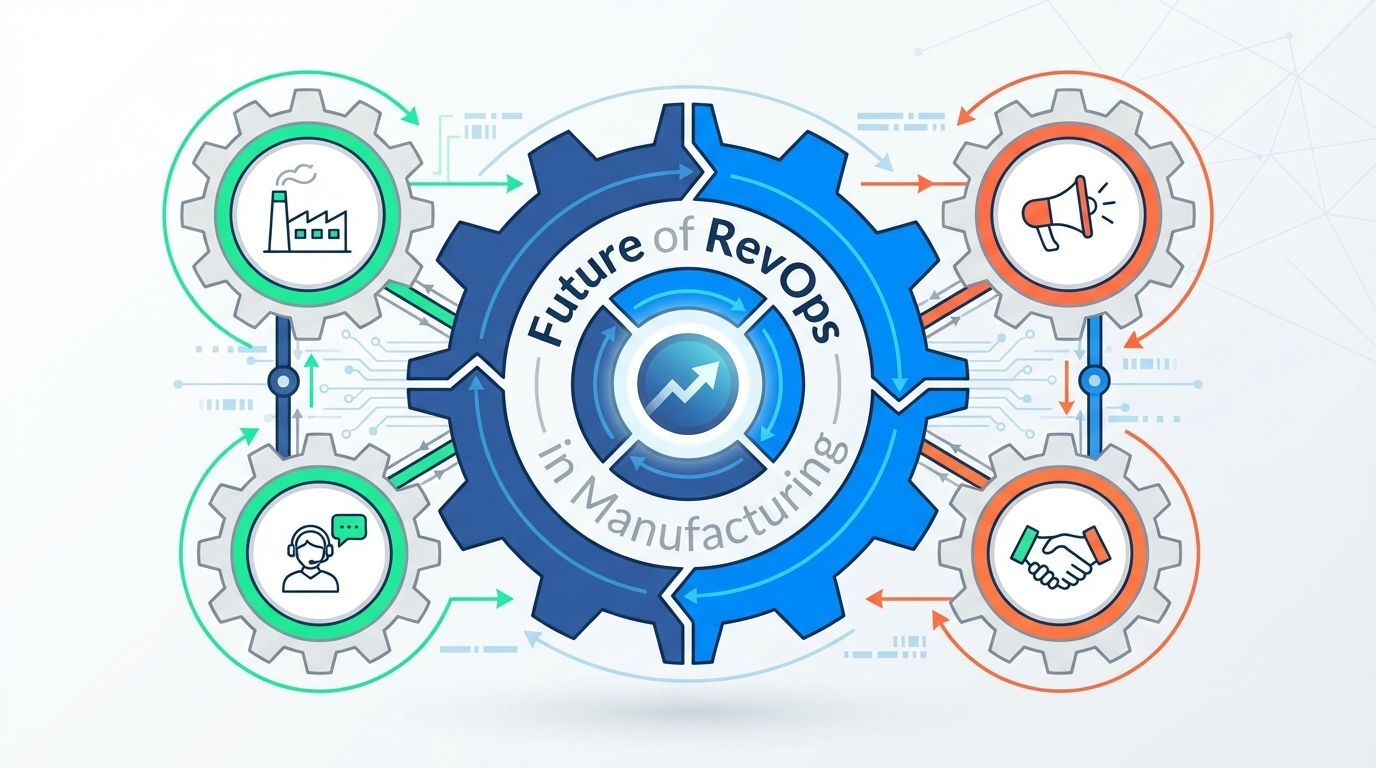
In 2026, RevOps in manufacturing will be defined by three core trends: AI-powered predictive analytics, hyper-personalization of the complex B2B buyer journey, and the complete unification of operational data (from the factory floor to the customer) to create a single, actionable source of truth.
What You'll Learn
For Marketing Directors in the manufacturing sector, understanding the evolution of Revenue Operations (RevOps) is key to building a competitive advantage. This article breaks down the essential RevOps trends that will shape the industry by 2026. We will explore how these shifts are moving beyond simple sales and marketing alignment to create a deeply integrated, intelligent, and customer-centric revenue engine.
The key takeaways include:
- AI-Powered Predictive Analytics: Moving from reactive reporting to proactive forecasting for demand, sales, and customer churn.
- Hyper-Personalization at Scale: Using advanced buyer insights to customize content and sales cycles for long, complex B2B buying committees.
- Total Data Unification: Integrating data from ERPs, CRM, and even IoT devices to create a 360-degree view of the customer lifecycle.
- Service as a Revenue Driver: Transforming post-sale service and support into a proactive, revenue-generating function through RevOps principles.
Trend 1: AI-Powered Predictive Analytics and Forecasting
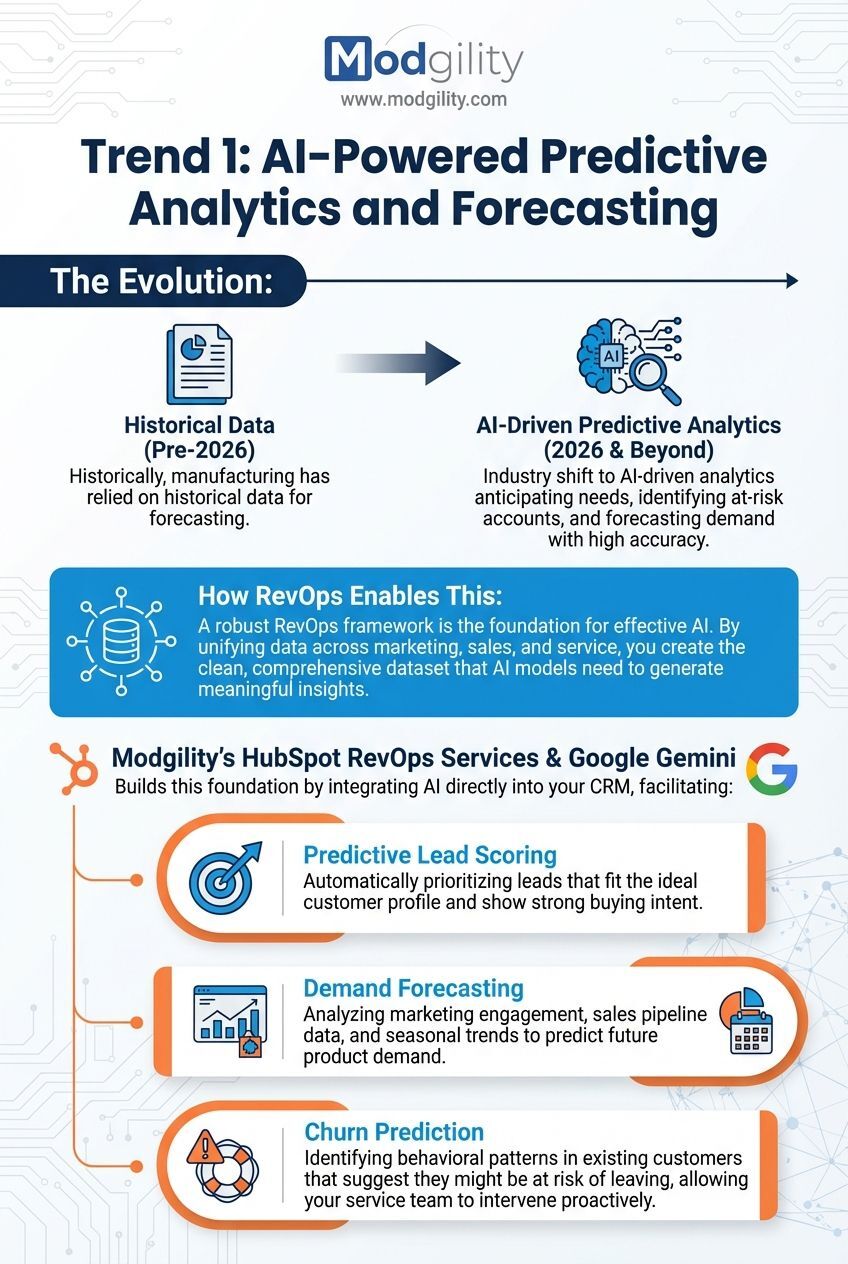
Historically, manufacturing has relied on historical data for forecasting. By 2026, the industry is projected to see a full shift toward AI-driven predictive analytics that anticipate market needs, identify at-risk accounts, and forecast demand with much higher accuracy.
This isn't just about sales numbers. It’s about predicting which product lines will see a surge in interest, when a key account might be looking to reorder spare parts, or which marketing leads have the highest probability of closing based on thousands of data points.
How RevOps Enables This:
A robust RevOps framework is the foundation for effective AI. By unifying data across marketing, sales, and service, you create the clean, comprehensive dataset that AI models need to generate meaningful insights.
A solution like Modgility's HubSpot RevOps Services is designed to build this foundation. By integrating AI tools like Google Gemini directly into your CRM, it facilitates:
- Predictive Lead Scoring: Automatically prioritizing leads that fit the ideal customer profile and show strong buying intent.
- Demand Forecasting: Analyzing marketing engagement, sales pipeline data, and seasonal trends to predict future product demand more accurately.
- Churn Prediction: Identifying behavioral patterns in existing customers that suggest they might be at risk of leaving, allowing your service team to intervene proactively.
Trend 2: Hyper-Personalization of the B2B Buyer Journey
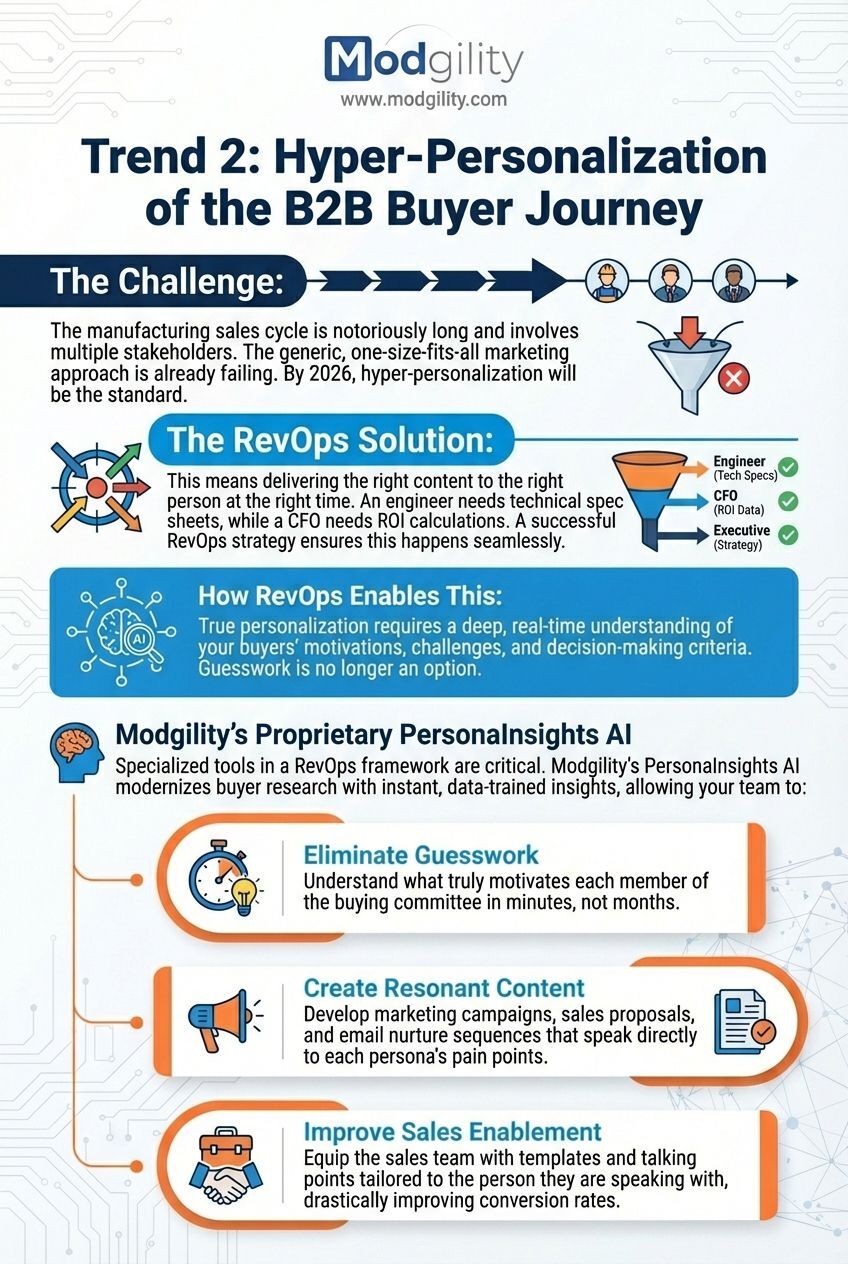
The manufacturing sales cycle is notoriously long and involves multiple stakeholders—from engineers to procurement officers to C-suite executives. The generic, one-size-fits-all marketing approach is already failing. By 2026, hyper-personalization will be the standard.
This means delivering the right content to the right person at the right time. An engineer needs technical spec sheets, while a CFO needs ROI calculations. A successful RevOps strategy ensures this happens seamlessly.
How RevOps Enables This:
True personalization requires a deep, real-time understanding of your buyers' motivations, challenges, and decision-making criteria. Guesswork is no longer an option.
This is where specialized tools integrated into a RevOps framework become critical. For example, Modgility's proprietary PersonaInsights AI platform modernizes buyer research by delivering instant, data-trained insights. This allows marketing and sales teams to:
- Eliminate Guesswork: Understand what truly motivates each member of the buying committee in minutes, not months.
- Create Resonant Content: Develop marketing campaigns, sales proposals, and email nurture sequences that speak directly to each persona's specific pain points.
- Improve Sales Enablement: Equip the sales team with templates and talking points tailored to the person they are speaking with, drastically improving conversion rates.
Trend 3: Unification of Operational and Customer Data
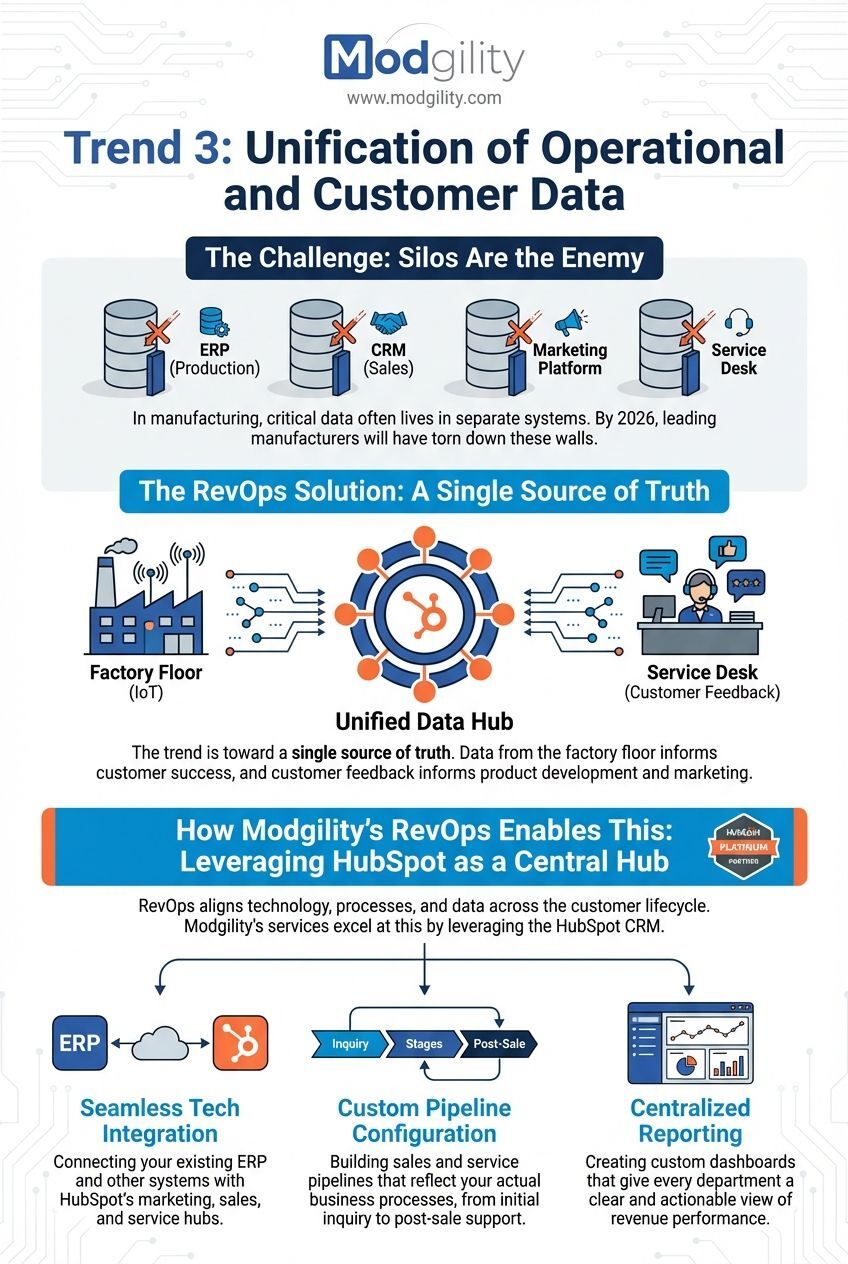
Silos are the enemy of growth. In manufacturing, critical data often lives in separate systems: an ERP for production, a CRM for sales, a marketing automation platform, and service desk software. By 2026, leading manufacturers will have torn down these walls by focusing on unifying operational and customer data into a single source of truth.
The trend is toward a single source of truth where data from the factory floor (e.g., IoT sensor data on product usage) informs the customer success team, and customer feedback from the service desk informs future product development and marketing messages.
How RevOps Enables This:
RevOps is the strategic discipline focused on creating this unified view. The goal is to align technology, processes, and data across the entire customer lifecycle.
As HubSpot Platinum Partners, Modgility’s RevOps services excel at this by leveraging the HubSpot CRM as a central hub. Their approach includes:
- Seamless Tech Integration: Connecting your existing ERP and other systems with HubSpot’s marketing, sales, and service hubs.
- Custom Pipeline Configuration: Building sales and service pipelines that reflect your actual business processes, from initial inquiry to post-sale support.
- Centralized Reporting: Creating custom dashboards that give every department—from marketing to the executive team—a clear and actionable view of revenue performance.
Trend 4: The Rise of "Service-as-a-Revenue-Driver"
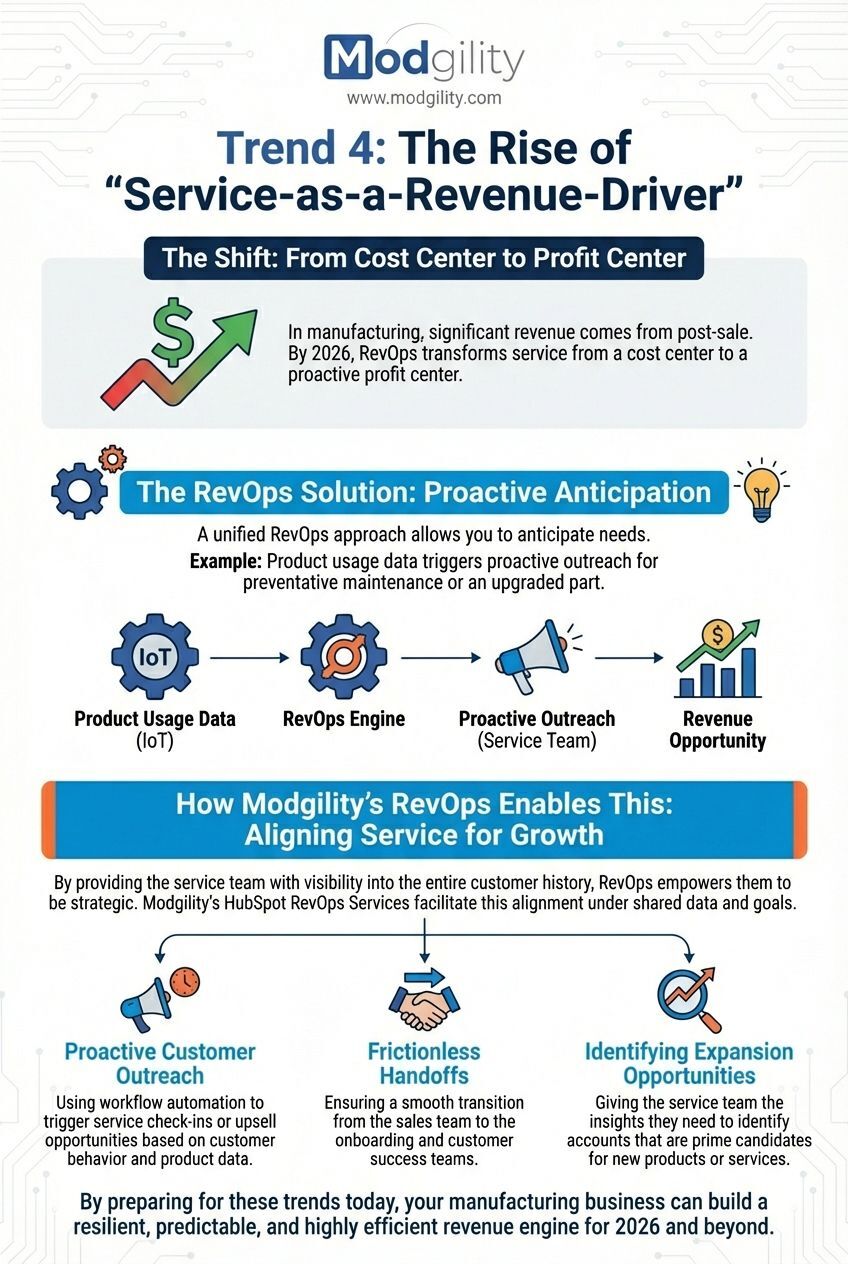
In manufacturing, significant revenue comes from post-sale activities: service contracts, spare parts, and system upgrades. By 2026, RevOps will fully integrate the customer service function into the revenue engine, transforming it from a cost center into a proactive profit center.
Instead of waiting for a customer to report a problem, a unified RevOps approach allows you to anticipate needs. For example, product usage data could trigger a proactive outreach from your service team about preventative maintenance or a timely offer for an upgraded part.
How RevOps Enables This:
By providing the service team with visibility into the entire customer history—from the marketing materials they first saw to their full sales cycle—RevOps empowers them to be more strategic.
Modgility’s HubSpot RevOps Services facilitate this by aligning the customer success team with marketing and sales under one shared set of data and goals. This enables:
- Proactive Customer Outreach: Using workflow automation to trigger service check-ins or upsell opportunities based on customer behavior and product data.
- Frictionless Handoffs: Ensuring a smooth transition from the sales team to the onboarding and customer success teams.
- Identifying Expansion Opportunities: Giving the service team the insights they need to identify accounts that are prime candidates for new products or services.
By preparing for these trends today, your manufacturing business can build a resilient, predictable, and highly efficient revenue engine for 2026 and beyond.
Frequently Asked Questions
What are the key RevOps trends expected in manufacturing by 2026?
By 2026, the key RevOps trends in manufacturing will be the use of AI-powered predictive analytics for forecasting, the hyper-personalization of the B2B buyer journey, the complete unification of operational and customer data into a single source of truth, and the transformation of customer service into a proactive, revenue-driving function.
How does AI-powered predictive analytics change manufacturing RevOps?
AI-powered predictive analytics shifts manufacturing from relying on historical data to using proactive forecasting. This allows businesses to anticipate market needs, predict product demand, identify at-risk customer accounts, and score marketing leads with much higher accuracy, creating a more intelligent revenue engine.
Why is data unification important for RevOps in manufacturing?
Data unification is crucial because it breaks down data silos between separate systems like ERPs, CRMs, and marketing platforms. By integrating this data, manufacturers can create a single source of truth, providing a complete 360-degree view of the customer lifecycle to inform everything from marketing to product development.
How does RevOps transform customer service in manufacturing?
RevOps transforms customer service from a reactive cost center into a proactive profit center. By unifying customer data, service teams can anticipate needs like maintenance or upgrades, perform proactive outreach, and identify expansion opportunities, turning post-sale support into a revenue-driving function.
No Comments Yet
Let us know what you think