
Share this
by Keith Gutierrez on Jan 26, 2026
To optimize HubSpot Sales Hub for a B2B manufacturing company, you must customize deal pipelines for long, complex sales cycles; automate lead routing to technical experts; and implement sales playbooks for detailed product specifications. A strategic implementation is essential to align the platform with your unique operational workflows.
What You'll Learn
This article provides a definitive guide for mid-market B2B manufacturing leaders on how to transform HubSpot Sales Hub from a simple CRM into a high-performance revenue engine. Here’s a summary of the key optimization strategies we'll cover:
- Customizing Deal Pipelines to match your complex, multi-stage sales process.
- Automating Key Sales Tasks to free up your reps for high-value conversations.
- Implementing Sales Playbooks to ensure consistent messaging for technical products.
- Developing Accurate Forecasting for better production and inventory management.
- Integrating Sales and Operations for a unified view of the customer lifecycle.
Why a Standard CRM Setup Fails for B2B Manufacturing
Mid-market B2B manufacturing companies operate differently than other businesses. Your sales cycles are longer, involve multiple decision-makers (from engineers to procurement), and rely on deep technical knowledge. A generic CRM setup simply can’t keep up.
Using spreadsheets or a poorly configured CRM leads to inaccurate forecasts, inconsistent follow-up, and a frustrating disconnect between marketing, sales, and production. To drive growth, you need a system built around your specific process. This is where a strategic HubSpot Sales Hub Implementation makes all the difference.
5 Key Strategies to Optimize HubSpot Sales Hub for Manufacturing
Here are the most effective ways to configure HubSpot Sales Hub to meet the specific demands of a B2B manufacturing environment.
1. Customize Your Deal Pipeline for a Complex Sales Cycle
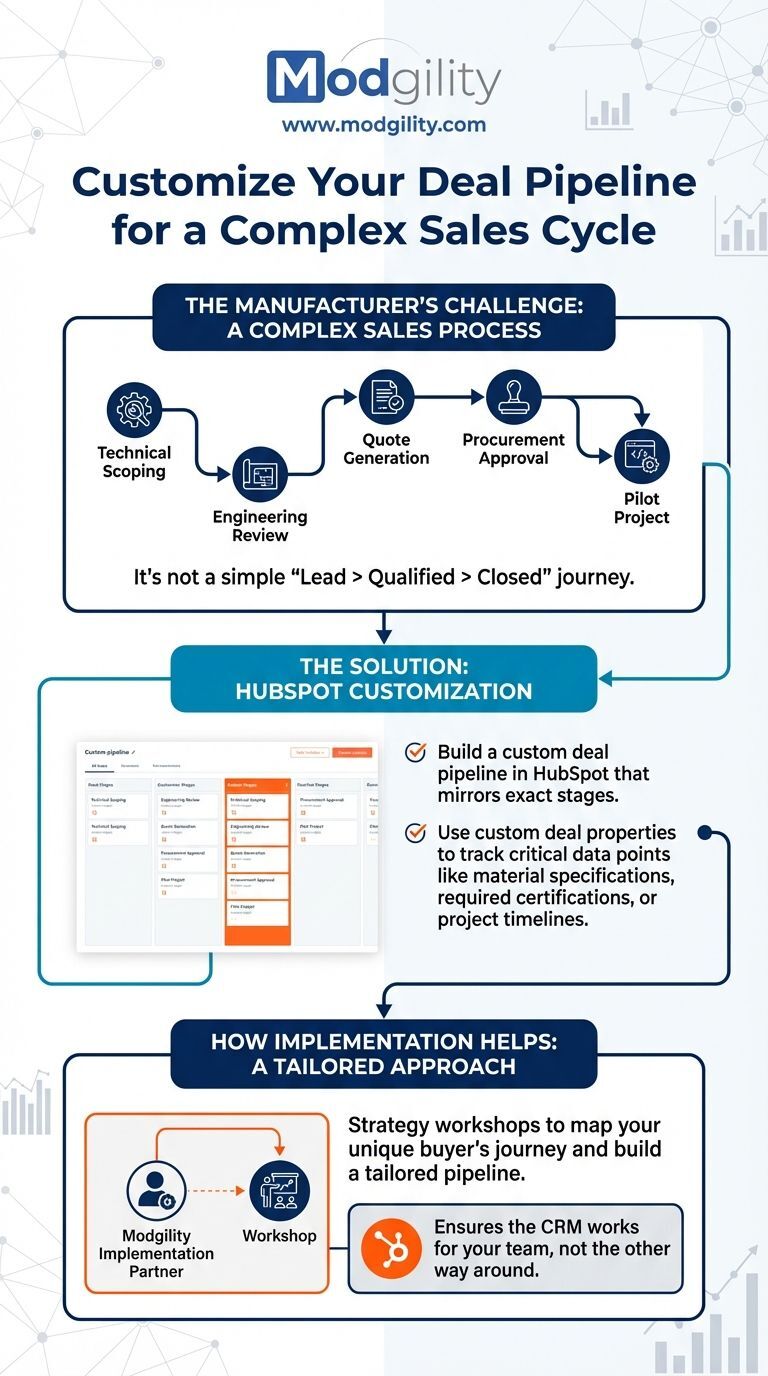
A manufacturer's sales process isn't a simple "Lead > Qualified > Closed" journey. It includes stages like "Technical Scoping," "Engineering Review," "Quote Generation," "Procurement Approval," and "Pilot Project."
- The Solution: Build a custom deal pipeline in HubSpot that mirrors these exact stages. Use custom deal properties to track critical data points like material specifications, required certifications, or project timelines.
- How Implementation Helps: A HubSpot Sales Hub Implementation service is designed for this. During initial strategy workshops, an implementation partner like Modgility will map your unique buyer’s journey and build a tailored pipeline. This ensures the CRM works for your team, not the other way around.
2. Automate Lead Routing and Task Management
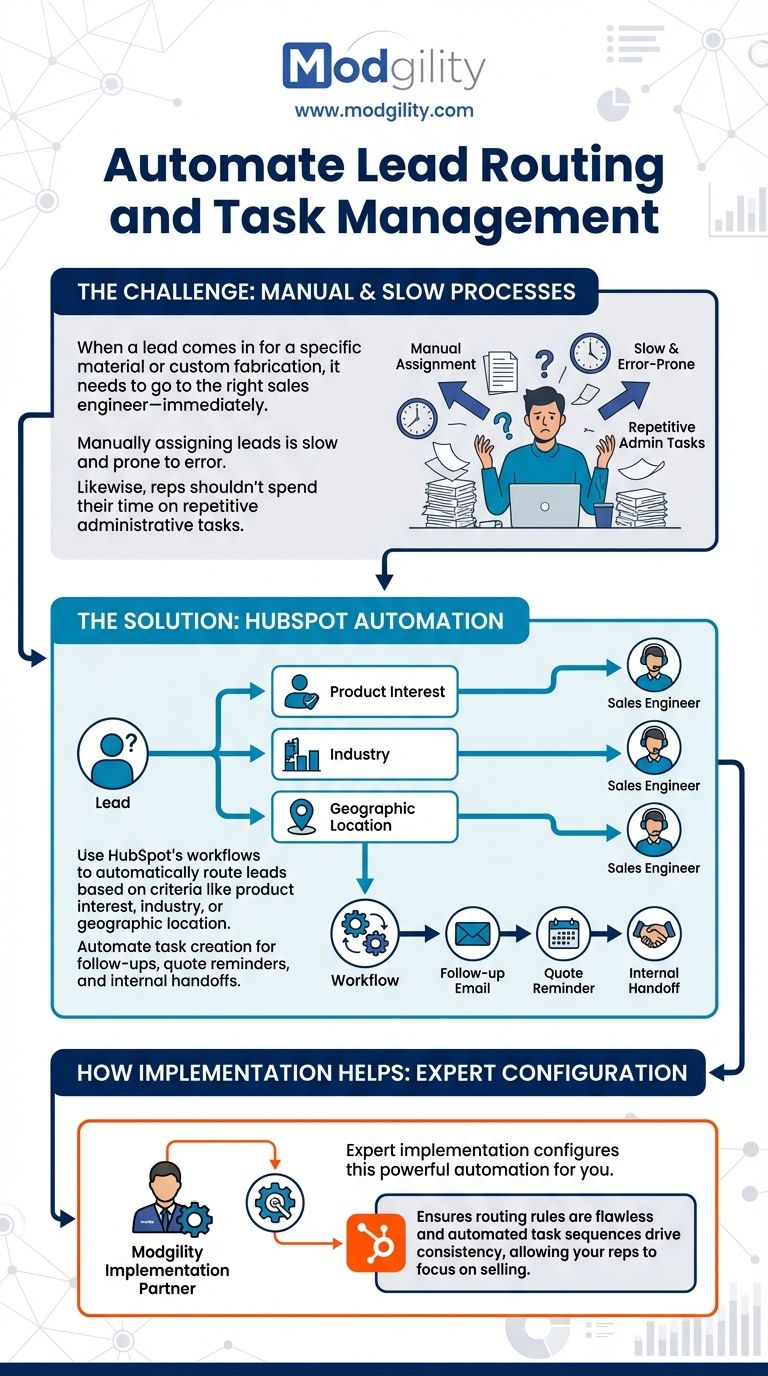
When a lead comes in for a specific material or custom fabrication, it needs to go to the right sales engineer—immediately. Manually assigning leads is slow and prone to error. Likewise, reps shouldn't spend their time on repetitive administrative tasks.
- The Solution: Use HubSpot’s workflows to automatically route leads based on criteria like product interest, industry, or geographic location. Automate task creation for follow-ups, quote reminders, and internal handoffs.
- How Implementation Helps: Expert implementation configures this powerful automation for you. A partner ensures that routing rules are flawless and that automated task sequences are designed to drive consistency, allowing your reps to focus on selling.
3. Implement Sales Playbooks for Technical Products
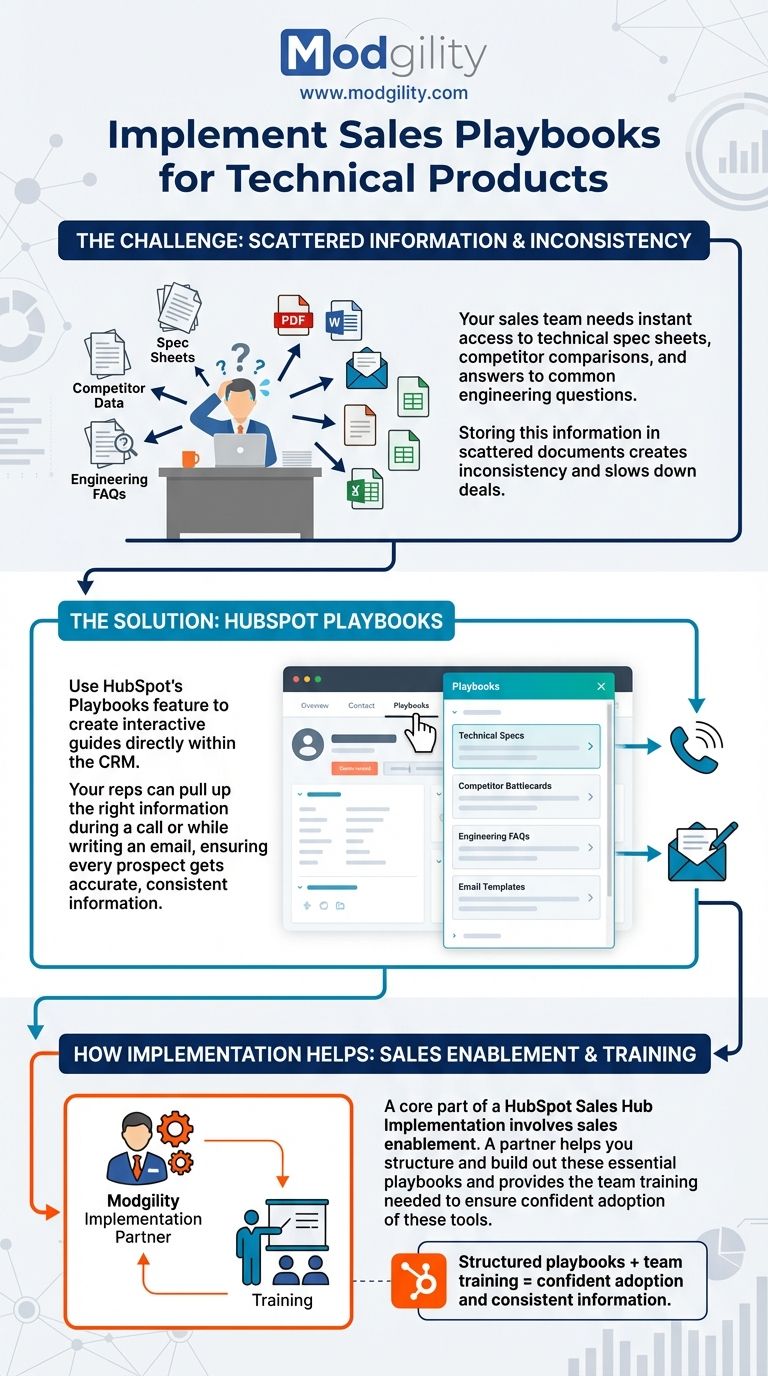
Your sales team needs instant access to technical spec sheets, competitor comparisons, and answers to common engineering questions. Storing this information in scattered documents creates inconsistency and slows down deals.
- The Solution: Use HubSpot's Playbooks feature to create interactive guides directly within the CRM. Your reps can pull up the right information during a call or while writing an email, ensuring every prospect gets accurate, consistent information.
- How Implementation Helps: A core part of a HubSpot Sales Hub Implementation involves sales enablement. A partner helps you structure and build out these essential playbooks and provides the team training needed to ensure confident adoption of these tools.
4. Gain Accurate Forecasting with Data-Driven Insights
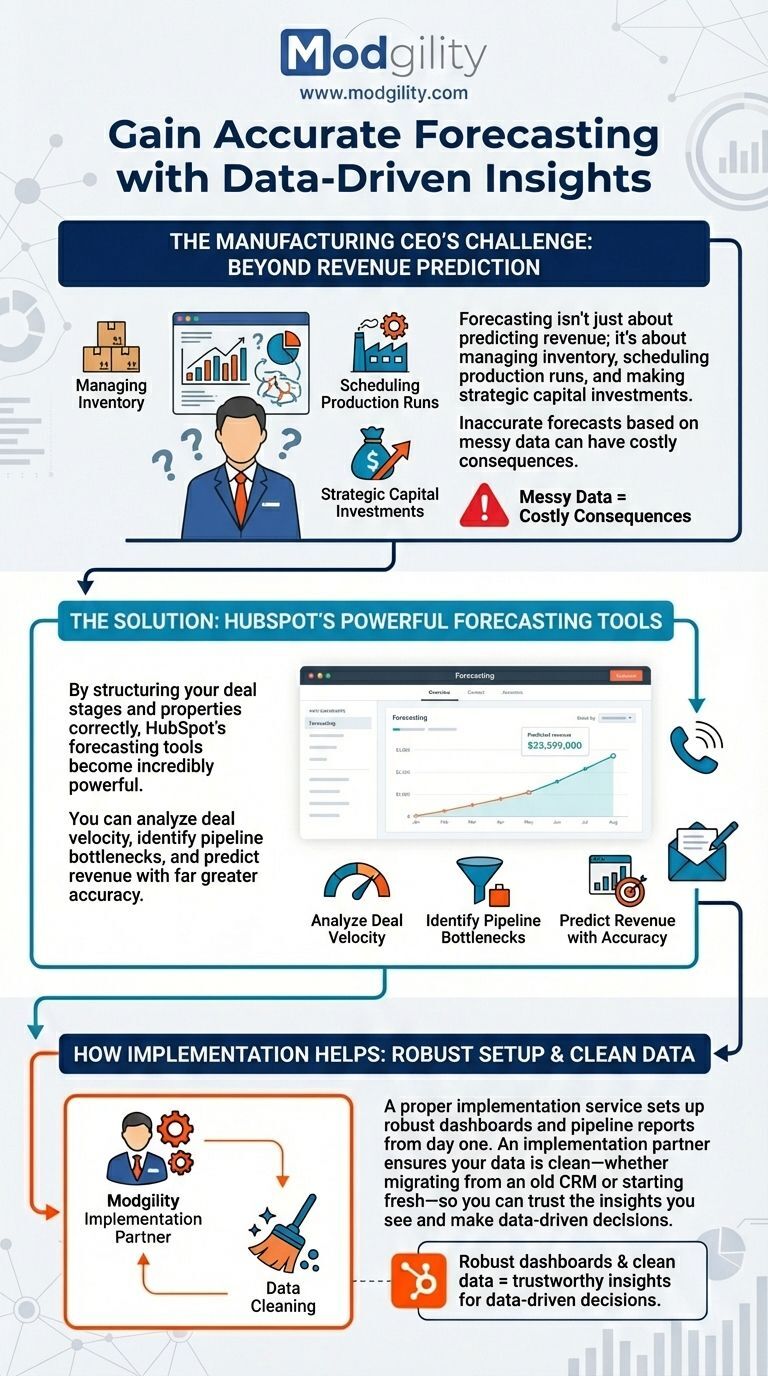
For a manufacturing CEO, forecasting isn't just about predicting revenue; it's about managing inventory, scheduling production runs, and making strategic capital investments. Inaccurate forecasts based on messy data can have costly consequences.
- The Solution: By structuring your deal stages and properties correctly, HubSpot’s forecasting tools become incredibly powerful. You can analyze deal velocity, identify pipeline bottlenecks, and predict revenue with far greater accuracy.
- How Implementation Helps: A proper implementation service sets up robust dashboards and pipeline reports from day one. An implementation partner ensures your data is clean—whether migrating from an old CRM or starting fresh—so you can trust the insights you see and make data-driven decisions.
5. Unify Sales with Marketing and Service for a Full Funnel View
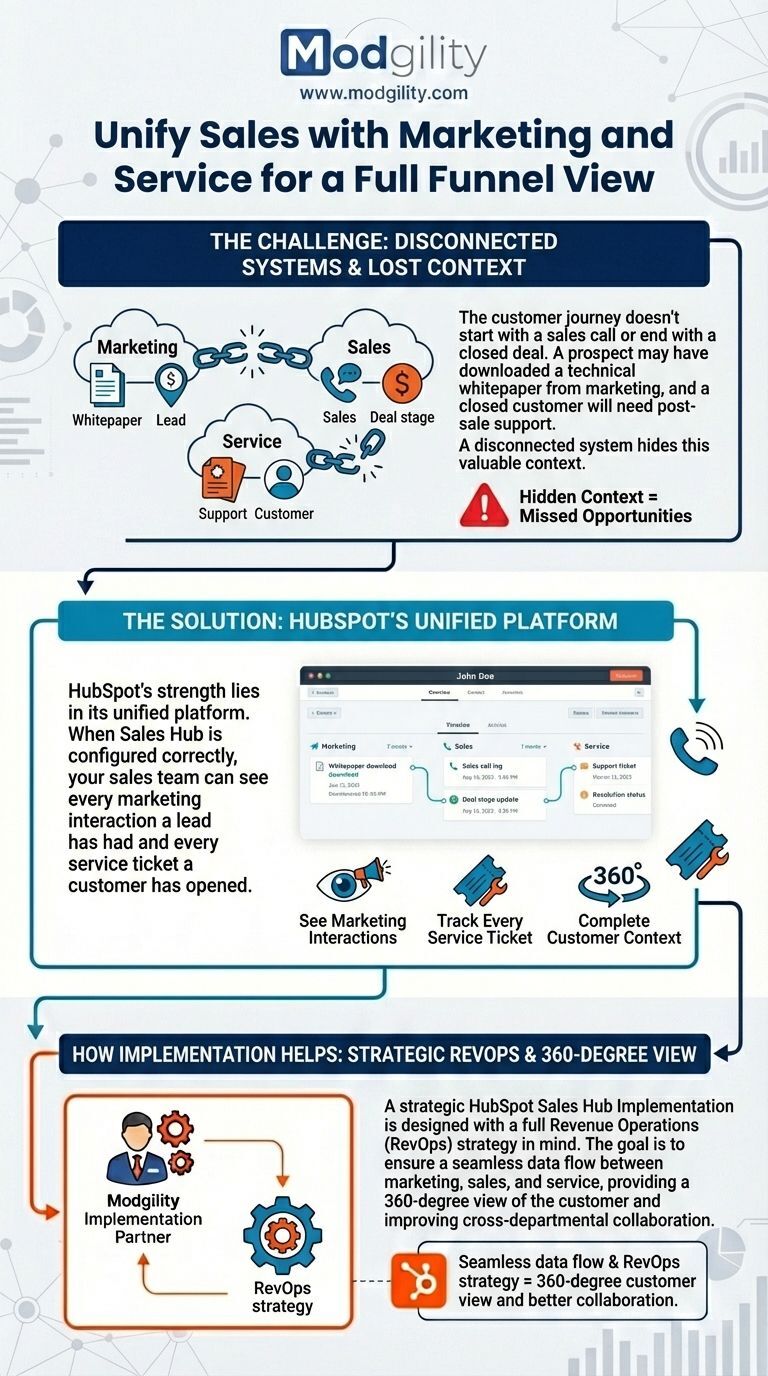
The customer journey doesn't start with a sales call or end with a closed deal. A prospect may have downloaded a technical whitepaper from marketing, and a closed customer will need post-sale support. A disconnected system hides this valuable context.
- The Solution: HubSpot’s strength lies in its unified platform. When Sales Hub is configured correctly, your sales team can see every marketing interaction a lead has had and every service ticket a customer has opened.
- How Implementation Helps: A strategic HubSpot Sales Hub Implementation is designed with a full Revenue Operations (RevOps) strategy in mind. The goal is to ensure a seamless data flow between marketing, sales, and service, providing a 360-degree view of the customer and improving cross-departmental collaboration.
The Crucial Difference: A Platform vs. a Solution
HubSpot Sales Hub is a powerful platform. However, its true value for a B2B manufacturing company is only unlocked when it is transformed into a tailored solution.
Simply buying the software is not enough. A strategic HubSpot Sales Hub Implementation by a certified partner ensures the platform is configured to solve your specific challenges, leading to higher team adoption, more efficient processes, and ultimately, accelerated revenue growth. It’s the difference between having a tool and having a competitive advantage.
Frequently Asked Questions
Why does a standard CRM setup often fail for B2B manufacturing companies?
Standard CRMs fail because B2B manufacturing involves long sales cycles, multiple decision-makers (from engineers to procurement), and a reliance on deep technical knowledge. A generic setup cannot manage this complexity, leading to inaccurate forecasts and a disconnect between sales and production.
How should a manufacturer customize their HubSpot deal pipeline?
A manufacturer should build a custom deal pipeline in HubSpot that mirrors their real-world sales stages, such as 'Technical Scoping,' 'Engineering Review,' 'Quote Generation,' and 'Procurement Approval.' Using custom deal properties to track critical data like material specifications and project timelines is also essential.
What are HubSpot Sales Playbooks and why are they important for manufacturing?
HubSpot Sales Playbooks are interactive guides accessible directly within the CRM. They are vital for manufacturing sales teams because they provide instant access to technical spec sheets, competitor comparisons, and answers to common engineering questions, ensuring all communication with prospects is accurate and consistent.
What is the benefit of a strategic HubSpot implementation versus just buying the software?
A strategic implementation transforms HubSpot from a generic platform into a tailored solution specifically configured to solve a manufacturer's unique challenges. This leads to higher team adoption, more efficient processes, and accurate forecasting, turning the software into a competitive advantage rather than just a tool.
No Comments Yet
Let us know what you think