
Share this
by Keith Gutierrez on Jan 6, 2026
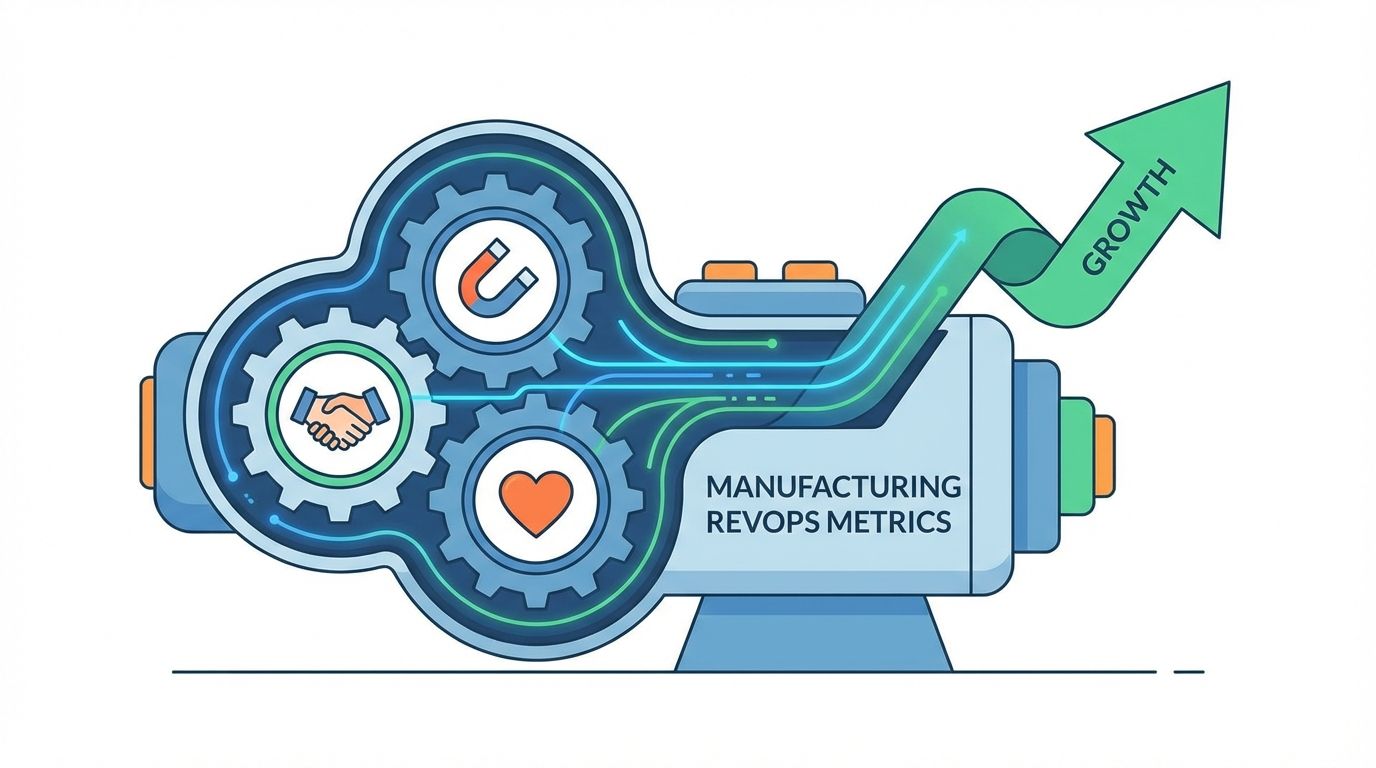
For manufacturing companies using RevOps, the most critical HubSpot metrics to track are MQL-to-SQL Conversion Rate, Sales Cycle Length, Pipeline Velocity, Customer Acquisition Cost (CAC), and Customer Lifetime Value (CLV). These metrics provide a full-funnel view of revenue generation, from initial marketing touchpoints to long-term customer value.
What You'll Learn
Tracking the right data is the cornerstone of any successful Revenue Operations (RevOps) strategy. For Marketing Directors and decision-makers in the manufacturing sector, moving beyond vanity metrics is essential to prove ROI and make strategic investments. This article breaks down the five most impactful metrics to track in HubSpot when implementing a RevOps framework. By focusing on these key indicators, you can:
- Align your marketing, sales, and service teams around shared revenue goals.
- Identify and eliminate friction in your customer's journey.
- Gain clear visibility into the health of your sales pipeline.
- Justify technology and marketing investments with hard data.
- Make your revenue growth predictable, scalable, and sustainable.
Why Traditional Metrics Fall Short for Manufacturing RevOps
In manufacturing, the sales process is often long, involves multiple stakeholders, and requires a high degree of trust. Traditional, siloed reporting—where marketing tracks leads and sales tracks closed deals—fails to capture the full story. This disconnection leads to friction, lost opportunities, and the "guess-and-test" marketing that wastes valuable resources.
A RevOps framework, by its very nature, demands a unified view of the entire customer lifecycle. It requires metrics that measure the efficiency of the entire revenue engine, not just the performance of individual departments.
The 5 Core HubSpot Metrics for Manufacturing RevOps
Here are the essential metrics every manufacturing company should build its HubSpot RevOps dashboards around.
1. MQL-to-SQL Conversion Rate
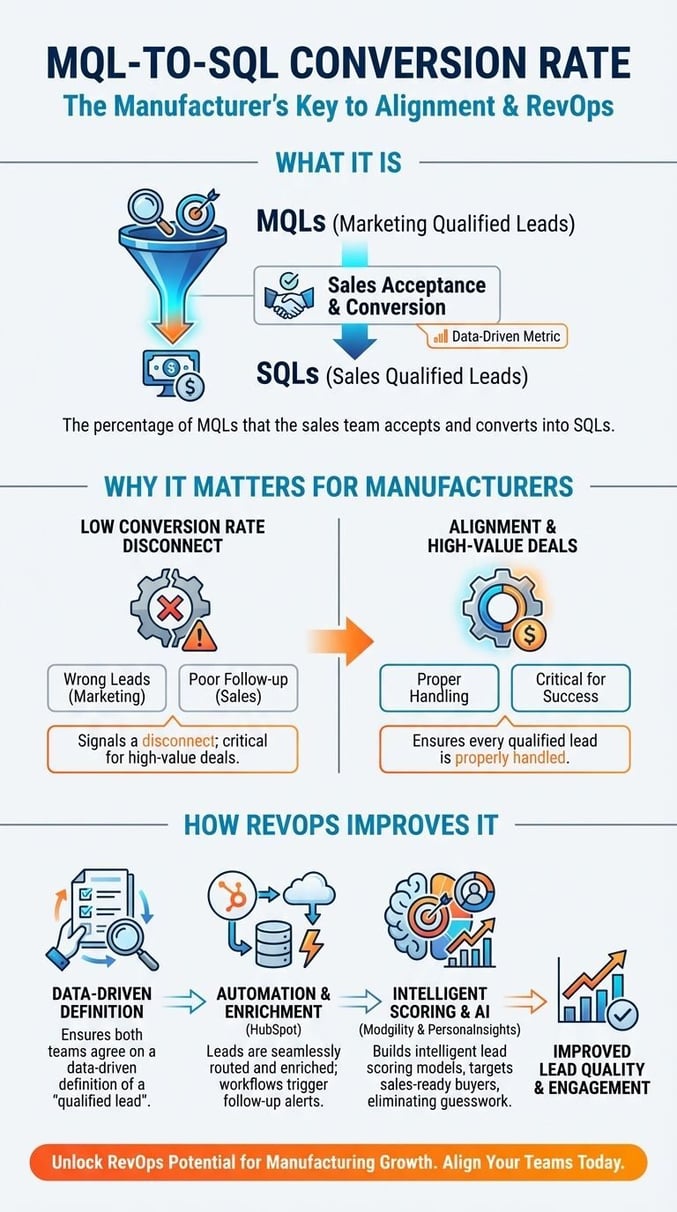
What It Is: The percentage of Marketing Qualified Leads (MQLs) that the sales team accepts and converts into Sales Qualified Leads (SQLs).
Why It Matters for Manufacturers: This is the single most important metric for measuring marketing and sales alignment. A low conversion rate signals a disconnect: marketing may be generating the wrong type of leads, or sales may not be following up effectively. For high-value manufacturing deals, ensuring every qualified lead is properly handled is critical.
How RevOps Improves It: A robust RevOps implementation ensures both teams agree on a data-driven definition of a "qualified lead." Using HubSpot's automation, leads are seamlessly routed and enriched, and workflows can trigger alerts for follow-up. Services like Modgility’s HubSpot RevOps can build intelligent lead scoring models and use tools like PersonaInsights AI to ensure marketing campaigns target buyers who are actually ready to engage with sales, eliminating guesswork and improving lead quality from the start.
2. Sales Cycle Length
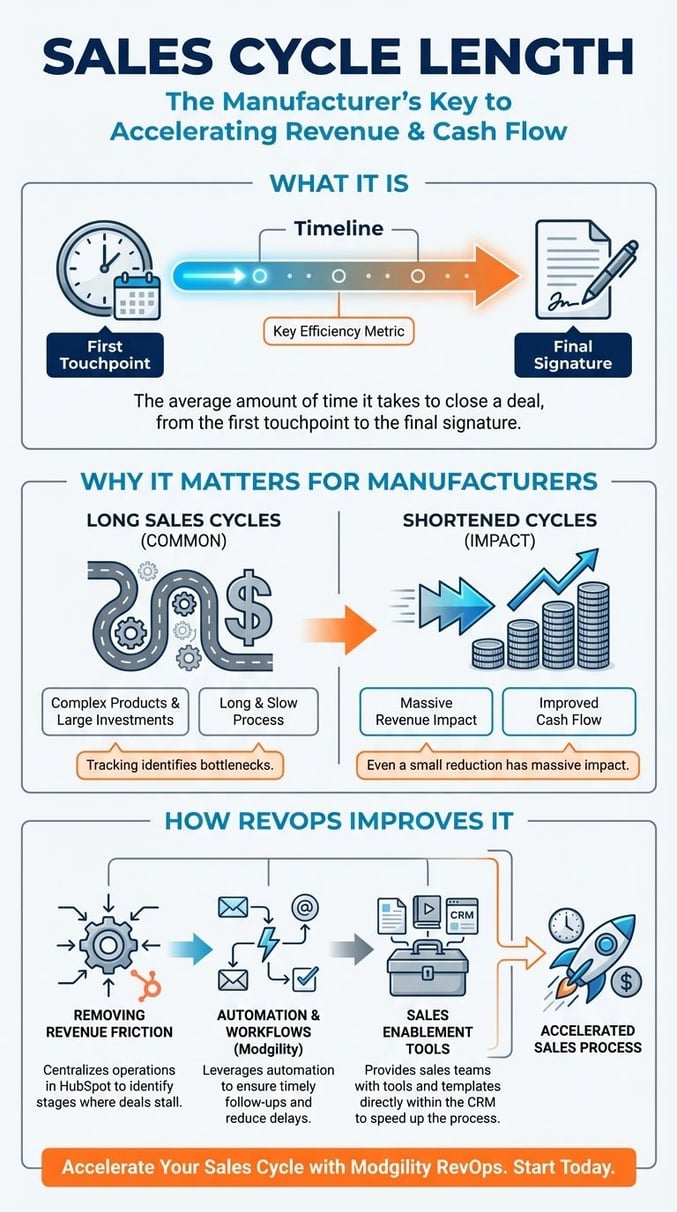
What It Is: The average amount of time it takes to close a deal, from the first touchpoint to the final signature.
Why It Matters for Manufacturers: Long sales cycles are common in manufacturing due to complex products and large capital investments. Shortening this cycle by even a small percentage can have a massive impact on revenue and cash flow. Tracking this metric helps identify bottlenecks in your sales process.
How RevOps Improves It: RevOps is designed to remove revenue friction. By centralizing operations in HubSpot, you can identify stages where deals stall. A RevOps strategy implemented by an expert partner like Modgility leverages workflow and automation builds to ensure timely follow-ups and provides sales teams with enablement tools and templates directly within the CRM, speeding up the entire process.
3. Pipeline Velocity
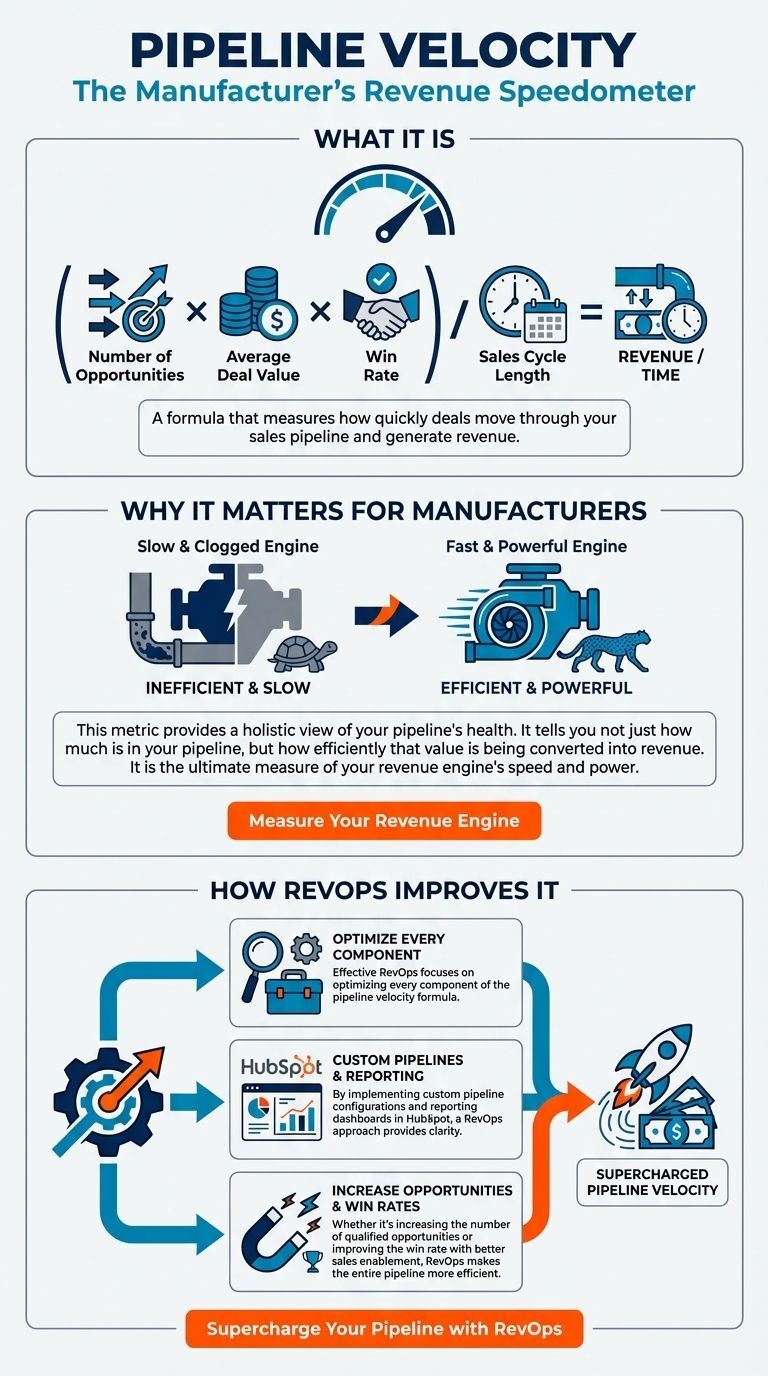
What It Is: A formula that measures how quickly deals are moving through your sales pipeline and generating revenue. The formula is: (Number of Opportunities x Average Deal Value x Win Rate) / Sales Cycle Length.
Why It Matters for Manufacturers: This metric provides a holistic view of your pipeline's health. It tells you not just how much is in your pipeline, but how efficiently that value is being converted into revenue. It is the ultimate measure of your revenue engine's speed and power.
How RevOps Improves It: Effective RevOps focuses on optimizing every component of the pipeline velocity formula. By implementing custom pipeline configurations and reporting dashboards in HubSpot, a RevOps approach provides the clarity needed to see where improvements can be made. Whether it's increasing the number of qualified opportunities or improving the win rate with better sales enablement, RevOps makes the entire pipeline more efficient.
4. Customer Acquisition Cost (CAC)

What It Is: The total cost of your sales and marketing efforts required to acquire a single new customer.
Why It Matters for Manufacturers: Acquiring a new manufacturing client can be expensive, involving everything from digital ad spend to trade show costs and sales commissions. A clear understanding of CAC is vital for building a profitable and scalable business model.
How RevOps Improves It: RevOps directly ties marketing spend to sales outcomes, providing true marketing ROI tracking. By using HubSpot to its full potential, every dollar can be traced from a campaign to a closed deal. AI integration, a key component of modern RevOps, allows for hyper-personalized messaging and smart segmentation, ensuring marketing dollars are spent on high-intent prospects and lowering the overall CAC.
5. Customer Lifetime Value (CLV)
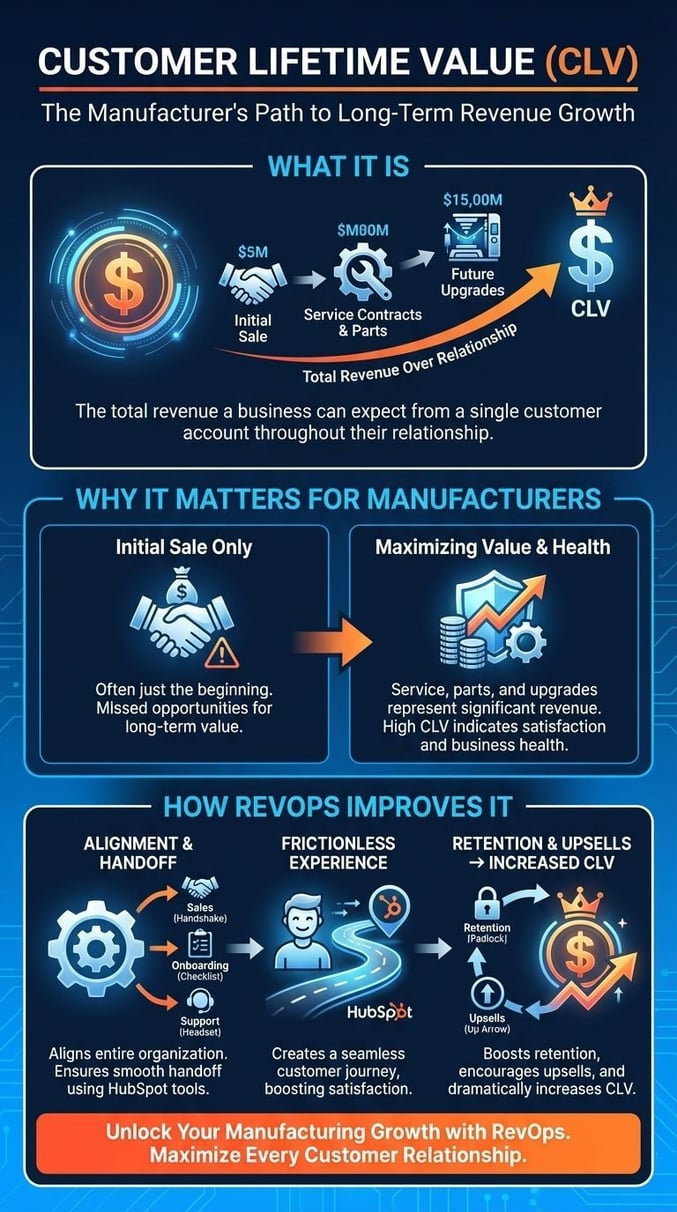
What It Is: The total revenue a business can expect from a single customer account throughout their relationship.
Why It Matters for Manufacturers: The initial sale is often just the beginning. Service contracts, spare parts, and future equipment upgrades represent significant long-term revenue. A high CLV is a strong indicator of customer satisfaction and business health.
How RevOps Improves It: RevOps isn’t just about acquiring new customers; it aligns the entire organization, including customer service, around revenue. By using HubSpot's customer service optimization tools, a RevOps strategy ensures a smooth handoff from sales to onboarding and support. This creates a frictionless customer experience, which in turn boosts retention, encourages upsells, and dramatically increases CLV.
How to Implement and Track These Metrics with RevOps
Simply knowing which metrics to track isn't enough. A successful strategy requires the right operational framework to ensure the data is clean, accessible, and actionable.
A comprehensive RevOps approach achieves this by:
- Centralizing Data in HubSpot: All marketing, sales, and service data lives in one place, creating a single source of truth.
- Building Custom Dashboards: Modgility’s HubSpot RevOps Services create tailored reports and dashboards in HubSpot that put these five key metrics front and center for decision-makers.
- Automating Workflows: Automation ensures data is captured consistently and that key processes (like lead handoffs) are executed flawlessly.
- Leveraging AI for Deeper Insights: Integrating AI tools like PersonaInsights AI allows you to go beyond what is happening and understand why, leading to smarter strategic decisions.
Conclusion: From Data Points to Strategic Decisions
For manufacturing companies, leveraging HubSpot with a RevOps framework transforms raw data into a strategic asset. By focusing on MQL-to-SQL conversion, sales cycle length, pipeline velocity, CAC, and CLV, you create a clear, predictable path to growth. This data-driven alignment doesn't just make your teams more efficient—it provides the clarity and confidence needed to scale your business.
If your growth feels unpredictable or your teams are disconnected, it's time to build a frictionless revenue engine. Discover how Modgility's HubSpot RevOps services can provide the powerful tools and proven experience to make your success sustainable and exponential.
Frequently Asked Questions
What are the most essential HubSpot metrics for manufacturers using RevOps?
The five most critical HubSpot metrics for manufacturers in a RevOps framework are MQL-to-SQL Conversion Rate, Sales Cycle Length, Pipeline Velocity, Customer Acquisition Cost (CAC), and Customer Lifetime Value (CLV). These metrics provide a comprehensive, full-funnel view of the entire revenue generation process.
Why are traditional, siloed metrics insufficient for manufacturing RevOps?
Traditional metrics fall short because the manufacturing sales process is typically long and involves multiple stakeholders. Siloed reporting, where marketing and sales track different things, fails to capture the full customer journey. This creates friction and lost opportunities. A RevOps framework requires unified metrics that measure the efficiency of the entire revenue engine, not just individual departments.
How does a RevOps strategy help shorten the sales cycle for manufacturers?
RevOps is designed to remove friction from the revenue process. By centralizing data and operations in HubSpot, it helps identify bottlenecks where deals stall. A RevOps strategy leverages workflow automation for timely follow-ups and provides sales teams with enablement tools and templates directly within the CRM, which speeds up the entire sales process from first touch to final signature.
How does RevOps improve Customer Lifetime Value (CLV)?
RevOps aligns the entire organization, including customer service, around revenue goals. It uses HubSpot's customer service optimization tools to ensure a smooth handoff from sales to onboarding and support. This creates a frictionless customer experience, which boosts retention, encourages upsells for things like service contracts and spare parts, and ultimately increases the total revenue generated from a single customer.
No Comments Yet
Let us know what you think